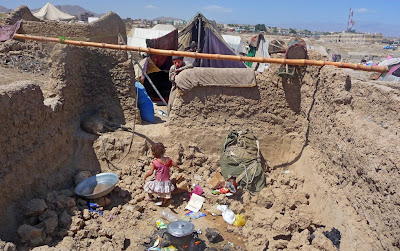
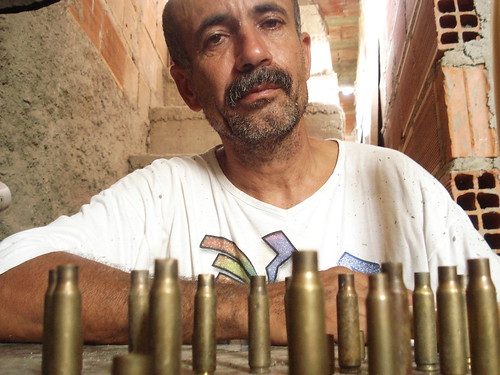
Nem -- aka Antônio Francisco Bonfim Lopes -- the dono do morro of Rocinha, was captured this week by police in Rio de Janeiro. It's a wacky story (The Guardian offers details): the local drug gang boss tried to flee the favela in the trunk of a car. And his bodyguards apparently told the cops they were African diplomats.
According to the article, police claimed that Nem's drug trade in Rocinha involved "200 rifle-toting soldiers who were responsible for selling some 200kg of Bolivian cocaine a month" and brought in an annual fortune of around $57 million.
Of course, my time in Rocinha was a decade back, so I can't really talk about current reality (though, given what I've read about recent coke busts, the value given seems absurdly high.) But, a friend has pointed out that the police are about to occupy Rocinha in a highly publicized putsch, which probably means that the local cops were no longer going to be able to take their traditional pay-offs from the drug lord. Add to this the fact that Rio is desperately trying to clean its image in preparation for the World Cup and the Olympics, and the bust seems like a pretty shrewd PR move.
If anyone from Rocinha reads this, please let us know what's going on.
Friday, November 11, 2011
Tuesday, November 01, 2011
The UK's anti-squatter plan
The UK government has fast-tracked its attempt to change the law to make it easier to evict squatters, and the proposal is set to be debated tomorrow. The charity Housing Justice opposes the Cameron Administration plan. Money quote: "The existing law already allows for the fast track eviction of squatters if the displaced occupier needs the home to live in....The proposed amendment is particularly worrying as it will mean that all of the people currently living in squats will be committing a crime should it come into law. This will create a situation in which tens of thousands of people nationwide stand to lose their home." Independent Catholic News has details.
Monday, October 31, 2011
good for goats, bad for people
Count 80,000 people homeless and a bunch of goats happy after Kyang’ombe, a squatter community near Jomo Kenyatta International Airport, in Nairobi, was demolished last week. The airport authority suggests that the neighborhood was dangerously near runways and in the flight path of many planes. But Muungano Wa Wanavijiji, a squatter federation and advocacy group, has suggested that the real impetus for the eviction, which started at around midnight on Friday, was that politically connected developers had taken control of the land.
Wednesday, October 26, 2011
Me on NPR's 'Fresh Air'
I will try to avoid posting too many plugs for my new book on this blog. But I can't resist popping this one up: Today, the National Public Radio show Fresh Air discovers the informal economy.
Monday, October 17, 2011
my new book
crossposted from my blog Stealth of Nations
Well, it's finally arrived:
Stealth of Nations, the book, hits the stores tomorrow. On Saturday, the The Wall Street Journal reviewed it. And you can get a taste of what's inside the covers on Bloomberg View.
Well, it's finally arrived:
Stealth of Nations, the book, hits the stores tomorrow. On Saturday, the The Wall Street Journal reviewed it. And you can get a taste of what's inside the covers on Bloomberg View.
Wednesday, October 05, 2011
squat or what?
Britain's conservative government wants to tilt the nation's laws against squatters, The New York Times reports. But at what cost. While some landlords may find ejecting squatters legally a cumbersome process, the article also notes that "Housing advocates say there are an estimated 762,000 empty and abandoned properties in Britain that would actually benefit by having tenants. And with homelessness likely to increase in the next few years, as deep cuts in housing allowances for welfare recipients take affect, advocates say it would make sense to match tenantless homes with homeless tenants
After all, as one housing lawyer told the paper, squatting is hard work and most people are serious about needing a home. “Most squatters who are actually looking for a place to live are doing it on entirely rational grounds, and not looking for somewhere where there’s a homeowner likely to turn up at any moment,” that attorney, Giles Peaker, said. “They’re looking for something that’s long-term vacant, where the owner has dropped the ball."
Tuesday, September 13, 2011
mud vs. sheetmetal
Five more people have died in the wake of the oil leak inferno that burned through the Sinai squatter community in Nairobi. The disaster is mind-boggling and awful. But it has left me wondering about a simple but little remarked fact: As the picture of Kenyan Prime Minister Raila Odinga touring the community shows, Sinai was built mostly of corrugated metal--a cheap and incredibly time- and labor-saving building material. A stick frame and some rolls of steel and a community can be created in minutes. Older squatter communities -- Kibera, for instance -- feature homes built mostly from mud, which must be dug, and mixed with water to the right consistency, and built up by someone who knows what they are doing. Mud is a better insulator--keeping homes warm during cool seasons and cool during warm times. Steel, by contrast, conducts the heat--and metal homes often become overheated in sunny weather. I'm wondering if a community made from mud or brick would have fared better in warding off the flames, and how many of the burn injuries were from the flames and how many were inflicted as people attempted to flee their superheated sheetmetal houses.
Monday, September 12, 2011
river of bodies
Tragedy in Kenya's capital as an oil pipeline in a squatter community ruptured early Monday morning, and turned deadly soon thereafter when it ignited into a fireball, killing 100 and sending hundreds more to the hospital.
Sinai is a small squatter community in Nairobi's industrial area, not far from Jomo Kenyatta International Airport. The oil pipeline, which slices across the community and apparently runs to the airport, sprung a huge leak, sending oil cascading down the community's streets and into the nearby Ngong River. Many community residents headed towards the leak, to gather some of the valuable fuel. Somehow, the oil ignited--the New York Times reports the blaze took hold because cinders from a nearby garbage fire blew over in the wind, though other sources speculate about different causes. But whatever happened, the blast of flame was deadly.
The Nation newspaper reports that a loose gasket in the pipeline was responsible for the oil leak, and notes that "There were two different accounts of the cause of the inferno. While some of the survivors said the petrol from the pipeline came with the fire, others said it was lit by a man smoking a cigarette." The paper also offers a 2 minute TV news report from the scene.
The Standard reports that oil pipelines have a lifespan of about 25 years, while this one had been in continual service for 33 years, adding that and a decade-old study commissioned by the public/private commission that manages the pipeline had concluded that it was obsolete--but that the commission rejected the report and instead expanded its usage. Just a few weeks back, the government's energy secretary called for it to be replaced within three years.
The Guardian also has details, and a short video.
Sinai is a small squatter community in Nairobi's industrial area, not far from Jomo Kenyatta International Airport. The oil pipeline, which slices across the community and apparently runs to the airport, sprung a huge leak, sending oil cascading down the community's streets and into the nearby Ngong River. Many community residents headed towards the leak, to gather some of the valuable fuel. Somehow, the oil ignited--the New York Times reports the blaze took hold because cinders from a nearby garbage fire blew over in the wind, though other sources speculate about different causes. But whatever happened, the blast of flame was deadly.
The Nation newspaper reports that a loose gasket in the pipeline was responsible for the oil leak, and notes that "There were two different accounts of the cause of the inferno. While some of the survivors said the petrol from the pipeline came with the fire, others said it was lit by a man smoking a cigarette." The paper also offers a 2 minute TV news report from the scene.
The Guardian also has details, and a short video.
Saturday, September 10, 2011
Accra politicos vow demolition & eviction
The political class of Accra, Ghana, have vowed to evict 80,000 people from the squatter community called Sodom and Gomorrah. "Whether or not the people have their homes there does not matter, the final decision is that it has to go.” the municipality's Public Relations Officer, Numo Blafo, told My Joy Online.
It seems as if the municipality doesn't understand why people come to the city. As stalwart anti-demolition advocate Farouk Braimah, from Peoples Dialogue on Human Settlement, explained, "it is income that brings people to the city and not shelter."
In other words, demolishing a community doesn't stop people from coming to Accra and certainly doesn't make the housing crisis go away. It just pushes poor and working people further out of town. That's urban removal not urban renewal.
It seems as if the municipality doesn't understand why people come to the city. As stalwart anti-demolition advocate Farouk Braimah, from Peoples Dialogue on Human Settlement, explained, "it is income that brings people to the city and not shelter."
In other words, demolishing a community doesn't stop people from coming to Accra and certainly doesn't make the housing crisis go away. It just pushes poor and working people further out of town. That's urban removal not urban renewal.
when the city owns vacant buildings
The Squatters Advisory Service in the UK submitted a Freedom of Information request to the Camden Council in London seeking a complete list of vacant properties in the area. The group has now won a court judgment in its favor -- a decision one City Councillor described as "lunacy."
But Paul Reynolds, a spokesman for Squash, a squatters' rights group, makes a lot of sense when he explains the decision: “It is about accountability. They will no longer be able to hide the extent of empty, publicly-owned housing in Camden. And if nothing is done to fix, repair or fill an empty home, homeless people can move in until this is done, which is a good thing. If Camden does not want this to happen, they should put people in these properties.”
That's a bright idea. Are you listening, Detroit (and all the other American cities with large patches of abandonment)?
The Camden New Journal offers the details.
But Paul Reynolds, a spokesman for Squash, a squatters' rights group, makes a lot of sense when he explains the decision: “It is about accountability. They will no longer be able to hide the extent of empty, publicly-owned housing in Camden. And if nothing is done to fix, repair or fill an empty home, homeless people can move in until this is done, which is a good thing. If Camden does not want this to happen, they should put people in these properties.”
That's a bright idea. Are you listening, Detroit (and all the other American cities with large patches of abandonment)?
The Camden New Journal offers the details.
Friday, August 26, 2011
what's sensible for Detroit?
Here's a city with an eviction problem, a vacant building problem, and a squatter problem. According to the Detroit News, the city has more than 100,000 vacant homes. Yet as columnist Mitch Albom, of the Detroit Free Press, noted the other day, good families are getting evicted even though they're struggling to live by the rules. The question is: why can't the city government bring these things together. No more demolition and eviction. Instead, a guided program that will turn decent homes over the families willing to engage in serious sweat equity.
As the Detroit News article shows, people feel very mixed about squatting -- because some of the squatters aren't serious and aren't good neighbors. But if the city and community groups policed the program so that only squatters intent on rehabbing their new homes and becoming part of the neighborhood were involved, it could work to preserve the city. After all, the prior policy of demolishing everything that lay vacant for too long resulted in a city with blocks dominated by the devastation of vacant lots.
As Quincy Jones, head of the Osborn Neighborhood Alliance, put it, "We should look at it both ways: How do we embrace it and turn the negative into a positive? All these homes are sitting and it's an open invitation for squatters. It [squatting and thus reoccupying vacant houses] helps prevent homes from being stripped. It's become the elephant in the room. We should promote keeping up the house."
Over to you, City Hall.
As the Detroit News article shows, people feel very mixed about squatting -- because some of the squatters aren't serious and aren't good neighbors. But if the city and community groups policed the program so that only squatters intent on rehabbing their new homes and becoming part of the neighborhood were involved, it could work to preserve the city. After all, the prior policy of demolishing everything that lay vacant for too long resulted in a city with blocks dominated by the devastation of vacant lots.
As Quincy Jones, head of the Osborn Neighborhood Alliance, put it, "We should look at it both ways: How do we embrace it and turn the negative into a positive? All these homes are sitting and it's an open invitation for squatters. It [squatting and thus reoccupying vacant houses] helps prevent homes from being stripped. It's become the elephant in the room. We should promote keeping up the house."
Over to you, City Hall.
Thursday, July 21, 2011
struggles of Jo-berg's squatters
The Los Angeles Times offers a take on the perils faced by squatters in what the newspaper refers to as Johannesburg's "Mad Max downtown." Sadly, though, the paper seems to look at developers who buy derelict squatter-occupied properties as potential white knights, capable of revitalizing the central city. Rather, they are seeking to profit from the opportunity to purchase big buildings at fire-sale prices. Though no family should have to live in a 5 X 10 foot room with no electricity and no water, this good family will simply get pushed to worse and more precarious accomodations if they are evicted.
One owner, who the newspaper identifies as Mark, told the reporter that "he'll do everything by the book, including getting a court eviction order, but he's not planning any meetings with tenants. "We don't encourage that," he says brusquely. "They are welcome to apply to move back in when it's renovated," he adds, although many will probably not be able to pay a deposit and higher rents. He believes there's a pile of money to be made from Johannesburg's low-cost housing shortage, if you're brave enough."Still, he's not brave enough to actually visit the building he bought. Instead, he had a black friend go there to take pictures.
Wednesday, July 06, 2011
favela cable cars
Rio de Janeiro has opened a cable car line that makes 5 stops up the hill into the Complexo do Alemao collection of favelas in the city's Zona Norte. Dow Jones Newswires reports that the $134 million system can transport 3,000 people every hour (though this may not be the exact truth: each of the system's 152 cable cars would need to make two trips per hour at the full capacity of ten people to move 3,000 folks up and down the hill.) "We're already looking at an extension of the Alemao cable car, as well as putting cable cars into Rocinha and Mangueira," the head of the state-run company that built the system told the news service.
While it's great that the government is willing to make an investment in mass transit, the article doesn't report what residents must pay to use the cable car system, nor what its hours are, nor how many people were forced to move to make way for its installation.
Saturday, June 11, 2011
who benefits?
With the World Cup in 2014 and the Olympics two years later, it seems that authorities in Rio de Janeiro are following a well-worn path: remaking the city in ways that help the rich and hurt the poor. First on the list--a project called the Transcarioca--an express bus route that would link Barra da Tijuca, one of the city's toniest neighborhoods, with the international airport in the north.
The Associated Press reports that 1,000 families have been moved to make way for the Transcarioca. All told, the government says, 3000 homes will be demolished, and these city residents will be relocated 40 or 50 miles away. Several favelas, like Vila Autodromo, have also been targeted for extinction, and The Rio Times reports that Amnesty International has concerns about human rights abuses. Theresa Williamson, of Catalytic Communities, a local watchdog group, told Rio Times that the city is violating its own rules, which require residents to be relocated within 7 kilometers of their existing homes.
“I don’t think the idea of having games here is to harm anyone,” an Olympic official told the AP. “Everything will be done with a very human touch.” But how human is it to put people out of their homes?
The Associated Press reports that 1,000 families have been moved to make way for the Transcarioca. All told, the government says, 3000 homes will be demolished, and these city residents will be relocated 40 or 50 miles away. Several favelas, like Vila Autodromo, have also been targeted for extinction, and The Rio Times reports that Amnesty International has concerns about human rights abuses. Theresa Williamson, of Catalytic Communities, a local watchdog group, told Rio Times that the city is violating its own rules, which require residents to be relocated within 7 kilometers of their existing homes.
“I don’t think the idea of having games here is to harm anyone,” an Olympic official told the AP. “Everything will be done with a very human touch.” But how human is it to put people out of their homes?
Monday, March 07, 2011
did arson destroy the shantytown?
The fire that roared through Garib Nagar on Friday, rendering slumdog millionaire star Rubina Ali and 750 of her neighbors homeless, may have been deliberately set, United News of India reports. The mostly-Muslim shantytown was adjacent to the Bandra train station along the Western Express Railway.
Tuesday, March 01, 2011
the opportunity tower
In Caracas, squatters have taken over an uncompleted office tower that was designed to have a helipad on the roof. The squatters first invaded the structure in 2007, and The New York Times reports that the 45-story building has over time become a vertical community, with stores scattered throughout the edifice.
A beauty salon operates on one floor. On another, an unlicensed dentist applies the brightly colored braces that are the rage in Caracas street fashion. Almost every floor has a small bodega. Julieth Tilano, 26, lives inside a small shop on the seventh floor with her husband and in-laws. They sell everything from plantains to Pepsi and Belmont cigarettes. Her husband, Humberto Hidalgo, 23, has a side business in which he charges children from the skyscraper 50 cents per half-hour to play PlayStation games on the four television sets in the family’s living room. “There’s opportunity in this tower,” said Mr. Hidalgo, who immigrated here last year from Valledupar, Colombia.As the BBC has reported, the housing shortage is so severe in the Venezuelan capital that homeless families have taken over portions of the still operating Foreign Ministry building.
Monday, February 28, 2011
no explanation necessary...
...but I'll provide one anyway. I took a hiatus from posting as I finished a book manuscript (see my Stealth of Nations blog for more on that) and then dealt with the emptiness that followed having finished the manuscript. Instead of blogging, I spent my time repairing manual typewriters.
Squattercity will be on the march again in March.
Tuesday, September 14, 2010
France targets Roma
In recent weeks, the government of Nicolas Sarkozy has evicted more than 1,000 Roma residents from their encampments in France and deported them to Bulgaria and Romania. Now,the European Union has called France's recent crackdown on Gypsy communities "a disgrace," The Guardian reports.
This was a U-turn for the EU, which had previously been mum on the evictions. The reason for the about face? A leaked French document seeming to show that Sarkozy had ordered local authorities to target Roma residents.
"Three hundred camps or illegal settlements must be evacuated within three months; Roma camps are a priority," the memo says. "It is down to the préfect [state representative] in each department to begin a systematic dismantling of the illegal camps, particularly those of the Roma."
If this truly represents official French policy, it would be unconstitutional and a violation of EU rules that block ethnic discrimination in member countries.
In response, French officials have noted that twice as many Roma were deported in 2009 as have been sent out of the country so far in 2010. "Free movement in the European area doesn't mean free settlement," France's immigration minister, Eric Besson, added. "What has been forgotten is that each of the European countries is responsible for its own national citizens."
This was a U-turn for the EU, which had previously been mum on the evictions. The reason for the about face? A leaked French document seeming to show that Sarkozy had ordered local authorities to target Roma residents.
"Three hundred camps or illegal settlements must be evacuated within three months; Roma camps are a priority," the memo says. "It is down to the préfect [state representative] in each department to begin a systematic dismantling of the illegal camps, particularly those of the Roma."
If this truly represents official French policy, it would be unconstitutional and a violation of EU rules that block ethnic discrimination in member countries.
In response, French officials have noted that twice as many Roma were deported in 2009 as have been sent out of the country so far in 2010. "Free movement in the European area doesn't mean free settlement," France's immigration minister, Eric Besson, added. "What has been forgotten is that each of the European countries is responsible for its own national citizens."
Tuesday, August 31, 2010
squatter TV in Buenos Aires
Residents of the Buenos Aires squatter community called Villa 31 have started a TV station, the Latin American Herald Tribune reports.
The new station is called Mundo Villa, and the article says it will offer original programming plus shows from three countries that many of the residents of Villa 31 hail from: Bolivia, Paraguay and Peru. "There are 25 guys in the neighborhood working to gather news, while journalism workshops are being given by students from different universities," said Mundo Villa TV director Victor Ramos.
The paper reports the station will be available to 1500 households--a number that seems suspiciously small given that a local cooperative claims the neighborhood's population is more than 120,000.
Ramos said his group would be meeting with the head of TV-Roc, the cable franchise that brings signal to Rocinha, most famous favela in Rio de Janeiro, to establish "a network of channels from Latin American slums."
When I was in Rocinha in 2001, TV-Roc did no original news programming. Perhaps that's changed. Does anyone know? Doew anyone know of other efforts by residents of squatter communities anywhere else in the world to produce news programs?
The new station is called Mundo Villa, and the article says it will offer original programming plus shows from three countries that many of the residents of Villa 31 hail from: Bolivia, Paraguay and Peru. "There are 25 guys in the neighborhood working to gather news, while journalism workshops are being given by students from different universities," said Mundo Villa TV director Victor Ramos.
The paper reports the station will be available to 1500 households--a number that seems suspiciously small given that a local cooperative claims the neighborhood's population is more than 120,000.
Ramos said his group would be meeting with the head of TV-Roc, the cable franchise that brings signal to Rocinha, most famous favela in Rio de Janeiro, to establish "a network of channels from Latin American slums."
When I was in Rocinha in 2001, TV-Roc did no original news programming. Perhaps that's changed. Does anyone know? Doew anyone know of other efforts by residents of squatter communities anywhere else in the world to produce news programs?
Monday, August 30, 2010
more Murambatsvina?
Another violent raid on a squatter community in Harare leaves 100 families homeless, the Zimbabwe Standard reports. Police burned scores of shacks, and arrested 55 people, though a department spokesman later denied any knowledge of the raid.
Thursday, August 26, 2010
thousands of squatters In New Orleans
Three to six thousand New Orleans residents are living as squatters, a house-by-house survey of the crescent city has revealed. The Times-Picayune reports.
UNITY, a local non-profit, surveyed 55,000 derelict buildings on 500 blocks chosen at random throughout the city. Among its interesting findings, the proportion of squatters in New Orleans who are elderly is four times the national average for homeless people--11.3 percent in NOLA vs. 2.8 percent throughout the US. The article suggests that these older squatters stay out of the city's shelter system because they want to "avoid the hubbub of traditional homeless shelters, preferring to hole up in vacant homes in familiar areas."
This is totally understandable. How sad, then, that the solution UNITY proposes amounts to more of what the squatters fear: "increased funding for case workers, homeless shelters and mental health services, as well as more assistance for moderate and low-income homeowners still trying to repair their houses."
Why not a program that works with the squatters to empower them to join together to bring the houses where they are currently encamped up to code? The fact that one in ten of these squatters is over 62 doesn't mean these people don't have skills to help the city rebuild.
UNITY, a local non-profit, surveyed 55,000 derelict buildings on 500 blocks chosen at random throughout the city. Among its interesting findings, the proportion of squatters in New Orleans who are elderly is four times the national average for homeless people--11.3 percent in NOLA vs. 2.8 percent throughout the US. The article suggests that these older squatters stay out of the city's shelter system because they want to "avoid the hubbub of traditional homeless shelters, preferring to hole up in vacant homes in familiar areas."
This is totally understandable. How sad, then, that the solution UNITY proposes amounts to more of what the squatters fear: "increased funding for case workers, homeless shelters and mental health services, as well as more assistance for moderate and low-income homeowners still trying to repair their houses."
Why not a program that works with the squatters to empower them to join together to bring the houses where they are currently encamped up to code? The fact that one in ten of these squatters is over 62 doesn't mean these people don't have skills to help the city rebuild.
Friday, August 20, 2010
the slippery slope
The Liberian Daily Observer editorializes against squatters who live around Monrovia's Ducor Intercontinental Hotel and are resisting government efforts to evict them. The squatters recently demonstrated at the hotel, brandishing sticks and broken bottles as well as chanting slogans and holding placards, the newspaper reports.
The key to the paper's argument:
This is trickle-down economics at its worst. It's simply disingenuous to say that social benefits will result from luxury redevelopment of the area. There may be some small economic advantage for the nation (though the redevelopment effort is likely induced through government subsidies that negate any real contribution to the national or local treasury), but luxury development simply engenders more luxury development and eats up an inordinate amount of government services.
The history of the site demands more. The Ducor closed in 1989 due to instability and violence in the country. It was occupied by squatters for better than a decade, as were the areas around it. Fairness for those who were most battered by Liberia's 14-year-long civil war demands that the government seek out a middle ground. Perhaps the squatters can be given the tools to rebuild on an area near the hotel. Or the government can provide relocation housing near enough to the center of the city for the squatters to retain their jobs.
Summarily evicting people who have lived there for better than a decade is not a development policy. Expecting that people quietly accept their annihilation is inhumane.
The key to the paper's argument:
Those who are resisting government's efforts should know that it is government's responsibility to give and assure protection to its people. It is also government's obligation to seek enabling conditions for economic growth and development. Mamba Point and the Ducor area have long been set aside as prime areas for hotels, embassies and restaurants. Should it now abandon its plan for economic development to satisfy squatters and liars? ... No government worth its salt should surrender to cabal of stick-wielding humbugs. They must be made to see the wisdom of government's plans and what social and national benefits will accrue there from.
This is trickle-down economics at its worst. It's simply disingenuous to say that social benefits will result from luxury redevelopment of the area. There may be some small economic advantage for the nation (though the redevelopment effort is likely induced through government subsidies that negate any real contribution to the national or local treasury), but luxury development simply engenders more luxury development and eats up an inordinate amount of government services.
The history of the site demands more. The Ducor closed in 1989 due to instability and violence in the country. It was occupied by squatters for better than a decade, as were the areas around it. Fairness for those who were most battered by Liberia's 14-year-long civil war demands that the government seek out a middle ground. Perhaps the squatters can be given the tools to rebuild on an area near the hotel. Or the government can provide relocation housing near enough to the center of the city for the squatters to retain their jobs.
Summarily evicting people who have lived there for better than a decade is not a development policy. Expecting that people quietly accept their annihilation is inhumane.
Wednesday, August 11, 2010
let the dead bury the dead
Jacob van Gardeneren, of Lawyers for Human Rights, said: "The surrounding neighbourhoods used typical excuses to justify their involvement in these evictions - such as that the informal settlement hosts criminals. The reality is that this informal settlement hosts their gardeners, domestic workers and construction workers, who are often paid so poorly they cannot afford to travel home every day."The squatters are threatened with eviction because the land had been allocated for the expansion of a nearby cemetery. Thus the dead have more rights in life than the living.
Tuesday, August 10, 2010
pushing the poor to the fringes
That's the story in Cairo, as documented in this article from the Los Angeles Times. The city is creating a comprehensive development plan, one which residents fear means removal, not renewal.
As one former municipal official told the paper, "The best solution would be first to prevent the spreading of any further slums, then to develop the existing slums from the inside rather than tearing them down." Still, his words ring hollow too: preventing the spread of squatter encampments requires creating a vast supply of affordable housing--something that governments and developers have never shown the ability to do on the scale required.
But officials can, of course, seize land in the same squatter areas for their own purposes. The article ends with the vision of a luxurious new sports facility. But locals "couldn't use it. It was for the children of government and military employees. Membership required."
Thus inequities perpetuate themselves.
slum tourism
A take on the phenomenon, courtesy of a Kibera resident and Wesleyan student, in The New York Times.
I've always thought that the impulse to connect is laudable, but that most tours through squatter communities amount to little more than gawking and taking photos.
Of course, it's also true that very few charities and NGOs are transparent, either.
I've always thought that the impulse to connect is laudable, but that most tours through squatter communities amount to little more than gawking and taking photos.
Of course, it's also true that very few charities and NGOs are transparent, either.
Monday, July 12, 2010
demolition derby in Delhi
The depressing truth: when a city wins the right to host a sporting event, the brutal evictions begin. The Guardian offers some ugly details from Delhi, site of the upcoming Commonwealth Games.
Wednesday, April 28, 2010
think like a squatter
As this New York Times article makes clear, many who were previously not squatters now are and will be for for the foreseeable future in the Haitian capital of Port-au-Prince.
And its not just residents like Ginette Lemazor and her family, who, the article notes, live "in a flimsy structure fashioned from plastic sheeting and salvaged wood. They have a bed — “Please, make yourself at home,” she said, pointing to it — and a chair." Schools are operating under tarps. Impromptu latrines are so full that people are invading half-wrecked houses to use their toilets. And one thought unites everyone: the government doesn't communicate (except to falsely promise supplies) and is doing nothing. Indeed, in a recent interview, President René Préval, rather than speaking about rebuilding, promised there would be more earthquakes.
There's hope, however, in the words and actions of this man:
"Jean-Claude Gouboth, 36, the leader of a small encampment on the grounds of an old villa, said he had ignored the president’s remarks “because the president ignores me.” Mr. Gouboth has already rebuilt his small convenience store with wood from inside his heavily damaged house. “You have to face the facts and recoup,” he said. “Nobody’s going to do anything for you."
Monday, April 26, 2010
This cup is empty
Sad to say, but former United Nations Secretary General Kofi Annan serves up nothing but platitudes in his recent Guardian column on the importance of the World Cup for Africa.
"The World Cup has the real potential to break down barriers and challenge stereotypes," Annan writes. "I sincerely hope that all of us will carry the spirit of the World Cup, that being part of a family of nations and peoples celebrating a common humanity, into our daily lives and works."
But nowhere does he mention the evictions and rip-offs that make a mockery of what he has written.
In three paragraphs, John Pilger catalogs some of the sordid details:
Africans can be rightly excited about the Cup without a whitewash about the costs. I fear for the favelas of Brazil, which is set to host the World Cup in 2014 and the Olympics in 2016.
UPDATE a few hours later:
Just came across this: the 27th of April is Freedom Day in South Africa. As in other years, the squatter organizing group Abahlali baseMjondolo will instead be celebrating 'Unfreedom Day.' As part of their declaration, they write:
2nd update:
"Street traders at the Grand Parade in Cape Town have been told to leave the area from May 1 until the end of the Soccer World Cup because of Fifa by-laws that relate to host cities." That's 300 traders being evicted from the best location at the center of town. The Mail & Guardian has the depressing details.
"The World Cup has the real potential to break down barriers and challenge stereotypes," Annan writes. "I sincerely hope that all of us will carry the spirit of the World Cup, that being part of a family of nations and peoples celebrating a common humanity, into our daily lives and works."
But nowhere does he mention the evictions and rip-offs that make a mockery of what he has written.
In three paragraphs, John Pilger catalogs some of the sordid details:
A new stadium near Nelspruit will host four World Cup matches over 10 days. Jimmy Mohlala, speaker of the local municipality, was gunned down in his home in January last year after whistle-blowing “irregularities” in the tenders. An entire school, which was in the way, has been removed into prefabricated, sweltering steel boxes on a desolate site with a road running through it. "When the World Cup is over," said the writer Ashwin Desai, "it will become obvious that these stadiums are going to be empty shells, that our money has been used for what is really a pyramid scheme."
A community of 20,000 people, the Joe Slovo Informal Settlement, is threatened with eviction from where they live near the main motorway between Cape Town and the city’s airport. They are deemed an “eyesore”. Street vendors will be arrested if they fail to comply with FIFA rules about trade and advertising and mention the words "World Cup", even "2010". FIFA will earn about two and quarter billion pounds from the TV rights, exceeding its income from the last two World Cups combined.
Incredibly, South Africa will get none of this. And this is country with up to 40 per cent unemployment, a male life expectancy of 49 and thousands of malnourished children. This truth about the "rainbow nation" is not what fans all over the world will see on their TV screens, although they may glimpse an unreported feature of modern South Africa, which is a vibrant, rolling resistance that has linked the World Cup to an economic apartheid that remains as divisive as ever. Indeed, another kind of World Cup for effective popular protest has long been won in the streets of South Africa’s townships.
Africans can be rightly excited about the Cup without a whitewash about the costs. I fear for the favelas of Brazil, which is set to host the World Cup in 2014 and the Olympics in 2016.
UPDATE a few hours later:
Just came across this: the 27th of April is Freedom Day in South Africa. As in other years, the squatter organizing group Abahlali baseMjondolo will instead be celebrating 'Unfreedom Day.' As part of their declaration, they write:
Is this a free country when grassroots organizations that have done everything that is required in terms of the Gatherings Act to organise a march find that their march is banned by Mike Sutcliffe just because he has power to do what ever he wants? Is this a free country when the police service who are suppose to protect us shoot to us? Is this a free country when the ANC can just decide to 'disband' our movement? Is this a free country when women are not safe on the streets after dark? Is this a free country when our children are chased from the schools because we don't have money? Is this a free country the people that live in the informal settlements are being dumped in the ’Transit Areas‘ which are situated 37 KM away from the City? Is this a free country when street traders are driven from the cities? Is this a free country when the taxis that are majority owned by black people will not be allowed to operate in the city center and only government buses will be allowed to transport commuters in the city? For example in the City of Durban the Public Taxis will end at Warwick.
In forty five days the world will be enjoying the so called,”African World Cup”. The question is will the poor enjoy or benefit? The answer is No. Who will benefit? The same people who will be celebrating the freedom day on the 27 April. The poor are being denied the right to sell near the stadiums and forced to sell their things far, far away from the stadiums. The taxis operators are also in trouble. Who will buy there? How will poor people be transported? Has the BRT replaced the black led transport industry? Can we really say that anyone in Blikkiesdorp is free?
2nd update:
"Street traders at the Grand Parade in Cape Town have been told to leave the area from May 1 until the end of the Soccer World Cup because of Fifa by-laws that relate to host cities." That's 300 traders being evicted from the best location at the center of town. The Mail & Guardian has the depressing details.
Tuesday, April 13, 2010
favela demolition
"A total of eight shantytowns in the city of Rio de Janeiro will be torn down and some 4,000 families will be forced to abandon their homes," the Latin American Herald Tribune reports.
Rio's Mayor Eduardo Paes has announced that 2,000 homes will be built on the site of the former Frei Caneca Prison, which was torn down last month. But that, of course, is only half the number that will be needed to house the people being displaced in these evictions. The article says that the Rio state government will pay 400 reais ($230) a month to the families while the new dwellings are under construction.
Sunday, April 11, 2010
forced evictions in Rio?
In the wake of mudslides that claimed more than 200 lives in the region, Rio de Janeiro mayor Eduardo Paes has signed a decree permitting the forced removal of residents in 158 "high-risk" areas, The Guardian reports. The newspaper notes that Paes also signaled that two favelas – Morro dos Prazeres, where 25 people died, and the Laboriaux neighborhood of Rocinha, where two were killed – would be permanently removed.
"We are not animals. We are human beings and we need the support of the town hall," Elisa Rosa Brandão, president of the Morro dos Prazeres residents association, told the news website G1. "This community has history and the families do not just want to leave."
Across the harbor in Niteroi, one resident of favela Morro da Bumba, which had been built on a former trash heap and was a scene of great tragedy after the rains, pointed out that forced evictions are no answer if replacement homes are not available. "I'm against violence but if the government doesn't help, what I am supposed to do? Go and sleep outside the town hall with my kids?"
While mudslides on the many hills in Brazil's former capital are normal occurrences, the threat of forced evictions is a putsch against these communities that house one in five city residents. The government needs, instead, to work with these neighborhoods to create solutions -- both short term, to house those who have lost their homes, and long term, to create proper drainage and sewers and construction standards so the communities are not at risk ever again. Otherwise, these kinds of tragedies will simply continue.
"We are not animals. We are human beings and we need the support of the town hall," Elisa Rosa Brandão, president of the Morro dos Prazeres residents association, told the news website G1. "This community has history and the families do not just want to leave."
Across the harbor in Niteroi, one resident of favela Morro da Bumba, which had been built on a former trash heap and was a scene of great tragedy after the rains, pointed out that forced evictions are no answer if replacement homes are not available. "I'm against violence but if the government doesn't help, what I am supposed to do? Go and sleep outside the town hall with my kids?"
While mudslides on the many hills in Brazil's former capital are normal occurrences, the threat of forced evictions is a putsch against these communities that house one in five city residents. The government needs, instead, to work with these neighborhoods to create solutions -- both short term, to house those who have lost their homes, and long term, to create proper drainage and sewers and construction standards so the communities are not at risk ever again. Otherwise, these kinds of tragedies will simply continue.
Wednesday, April 07, 2010
landslides in the favelas
More than 100 people, many of them from the favelas, have died in landslides as strong rains have hit Rio de Janeiro. Nine inches of rain fell in 24 hours Monday and Tuesday. And though the rains have slowed or stopped on April 7, the dry interval is apparently temporary and more rain is in the forecast.
Reuters and RTE have some details.
UPDATE a few hours later: The BBC has more.
More, one day later, from The Associated Press via The New York Times, detailing the landslide in favela Morro Bumba in Niteroi, across the Bay of Guanabara from downtown Rio.
A close-up of the devastation in Morro dos Prazeres near Santa Teresa in Rio:
WEEKEND UPDATE: The death toll in Rio and Niteroi is now more than 200. But as people dig out from the disaster, thoughts have turned to the politics of the problem and the city's response to it. Here's one important take, from Luis Odison, a resident of Morro dos Prazeres. He told the BBC: "What I want is politicians to stop worrying about World Cup or Olympics and think a bit more about the needs of the people who live here."
Thursday, April 01, 2010
beneath the World Cup
People who were booted from all over Cape Town to make way for the soccer World Cup have been forced to take shelter in Blikkiesdorp, a.k.a. Tin Can Town. The Guardian takes a look at the horrific underside of South Africa's deal to host the global football contest.
South Africa has spent 13 billion rand--or $1.8 billion U.S.--on infrastructure. But the government hasn't provided housing for the people it has evicted to make way for the soccer facilities.
Columnist Andile Mngxitama, the paper reports, is publishing a pamphlet titled Fuck the World Cup. "We never needed the World Cup. It is a jamboree by the politicians to focus attention away from the 16 years of democracy that have not delivered for the majority of black people in this country."
South Africa has spent 13 billion rand--or $1.8 billion U.S.--on infrastructure. But the government hasn't provided housing for the people it has evicted to make way for the soccer facilities.
Columnist Andile Mngxitama, the paper reports, is publishing a pamphlet titled Fuck the World Cup. "We never needed the World Cup. It is a jamboree by the politicians to focus attention away from the 16 years of democracy that have not delivered for the majority of black people in this country."
Friday, March 26, 2010
learning from Phnom Penh
This article from The National, an English-language paper from Abu Dhabi, offers a fascinating squatter history of the Cambodian capital. In the decade after the Khmer Rouge were overthrown, the city developed on a self-built model--but over the last 20 years, more than ten percent of Phnom Penh's residents have been displaced.
Among the great points made by writer John Gravois:
1. After the fall of the Khmer Rouge, "the Vietnamese made a bold, perhaps brilliant move: they rendered all prior property claims in the city null and void....Phnom Penh was opened up for settlement on a “first-come, first-serve” basis. All property still technically belonged to the state; real estate transactions were illegal. This period of “spontaneous resettlement” produced an otherworldly urban landscape. What qualified as a dwelling was left up to the imagination; the city essentially presented a set of containers and surfaces. And so, for example, more than 15,000 people across Phnom Penh still live on rooftops; the largest such settlement, called Bloc Tanpa, was home to more than 1,000 people, who lived in a dense shantytown atop a single apartment building until it was destroyed by a fire in 2002. The rooftop – located just a few blocks from the city’s Central Market – boasted its own local government, schools and a village square, all connected to the street below by a single dingy stairwell." Amazing: a squatter city, by design.
2. "For the urban poor, property takes a back seat to proximity." A vital point. People need to live close to where they can make money. Otherwise, the commute may cost more than the money they make.
3. "The current population of the Jakarta metropolitan area is larger than that of the world at the time of the French Revolution. A wave of humanity this large cannot be excluded forever, and the future of the developing world may depend on whether its cities make peace with the slums in their midst." A crucial truth: social and economic inclusion is key to the future of the world's cities.
Among the great points made by writer John Gravois:
1. After the fall of the Khmer Rouge, "the Vietnamese made a bold, perhaps brilliant move: they rendered all prior property claims in the city null and void....Phnom Penh was opened up for settlement on a “first-come, first-serve” basis. All property still technically belonged to the state; real estate transactions were illegal. This period of “spontaneous resettlement” produced an otherworldly urban landscape. What qualified as a dwelling was left up to the imagination; the city essentially presented a set of containers and surfaces. And so, for example, more than 15,000 people across Phnom Penh still live on rooftops; the largest such settlement, called Bloc Tanpa, was home to more than 1,000 people, who lived in a dense shantytown atop a single apartment building until it was destroyed by a fire in 2002. The rooftop – located just a few blocks from the city’s Central Market – boasted its own local government, schools and a village square, all connected to the street below by a single dingy stairwell." Amazing: a squatter city, by design.
2. "For the urban poor, property takes a back seat to proximity." A vital point. People need to live close to where they can make money. Otherwise, the commute may cost more than the money they make.
3. "The current population of the Jakarta metropolitan area is larger than that of the world at the time of the French Revolution. A wave of humanity this large cannot be excluded forever, and the future of the developing world may depend on whether its cities make peace with the slums in their midst." A crucial truth: social and economic inclusion is key to the future of the world's cities.
Monday, March 22, 2010
railway eviction planned
Once again, the Kenya Railways Corporation is pushing to evict squatters in a 200 foot wide swathe around its train tracks, The Nation reports.
Among the crazy allegations: that a derailment in Kibera last December that killed two people, was caused by 'flying toilets' -- the waste disposal method of last resort in squatter communities that don't have toilets or sewers: people defecate in a plastic bag, tie it closed, and fling it as far from their homes as possible.
The people operating the rail line have never worked to keep the tracks clean and clear. They have never offered for form a partnership with communities like Kibera, to find solutions or build replacement homes for those around the tracks, or, even, as one commenter on The Nation article pointed out, to build toilets so people would not have to shit in plastic bags.
The only solution they push for is summary eviction.
It's an awful, short-sighted, and anti-human policy.
Among the crazy allegations: that a derailment in Kibera last December that killed two people, was caused by 'flying toilets' -- the waste disposal method of last resort in squatter communities that don't have toilets or sewers: people defecate in a plastic bag, tie it closed, and fling it as far from their homes as possible.
The people operating the rail line have never worked to keep the tracks clean and clear. They have never offered for form a partnership with communities like Kibera, to find solutions or build replacement homes for those around the tracks, or, even, as one commenter on The Nation article pointed out, to build toilets so people would not have to shit in plastic bags.
The only solution they push for is summary eviction.
It's an awful, short-sighted, and anti-human policy.
Thursday, March 11, 2010
Squatters and the World Cup
South African squatters are suggesting that they will protest during the soccer World Cup to dramatize the lack of affordable housing and horribly deprived and neglected condition of their communities.
Understandable. After all, the South African government and various municipalities are spending hundreds of millions of dollars on the Football World Cup, including, the Telegraph notes, $170 million just for security.
But what a difference a different newspaper makes. Here's the lede from the coverage in The Star: "Poor and homeless South Africans are threatening to turn the World Cup into a bloodbath by unleashing a wave of riots during the tournament."
A bloodbath? Riots?
The Star seems to believe that people have no right to point out the horrible inequity of spending millions for the sporting event while spending almost nothing for people's homes and communities.
Tuesday, February 16, 2010
colin ward's ideas
Colin Ward, the visionary British anarchist who died on February 11 at the age of 85, was an inspiring advocate for mutual action and a staunch defender of squatters.
Most relevant to squatters was his recent work on what he called 'housing's hidden history,' Cotters and Squatters, published by Five Leaves.
Here's a review of that book, from The Independent
And here's Anarchism as a Theory of Organization, an essay from 1966.
You can read more about him on Wikipedia, in a profile that ran in The Guardian a few years back, and in this generous appreciation from Next Left.
Most relevant to squatters was his recent work on what he called 'housing's hidden history,' Cotters and Squatters, published by Five Leaves.
Here's a review of that book, from The Independent
And here's Anarchism as a Theory of Organization, an essay from 1966.
You can read more about him on Wikipedia, in a profile that ran in The Guardian a few years back, and in this generous appreciation from Next Left.
Thursday, January 21, 2010
Black Thursday
That's the day the big classified newspaper in Paris comes out with all the housing ads, and it's a horrible day for apartment seekers. The squatter group Jeudi Noir has now occupied #1 Place des Vosges. The Guardian calls it "a luxurious Parisian address which once housed Madame de Sévigné and Isadora Duncan." Jeudi Noir reports that the building has been empty for 44 years.
The Guardian's Jessica Reed writes: "It might be hard to immediately sympathise with squatters – the right to own property runs so deep in modern western society that anything challenging the status quo is bound to make waves. I would, however, question the intentions and principles of those willing to let their own buildings decay uninhabited for 40 years while homeless people die every winter from exposure. How to rationalise that? I struggle to find any excuse for leaving the most impoverished section of the population out in the cold, when buildings go unused and unlet for very long periods of time."
Four decades? Zut alors, it's about time someone took it over.
Cité Soleil
The Independent offers a clear-eyed view of the situation in the notorious Port-au-Prince shantytown.
"We don't have doctors, we don't have food, we don't have water," said Louis Jean Jaris, a 29-year-old resident. "The aid comes to Haiti, but it goes elsewhere. In Cité Soleil we are all victims, just like everyone else, but compared to the rest of the country, we are a low priority. To the people in power, we are not considered to be victims."One significant thing the article doesn't say: whether Cité Soleil experienced much destruction due to the quake. There's no doubt that the people there are victims, just like everyone else, but I wonder if the smaller-scale structures of the squatter community were extensively damaged.
Black Hawk helicopters were thundering overhead yesterday, taking aid from the airport to desperate survivors. But the shanty town does not have an official food aid distribution post, and only one small water truck was to be found on the streets, surrounded by a fractious crowd.
Small amounts of supplies are of course available, to those who have money. But Cité Soleil's biggest employer, a garment factory, has yet to reopen, and most locals are instead forced to walk miles into central Port-au-Prince in search of handouts. So far, the dysfunctional international aid effort means they are very lucky to find any.
Thursday, January 07, 2010
can solar help squatters?
The Times of London thinks so.
It's an appealing idea: The NGO SolarAid has organized a program to bring solar panels and bulbs to Kibera, a community where most people have no electricity, and those that do have illegal hookups that short out regularly and barely power a feeble bulb.
A few caveats and thoughts:
1. cost: "the panels and attachments were sourced in Switzerland, where a well-wisher subsidised them to bring the price down."
2. Though it's not clear whether this is with the subsidy or without, "they cost about 2,500 shillings," which, according to the article, is the cost of about five months worth of kerosene. That works out to be $33, which is a huge amount for most people in Kibera. After all, Josephine Anangwe, the mother who is mentioned at the beginning of the article, survives on her husband's 750 shillings-a-week salary. So it would take
3. Though I have no idea if this is true, one commenter pointed out that kerosene fumes, though toxic, serve as a mosquito repellent and thus help reduce the prevalence of malaria & dengue and other insect-borne ailments.
4. A communal charger--perhaps available at a church or through a merry-go-round (a group of women who pool money)--might be a way to bring down the cost for a family.
Wednesday, January 06, 2010
evicted in Madrid
Police in the Spanish capital have moved against El Patio Maravillas, a building which has been occupied by squatters since 2007, Typically Spanish reports.
A similar action last year failed because of public resistance. What accounts for the difference this year, I don't know.
The squat apparently was a popular and busy cultural center, but people who lived nearby on Calle del Acuerdo in the university neighborhood called Malasaña routinely complained about noise.
Organizers of the squat have vowed on their website (in Spanish) to continue their organizing activities.
Thursday, December 24, 2009
fire in Sodom & Gomorrah
The Accra squatter community known as Sodom & Gomorrah has had its fourth fire of the year. This one claimed 2,000 structures, but no lives, Joy Online reports.
The squatters "had difficulty accessing water to bring the fire under control, because some of the [water] pipelines had been disconnected because they had been illegally connected," the article reports.
This, of course, is a form of official discrimination against these communities. Don't provide water and don't allow illegal connections to function either. This policy marks a war of attrition against squatters.
Sunday, December 13, 2009
a bridge too far
The Times of India asks if the 100-year-old Reay Road bridge, which was manufactured in the UK and assembled on-site in Mumbai, needs restoration.
The paper states, "Once the solid brick extensions and black plastic sheets covering the structure are removed, the bridge will seem more striking than the common wall of stone it appears to be."
Of course, for more than a generation, the bridge has also been home to hundreds of families. The Times of India calls it "a squatter's paradise."
But there is a history here. "My mother was born and raised on this bridge and now I am married into a family living here as well," one resident tells the paper. It may not be ideal to live in a makeshift shelter on a bridge, but you can't just trash homes people have lived in for generations in the name of historic preservation.
The paper states, "Once the solid brick extensions and black plastic sheets covering the structure are removed, the bridge will seem more striking than the common wall of stone it appears to be."
Of course, for more than a generation, the bridge has also been home to hundreds of families. The Times of India calls it "a squatter's paradise."
But there is a history here. "My mother was born and raised on this bridge and now I am married into a family living here as well," one resident tells the paper. It may not be ideal to live in a makeshift shelter on a bridge, but you can't just trash homes people have lived in for generations in the name of historic preservation.
Monday, December 07, 2009
A new home in 1,178 years
That's how long it will take for all the residents of Kibera to receive new apartments in the current upgrading scheme if it continues at its current pace, Coastweek reports.
The article, by a reporter for the InterPress Service, also notes that the homes being built are actually shared apartments: two families sharing each two-bedroom apartment.
The article offers a sensitive portrayal of the complicated passions and position of the Nubians, Kibera's original residents, who have voiced some of the most vocal resistance to the UN's so-called upgrading project.
The Nubians were originally from North Africa and were conscripted into service in the British colonial armed forces. Ultimately settled in this valley on what was then the outskirts of Nairobi, documentary evidence suggests that the British government promised them title to at least some of the land on which they were living.
From the article:
The article, by a reporter for the InterPress Service, also notes that the homes being built are actually shared apartments: two families sharing each two-bedroom apartment.
The article offers a sensitive portrayal of the complicated passions and position of the Nubians, Kibera's original residents, who have voiced some of the most vocal resistance to the UN's so-called upgrading project.
The Nubians were originally from North Africa and were conscripted into service in the British colonial armed forces. Ultimately settled in this valley on what was then the outskirts of Nairobi, documentary evidence suggests that the British government promised them title to at least some of the land on which they were living.
From the article:
The Nubian community has resisted moving into the new apartments and instead vowed to stay put in the informal structures until government gives them adequate compensation; the community is the most well-established in Kibera, with many families renting accommodation to other residents.
The Nubian community says they have never been consulted about the upgrade.
Yusuf Diab, secretary general of the Nubian Council of Elders, argues that the government and donors came into their community with a "know-it-all" approach and assumed all residents of Kibera live on less than a dollar a day and will eternally depend on handouts.
"We may live in this informal structures but that does not mean we do not have finances. We as a community stick to our culture of generations living together in one house. But this does not mean we are poor.
"If you come into our homes we have all the facilities that affluent people have and despite being informal we have enough room to accommodate our large families," he says.
He wonders how a household of up to five generations is expected to reside in one room sharing the toilet, bathroom and kitchen area with another family.
"This plan would turn us into government tenants for the rest of our lives."
Saturday, December 05, 2009
'from the inside'
Squatters in Buenos Aires have started their own newspaper, Inter Press Service reports. Desde Adentro (From the Inside) is written by residents of the community called Villa 1-11-14. Agustín Garone, one of the writer/editors, told IPS that the intent is to "generate an image that contrasts with the labels put on us by the big media outlets, which associate poverty with crime, and thus only generate negative views of the neighbourhood." Buenos Aires is a city of 13 million, and right now the paper has a tiny print run of just 3,000.
It's a great idea, and very necessary, even if they are starting small.
One caveat, though: IPS reports that Desde Adentro is financed by the Buenos Aires city government. So how independent can it be?
It's a great idea, and very necessary, even if they are starting small.
One caveat, though: IPS reports that Desde Adentro is financed by the Buenos Aires city government. So how independent can it be?
refugee camps are no refuge
There are now 160,000 Africans living in Yemen, the United Nations Reports. Awdal News Network has the story of the semi-permanent camps the UN runs outside of Yemeni cities. Many refugees report being told to leave the camps and go to the cities.
Yet life in the city is full of despair. "Refugees say they face constant discrimination. Abi Abyah al-Manah, an Ethiopian refugee who heads the Mandated Refugee Association in the capital San'a says Africans are subjected to arbitrary arrests, violence, sexual violence and extortion by the authorities and the local people."
Just say no in Rio
From Rio de Janeiro, two distressing tales:
1. Crack is expanding its hold, The Final Call reports. Shocking fact: "The amount of crack seized by the police this year in Rio was six times the total confiscated in 2008."
2. But here's what not to do about it: hire Rudy Giuliani. Brazzil reports that the Rio city and state governments are bringing in the former NYC mayor as a security consultant. Giuliani was wrongly given full credit for reducing crime in NYC. The biggest factors in the reduced crime rate, actually, were the disappearance of crack (this started before Giuliani took office) and the resurgence of immigration, which had dropped precipitously during the 70s and recovered only modestly in the 80s. A million new New Yorkers arrived in the 1990s, bringing their energy and a newfound stability to many previously dangerous neighborhoods.
1. Crack is expanding its hold, The Final Call reports. Shocking fact: "The amount of crack seized by the police this year in Rio was six times the total confiscated in 2008."
2. But here's what not to do about it: hire Rudy Giuliani. Brazzil reports that the Rio city and state governments are bringing in the former NYC mayor as a security consultant. Giuliani was wrongly given full credit for reducing crime in NYC. The biggest factors in the reduced crime rate, actually, were the disappearance of crack (this started before Giuliani took office) and the resurgence of immigration, which had dropped precipitously during the 70s and recovered only modestly in the 80s. A million new New Yorkers arrived in the 1990s, bringing their energy and a newfound stability to many previously dangerous neighborhoods.
Thursday, December 03, 2009
make 'em pay taxes
New Mumbai Mayor Shraddha Jadhav wants squatters and street hawkers to pay taxes, the Indian Express reports.
After winning the Mayoralty, Jadhav issued a press release that said, "All unauthorised industries, small business, slumdwellers and hawkers who are doing business or staying illegally should be made to pay taxes. A policy should be in place and this will also help the BMC [Brihan Mumbai Corporation, the official name of the municipality] raise its revenue"
It doesn't appear that the Mayor, who is a member of the Hindu nationalist Shiv Sena party, has an actual proposal to present to the council. And she certainly hasn't understood that if she expects squatters and vendors to pay taxes, they will understandably expect benefits from her government, rather than the harassment and demolition drives that have been the hallmark of previous administrations' policies.
After winning the Mayoralty, Jadhav issued a press release that said, "All unauthorised industries, small business, slumdwellers and hawkers who are doing business or staying illegally should be made to pay taxes. A policy should be in place and this will also help the BMC [Brihan Mumbai Corporation, the official name of the municipality] raise its revenue"
It doesn't appear that the Mayor, who is a member of the Hindu nationalist Shiv Sena party, has an actual proposal to present to the council. And she certainly hasn't understood that if she expects squatters and vendors to pay taxes, they will understandably expect benefits from her government, rather than the harassment and demolition drives that have been the hallmark of previous administrations' policies.
Monday, November 30, 2009
NYC foreclosures
The Daily News highlights the situation in South Jamaica, where subprime loans and subsequent foreclosures have had harsh consequences on many streets.
The article's terminology is a bit misleading, though: most of the people quoted are not really squatters. They were renting the homes when the owners hit financial trouble and, essentially, abandoned the properties. So they are not squatters. They are tenants. And there ought to be a law that, when owners abandon a property, the tenants get the opportunity to keep the electricity on--because burning candles and kerosene lamps can lead to fires. If the owners walk away from the properties, the banks should also make an effort to keep the services on for the tenants who are left in dire conditions through no fault of their own.
Monday, November 23, 2009
denial in Delhi
Rather than do anything to improve the lives of squatters and street hawkers, the Mayor of the Indian capital wants to force them to get "bio-metric, bio-cryptic photo identity cards" and proposes to charge them 400 rupees--or almost $9 each--for the privilege.
Saturday, November 14, 2009
Manila eviction
780,000 squatters will soon lose their homes in the Philippine capital, Manila Standard Today reports.
There definitely need to be some changes to avoid more deaths due to flooding. But where will the city put these people? Don't they have rights? Shouldn't the city be working with them to find appropriate solutions?
Jakarta's Housing Shortfall
Jakarta needs about 70,000 housing units every year to cater to its growing population, but the city administration is only able to provide 20 percent of that figure. That's one of the facts contained in this worthy article from The Jakarta Globe.
'Soweto' in Rome
Ponte Mammolo is a mostly Eritrean shantytown in the center of Rome. SF Bay View has the details, including a short youtube clip.
Check out this horrific detail: in order to avoid detection and deportation if they are arrested, these immigrants often try to remove their fingerprints so they cannot be identified:
There are three ways commonly used to remove fingerprints. Refugees burn their own fingerprints and palm prints with a lit cigarette. This painstaking and slow process can take several hours. It leaves their fingers and hands in constant pain and unusable. Soon blisters appear and infection can spread.
Another method used by many refugees is to place their hands directly over a gas, charcoal or electric stove or immerse them in scalding water to remove their fingerprints and palm prints. This is no less painful than using a lit cigarette.
The third process requires rub sandpaper against their skin. It may seem comparatively less painful, but not so. Two or three days of rubbing their fingers and palms with sand paper to entirely remove the top skin leaves their hands raw and bloody.
Sunday, November 01, 2009
Going Dutch
The Netherlands seems poised to demolish the 1970s law that made squatting legal so long as a building had been vacant for a year.
Radio Netherlands Worldwide has the sad details.
'On Thursday, a parliamentary majority consisting of centre-right parties voted in support of the so-called Squatting Ban, a bill drafted by Christian Democrat MP Jan ten Hoopen. Housing Minister Eberhard van der Laan has already let it be known that he will not stand in the way of the bill. While not a fervent advocate of the ban, he regards non-occupancy as "an issue that's too important to be left to the squatters".'
Radio Netherlands Worldwide has the sad details.
Saturday, October 17, 2009
air war in the favelas
Bandidos in Rio shot down a police helicopter over the Zona Norte favela Morro dos Macacos after police apparently tried to intervene in a battle between two rival drug gangs--Amigos dos Amigos, which controlled the favela, and Comando Vermelho. (The picture here seems to show burnt out buses on the edge of the favela (hint: I don't know of any favelas that have traffic lights.) So far, authorities have said that 12 people have died.
The Guardian has details.
Two interesting facts:
1. "Hundreds of police officers descended on the area following the invasion" by the Comando Vermelho. This is significant because when I was in the favelas (eight years ago, which, I admit, in the fast changing world of the drug traffickers, can be considered ancient history), Amigos dos Amigos was known to be in cahoots with the cops. Indeed, a veteran police officer confirmed this to me. So no one should discount the possibility that the police were taking sides in this fight.
and
2. The drug gangs have "an increasingly sophisticated arsenal, including anti-aircraft guns and automatic rifles, often sourced from inventory intended for the Bolivian and Argentinian armies and smuggled into Rio." Isn't that a big story? These arms are undoubtedly stolen from official shipments. How can this be happening and isn't there a way for officials--including those in the U.S., which is most likely supplying the weaponry--to prevent it?
Thursday, October 15, 2009
the African National Congress vs. The People
Fresh from its victory in the Constitutional Court, Abahlali baseMjondolo now reports that five more of its leaders from the Kennedy Road community in Durban have been arrested. That makes 13 Abahlali members charged with crimes. Meanwhile, no one has been arrested or charged or even implicated in the recent violence that left 2 dead in Kennedy Road.
Now, an article in The Witness suggests a political motive in the attacks and arrests: the Kennedy Road group had pushed for new regulations reining in shebeens (informal bars), which have been open 24 hours a day in Kennedy Road. The community wants these places to close by 10. At the same time, local ANC leaders are irked by the political independence of Kennedy Road and Abahlali, which is a community organizing group and thus does not endorse candidates for office.
From the article:
The community’s new liquor regulations have angered local shebeen owners who found common cause with powerful ANC branch members who resent the loss of the powerful Kennedy vote bank. This is why the government immediately arrested eight members of Abahlali baseMjondolo a day or two after the attacks. This is why, this past weekend, they arrested another three members of the movement. This is why not a single shebeen owner or militia member has been arrested.
So it's a Nazi-style 'shebeen putsch' by the African National Congress in Kennedy Road.
Wednesday, October 14, 2009
SA Court overturns eviction statute!!!
Abahlali baseMjondolo has won a major legal victory: The Constitutional Court of South Africa has declared the KwaZulu-Natal Elimination and Prevention of Re-emergence of Slums Act illegal. The Act, cloaked as an attempt to moderate and mitigate bad housing conditions, actually made it easier for the government and owners to evict and eject squatters throughout the province.
You can read the court's judgment here, though oddly, the dissent comes before the controlling decision.
Tuesday, October 13, 2009
fire in SP favela leaves 1,000 homeless
There's more, in Portuguese, from Folha de São Paulo.
Thursday, October 08, 2009
'a profound disgrace to our democracy'
That's how Ruben Phillip, Anglican Bishop of Natal, characterized the violence against members of Abahlali baseMjondolo that left two people dead and a dozen injured. The Bishop made no bones about where blame lies: with local African National Congress cadres:
"The fact that the police have systematically failed to act against this militia while instead arresting the victims of their violence and destruction is cause for the gravest concern," he said, adding there were "credible claims that this militia has acted with the support of the local ANC structures. This, also, is cause for the most profound concern."Religious Intelligence has more.
bahamas fire
A fire in 'The Mud,' a mostly Haitian shantytown in the Bahamas, has left 39 people homeless, The Tribune reports.
Backstory:
The Mud and neighbouring Haitian shanty town Pigeon Pea is thought to house around 3,000 Haitian migrants and Haitian Bahamians on an area of land opposite the main port in Marsh Harbour....This brings up an issue common throughout the world. Migrants, who arrive in a country as economic refugees, are unable to afford legal housing. Most of these people work. Quite a number of them are legal immigrants. But they are forced to live in precarious conditions for years. And then when the predictable fire breaks out, they often are the ones who get blamed.
The settlements were established around 30 years ago and have been growing without any imposed health and safety regulations....
Many residents have legal status to live and work in the Bahamas....
Random raids orchestrated by the Immigration Department with support from the Royal Bahamas Defence Force attempt to crackdown on the illegal population, but have been shrouded in complaints of brutality....
Residents of the Mud claimed families were separated and residents were beaten, threatened and robbed by officers in the last large-scale raid in July.
homes of 400,000 people at stake
In the wake of the awful flooding two weeks ago that claimed 300 lives, a Philippine official has argued that 400,000 squatters must be relocated to make the city's drainage better. Agence France Presse has details.
Laguna Lake Development Authority chief Edgardo Manda told AFP, "I have made a strong recommendation to remove these people from the danger zones and not allow them to go back." He asserted that, "the authorities would probably need to erect barricades and station sentries in these areas."
Well, not if the politicians choose to work with the people to come up with appropriate solutions.
What's more, why are squatters the only ones asked to sacrifice. Consider: as the article notes, "chaotic urban planning, or no planning at all, exacerbated the crisis, particularly around Laguna where shantytowns, factories and housing developments have overtaken farms."
So what about the factories and housing developments? Is anyone proposing that they be evicted?
Laguna Lake Development Authority chief Edgardo Manda told AFP, "I have made a strong recommendation to remove these people from the danger zones and not allow them to go back." He asserted that, "the authorities would probably need to erect barricades and station sentries in these areas."
Well, not if the politicians choose to work with the people to come up with appropriate solutions.
What's more, why are squatters the only ones asked to sacrifice. Consider: as the article notes, "chaotic urban planning, or no planning at all, exacerbated the crisis, particularly around Laguna where shantytowns, factories and housing developments have overtaken farms."
So what about the factories and housing developments? Is anyone proposing that they be evicted?
Wednesday, October 07, 2009
support Abahlali, support justice
Supporters of Abahlali baseMjondolo are circulating an important letter to South African President Jacob Zuma. It is designed to push for safety, security, democracy and an impartial investigation into the ethnic cleansing that took place last week in the Kennedy Road shack settlement.
You can read it and sign it here
Monday, October 05, 2009
a real view, maybe
Two Portuguese filmmakers have released a documentary about Complexo do Alemao, arguably the most notorious favela in Rio, The Latin American Herald Tribune reports.
"People have a stereotyped image of what a 'favela' is – they’re afraid of anything that comes from there, so our intention was just to eliminate the clichés and let people see the truth," moviemaker Mario Patrocinio said.
The film is scheduled to be released in early 2010, so we all will be able to judge for ourselves.
"People have a stereotyped image of what a 'favela' is – they’re afraid of anything that comes from there, so our intention was just to eliminate the clichés and let people see the truth," moviemaker Mario Patrocinio said.
The film is scheduled to be released in early 2010, so we all will be able to judge for ourselves.
Friday, October 02, 2009
rights and wrongs
The metropolis of Accra seems poised to evict squatters in the communities of Sodom and Gomorrah and to push out the traders at Agbogbloshie market, the Joy newpspaer and Peace FM report.
Here's a doozie: while giving lip service to the human rights of squatters to live in better conditions, Alfred Okoe Vanderpuije, head of the Accra Metropolitan Assembly, told reporters that he is "in negotiations with the Electricity Company of Ghana, Ghana Water Company and other utility providers to halt the provision of their services to the slum."
So, in order to have them live better, he will cut off their water and electricity.
Let's call this two-faced approach what it is: duplicity.
Remember, this is the same politician who said in prior articles that there were plenty of vacant apartments that the squatters could rent in Accra.
The government is also pushing merchants at the local market further out of town, according to another article from Peace FM.
Here's a doozie: while giving lip service to the human rights of squatters to live in better conditions, Alfred Okoe Vanderpuije, head of the Accra Metropolitan Assembly, told reporters that he is "in negotiations with the Electricity Company of Ghana, Ghana Water Company and other utility providers to halt the provision of their services to the slum."
So, in order to have them live better, he will cut off their water and electricity.
Let's call this two-faced approach what it is: duplicity.
Remember, this is the same politician who said in prior articles that there were plenty of vacant apartments that the squatters could rent in Accra.
The government is also pushing merchants at the local market further out of town, according to another article from Peace FM.
Wednesday, September 30, 2009
intimidation vs. organizing
A new video from Abahlali baseMjondolo documents the appalling violence in Kennedy Road and the uncommonly brave response of Abahlali's community leaders.
Tuesday, September 29, 2009
'we have been arrested, beaten, killed, jailed and made homeless'
Another amazingly eloquent statement from S'bu Zikode, President of Abahlali baseMjondolo. Despite having had his home and possessions wrecked and ransacked in the recent violence in Durban's Kennedy Road squatter community, Zikode sees the bigger picture. He has lost none of his humanity:
"The strength of the movement, the strength of those who are supposed to be weak and silent and powerless, is taken as a threat," he writes. "Our crime is a simple one. We are guilty of giving the poor the courage to organise the poor. We are guilty of trying to give ourselves human values. We are guilty of expressing our views.....We are calling for close and careful scrutiny into the nature of democracy in South Africa."
He signs his letter this way:
"Sibusiso Innocent Zikode
President of Abahlali baseMjondolo (and, consequently, political refugee)"
Monday, September 28, 2009
violence in Kennedy Road
Violence over the weekend in Durban's Kennedy Road shack settlement seems based on simmering resentments between Zulus, who dominate the community, and Xhosas, who are in the minority, South Africa's Daily News newspaper reports. Two people died, the News reported on Sunday
The squatter movement Abahlali baseMjondolo, which has long been active in Kennedy Road, reports that none of the perpetrators have been arrested or even detained, and asserts that the violence is continuing despite the presence of the police and ANC leaders. Apparently, one of the shacks that has been destroyed was home to S'bu Zikode, one of Abahlali's most vocal leaders.
Friday, September 25, 2009
a Kabul squatter community

The Seattle Times visits a squatter community in Kabul. The back-story may be murky, but the truth is not: these are economic refugees, forced by the ravages of war, if not the violence itself, to leave their homes and come to Kabul, where at least they have a hope of survival.
Tuesday, September 22, 2009
a toxic scandal
In 1984, the Chilean government allowed processing company PROMEL to dump 21,000 tons of Swedish toxic waste near the city of Arica, in the far north of the country. Later, the government allowed shantytowns to be built almost directly on top of the waste.
LA NACIÓN (via The Santiago Times) reports that residents "were then plagued by a wide range of ailments, including arthritis, cancer and impotence. There was no explanation from the government until health authorities acknowledged the problem in 1998 and cleaned up much of the area’s waste. The government then declared the area contamination-free, although it failed to acknowledge the extent of the harm done to local residents by not disclosing results blood tests."
Now the Chilean government will relocated 1,800 families--but only homeowners will get benefits. And local residents say the government's relocation plan ignores 8,000 others who live in neighboring shantytowns.
The government estimates that the clean-up and relocation will eventually cost about US$600,000 per family. That's alot of money (the article suggests that it amounts to the largest residential relocation in Chile's history), but I wonder how much of that money is really going to the residents, and how much to the companies that are doing the environmental remediation.
LA NACIÓN (via The Santiago Times) reports that residents "were then plagued by a wide range of ailments, including arthritis, cancer and impotence. There was no explanation from the government until health authorities acknowledged the problem in 1998 and cleaned up much of the area’s waste. The government then declared the area contamination-free, although it failed to acknowledge the extent of the harm done to local residents by not disclosing results blood tests."
Now the Chilean government will relocated 1,800 families--but only homeowners will get benefits. And local residents say the government's relocation plan ignores 8,000 others who live in neighboring shantytowns.
The government estimates that the clean-up and relocation will eventually cost about US$600,000 per family. That's alot of money (the article suggests that it amounts to the largest residential relocation in Chile's history), but I wonder how much of that money is really going to the residents, and how much to the companies that are doing the environmental remediation.
ten thousand to be evicted
Ten thousand squatters occupying land near the airport in Monrovia, the capital of Liberia face eviction on October 1st, the Daily Observer reports.
"Most of us here came during the war and have absolutely no hope elsewhere. If we get abruptly removed from here, where do we go?" squatter leader Garmonyu W. Boe told the paper. "We cannot even afford to rent a room here in Monrovia since a single bedroom costs at least US$10. This is an amount that most of us cannot afford."
"There are no evacuation options from Government’s end. These people need to go to where they came from," Richlieu Williams, Director General of the Liberia Civil Aviation Authority, responded.
"Most of us here came during the war and have absolutely no hope elsewhere. If we get abruptly removed from here, where do we go?" squatter leader Garmonyu W. Boe told the paper. "We cannot even afford to rent a room here in Monrovia since a single bedroom costs at least US$10. This is an amount that most of us cannot afford."
"There are no evacuation options from Government’s end. These people need to go to where they came from," Richlieu Williams, Director General of the Liberia Civil Aviation Authority, responded.
Friday, September 18, 2009
Bullets over Brazil
A fierce and impassioned take on the gun violence that plagues Rio's favelas, courtesy of Open Democracy. Refreshingly free of cant and nonsense. The article quotes a former Military Police leader acknowledging that the police are themselves involved in weapons trafficking.
And some observers feel that a culture of normal violence has been created.
"Arms no longer provoke fear in a population that is so used to bullets and the sound of gunfire," says peace activist Leonardo Pimentel from Jacarezinho favela, a few miles down the road. "Things you used to only see in Haiti, Gaza Strip or Iraq you see here now. There's a naturalisation of the presence of arms. When I was young every kid's dream was to be a police officer," he continues. "In the mind of young kids today the police are the enemy, because they killed their brother, their friend, their uncle. Their dream is to kill a police officer."
And there's this acknowledgement of the class-bound nature of the concern over violence:
William Alencar is a resident of the Favela do Timbau in the huge Maré complex. He is also a sociology graduate from Rio's prestigious Catholic University (PUC), where he studied on scholarship, and now works as a teacher. He illustrates the intersection between poverty and insecurity with the following example from his own life. "When I was an adolescent I was in a football team. Out of 15 people that were involved, 10 have since died. Out of the remaining five, I'm the only one to have studied at university. Violence itself hasn't increased [since then]," he believes. "Since the 1980s we have stories of violence. It's just that now there are heavier arms available and now violence has spread throughout the city. While the violence was within a space that wasn't affecting the Brazilian elite, that was fine. But when it started to arrive in the big streets, in the asfalto [asphalt - a synecdoche commonly used to refer to any urban areas outside the favelas], the [middle classes] started to get concerned."
slum clearance?
The UN has broken ground on its Kibera 'upgrade,' the BBC reports.
I know they say they're relocating people into new housing that will cost $10 (747 Kenyan shillings.) And I know the photo of the relocation housing looks basic but OK.
Still, the BBC doesn't say how far away the relocation housing is, and whether it is subsidized and for how long it will be subsidized, and whether it will make it more difficult for people to commute to their jobs.
Every time I see a bulldozer smashing into someone's home, I get a sinking feeling. What will become of the land in Kibera that the people are being asked to vacate?
(see also a related story here)
UPDATE: The Daily Nation has a somewhat more complete story about the start of relocation in Kibera. For instance, it notes that this is a pilot program of just 600 apartments, built at a cost of 500 million Kenyan shillings--or almost $7 million. That's $11,000 per unit.
Thursday, September 17, 2009
squatters invest in infrastructure
In Suva, the capital of Fiji, where one in five residents is a squatter, shantytown residents banded together to pave an important road. Radio New Zealand has details.
Wednesday, September 16, 2009
More 'Let them eat cake!' in Ghana
King Tackie Tawiah III, one of the traditional rulers of downtown Accra, is in favor of evicting squatters from Sodom and Gomorrah. That's the news from the Daily Guide. "Let the government take the boldness of steps in ensuring that Sodom and Gomorrah is rid of the squatters," he told the newspaper.
squatters doing good in Prague
Speculators, many of them foreign-based, prefer to leave the building unoccupied and decaying rather than budge from their hoped for resale price or redevelopment plans even if these prove to be unrealistic.Radio CZsuggests that squatters have achieved one positive thing: they have drawn attention to the city's epidemic of vacant structures. According to the report, squatter organizations now have a short list of 80 buildings in the Czech capital that are ripe for occupation.
Michael Zachař, director of the Czech National Institute for the Preservation and Conservation of Monuments, tells the station that the government is powerless to force owners into taking far-reaching or rapid action. "The law recognises, for example, the possibility of dispossession but the moment the owner carries out even some partial reconstruction, the law regards this as a sign of intent and good will."
So owners get to keep houses vacant. And the police keep arresting squatters. Doesn't seem fair, somehow.
Friday, September 11, 2009
oh, those dirty squatters....
The Accra Metropolitan Assembly now argues that the 50,000 people living in Sodom and Gomorrah, as the Ghanaian capital's most notorious squatter community is called, are stalling an environmental project that will clean the waters of Accra's lagoon. Peacefm quotes AMA Chief Executive Dr. Alfred Vanderpuiye: "We are pumping money [into this project] and then we’ve another gateway pumping rubbish and feces [back] into the lagoon. Much resources have been wasted…even our donor partners are accusing us of high level of irresponsibility…That is the main reason why the project has stalled. They are putting up structures, buildings and expanding into the lagoon."
This is a classic strategy: call squatters dirty. While it may be true that the community is expanding into the lagoon, the way to confront this is to negotiate with the community to police its own boundaries. And the way to stop indiscriminate garbage dumping and sewage runoff is well-known and simple: to provide garbage pickup and sewers.
And here's Vanderpuiye on how the government will treat the squatters: "There is no compensation whatsoever to be paid to these squatters. There is no budget to compensate the nearly 50,000 people, who will be rendered homeless. Look, we’ve areas in Accra urgently requiring development assistance like schools, hospitals, etc… where they will relocate shouldn’t lie with me alone…there are so many rental places in town so they can go there."
Doesn't the good doctor know: people are living in the squatter community exactly because they can't afford those supposed "rental places in town" that he boasts of. His response amounts to a modern version of "Let them eat cake."
Tuesday, September 08, 2009
no room for refugees?
Just what does it mean to call an eviction ‘an open and first rate operation’? That's the question I'd ask French Immigration Minister Eric Besson who told The Daily Mail that the government will destroy "the jungle," an improvised shantytown of refugees near Calais.
The French government seems to be demonizing the refugees. The tragic fact that an Afghan people smuggler raped a Canadian journalist last summer should move the government to catch and prosecute the perpetrator and to crack down on human smuggling. But this one horrible crime doesn't mean all the 1,000 refugees camped out in the woods around Calais are rapists. And, as the article notes, 'the jungle' only exists because then Interior Minister Nicolas Sarkozy shut down a local red cross center in 2002.
Ghana's national security risk?
The government of Ghana has labeled the squatter community known as Sodom and Gomorrah as "a risk to national security" and intends to evict the 40,000 residents and demolish their community, The Daily Graphic (via Joy Online) reports.
A follow up story by peace fm notes that the government intends to push the residents out "without any form of compensation or relocation as earlier planned."
Human Rights advocate, Nana Oye Lithur has spoken out against the forced eviction, saying that the squatters must be offered replacement homes or should take action against the government.
Ghana's government seems to be following a sadly familiar script. Allow the community to fester. Then blame the residents for their material deprivation. Act as if all crime emanates from that one community. And, based on the repugnant defamation of all the residents, make no offer of negotiation, assistance, or compensation.
Wouldn't it be more sensible for the government to offer to redevelop the neighborhood in partnership with the squatters?
Thursday, September 03, 2009
doctors without borders in the favelas
The excellent NGO Doctors Without Borders (aka Medecins Sans Frontieres) is now working in the famous Complexo do Alemao in Rio de Janeiro, the BBC reports. The group has won the approval of local health authorities to set up shop in the embattled Zona Norte community, which has long been one of the most violent in Rio. The medical group is offering psychological counseling to residents who have lived through gun battles.
Talk therapy, of course, is not structural change. It does nothing to confront the fact that most favela residents are caught between two powerful and heavily armed gangs: the drug traffickers and the police. And it remains unclear if the MSF is also offering medical services in the favela, or whether its efforts only involve counseling. But it is an important first step.
UPDATE: MSF informs me that its doctors provide emergency medical care in Complexo do Alemão. According to the group's activity report, its clinic conducted more than 11,000 consultations in 2008. This is terrific news (and thanks to Pete Masters for sending it my way.)
Subscribe to:
Posts (Atom)