Two municipalities in Argentina are engaged in a war of words over a security wall. San Isidro Mayor Gustavo Posse is building a wall to separate the residents of La Horqueta, in his town, from those in Villa Jardín, a squatter area in neighboring San Fernando. SF's Mayor Osvaldo Amieiro has filed for a court injunction against the barrier, calling it "an outdated Berlin wall" that is "discriminatory and xenophobic." The Buenos Aires Herald (registration required) and 3 News (New Zealand) have details.
The San Isidro Mayor says he is building the mile-long 9-foot-high barrier to block thieves based in the shantytown in San Fernando who prey on 33 rich families who live in La Horqueta. Buenos Aires Governor Daniel Scioli condemned the wall, saying, sensibly, that "Crime is fought with more inclusion and not with discrimination."
Thursday, April 09, 2009


Monday, April 06, 2009
serbia goes after the roma

Serbia is this year's lead nation for the Roma Decade, a political commitment to improve the socio-economic status and social inclusion of Roma people in Europe, but at the same time the Belgrade government has demolished a Roma squatter settlement to make way for an access road to a venue for the Student Games 2009, B92, youth radio in Belgrade reports. Mayor Dragan Đilas said the Roma, "could realize their rights if they really are citizens of Belgrade" and called their demand for new housing "blackmail."
Wednesday, April 01, 2009
brunei evicts

For decades, squatters in Seria, a town in the wealthy Sultanate of Brunei, have lived in peace. Now, since they are on oil company land, they are being told to expect eviction any day, reports the Borneo Bulletin.
Awang Ngabong Anak Matan has been living in his "temporary" house for over 18 years. Ten other family members, including his two grandchildren, aged one and two, are also staying in the dilapidated house. The 59-year-old man, who has been served with several eviction notices in the past from BSP (Brunei Shell Petroleum), lamented to the Bulletin that he "had no choice but to stay in the house because he has no place to go".And check out the government's insulting offer to the squatters:
All the squatters who were served with eviction notices were instructed by the Land Department to apply for temporary stay licences at Kampong Lumut Tersusun, which is a squatter settlement area in Mukim Liang. The only catch is that all those who apply for the temporary stay licence at Kg Lumut Tersusun will need to fork out their own money to level the land within three months and construct a house within six months. If they fail to do so, they risk having their applications withdrawn. "This is absurd. We just don't have that kind of money to build a house within that limited period of time," said Awg Ngabong.
fences and forests
Rio de Janeiro plans to wall in several major favelas, in an attempt to prevent sprawl from wiping out the tropical forest, the Associated Press reports.
The article suggests that appoximately 205 hectares (506 acres) of Rio's urban rainforest were destroyed from 2005 to 2008, and says officials blame most of the destruction on the expansion of the favelas as more newcomers arrived from Brazil's interior. So the state government will erect seven miles of 10-ft-high barricades.
506 acres is a lot of land. I'd like to see the statistics on the expansion of major downtown favelas like Dona Marta, the one mentioned in the article, which is on a very steep hill overlooking the middle class neighborhood of Botafogo and doesn't have a lot of room to grow. And I'd like to compare that with the impact of development on the forest in the Barra de Tijuca (a wealthy district to the south) and the Baixada Fluminense, to the north.
The article suggests that appoximately 205 hectares (506 acres) of Rio's urban rainforest were destroyed from 2005 to 2008, and says officials blame most of the destruction on the expansion of the favelas as more newcomers arrived from Brazil's interior. So the state government will erect seven miles of 10-ft-high barricades.
506 acres is a lot of land. I'd like to see the statistics on the expansion of major downtown favelas like Dona Marta, the one mentioned in the article, which is on a very steep hill overlooking the middle class neighborhood of Botafogo and doesn't have a lot of room to grow. And I'd like to compare that with the impact of development on the forest in the Barra de Tijuca (a wealthy district to the south) and the Baixada Fluminense, to the north.
Friday, March 27, 2009
'rashomon' in Mumbai
In India, which like to call itself the world's largest democracy, a group of squatters were arrested on Wednesday in the Bandra neighborhood of Mumbai, and charged with rioting and unlawful assembly. The activists' accounts and press accounts differ, in that the press doesn't report police violence or the extent of the injuries they inflicted:
--from an article in sify.com:
Activists associated with [Social activist Medha] Patkar alleged that a group of around 500 people were on their way to meet the suburban collector in Bandra when they were arrested without reason. "We had a peaceful meeting with officials at the Maharashtra Housing and Area Development Authority today regarding alleged corruption in the Slum Rehabilitation scheme. When on our way to the collector's office for an appointment we were arrested," said Simpreet Singh, an activist with National Alliance for Peoples' Movement.
--from a letter circulated to activists:
About 300 slum dwellers, along with activists Medha Patkar, Simpreet Singh,
were arrested in Mumbai today evening. More than a thousand slum evictees were
protesting in front of the Maharashtra Housing Area Development Authority
(MHADA) building. They were protesting against atrocities and corruption by the
builders in the name of slum rehabilitation. After a dialogue with the MHADA,
Slum Rehabilitation Authority (SRA) and Mantralaya officials, the
representatives were about to go and meet the collector at 3 p.m. when the
police suddenly lathi-charged without any announcement or warning and began arrest....The arrested women, more than 200 in number, were brutally
lathi-charged and many women were molested and succumbed to injuries on the
skull, legs and arms. When reports last came, the injured were being taken to
hospital in batches.
[thanks, Richard, for sending this my way]
--from an article in sify.com:
Activists associated with [Social activist Medha] Patkar alleged that a group of around 500 people were on their way to meet the suburban collector in Bandra when they were arrested without reason. "We had a peaceful meeting with officials at the Maharashtra Housing and Area Development Authority today regarding alleged corruption in the Slum Rehabilitation scheme. When on our way to the collector's office for an appointment we were arrested," said Simpreet Singh, an activist with National Alliance for Peoples' Movement.
--from a letter circulated to activists:
About 300 slum dwellers, along with activists Medha Patkar, Simpreet Singh,
were arrested in Mumbai today evening. More than a thousand slum evictees were
protesting in front of the Maharashtra Housing Area Development Authority
(MHADA) building. They were protesting against atrocities and corruption by the
builders in the name of slum rehabilitation. After a dialogue with the MHADA,
Slum Rehabilitation Authority (SRA) and Mantralaya officials, the
representatives were about to go and meet the collector at 3 p.m. when the
police suddenly lathi-charged without any announcement or warning and began arrest....The arrested women, more than 200 in number, were brutally
lathi-charged and many women were molested and succumbed to injuries on the
skull, legs and arms. When reports last came, the injured were being taken to
hospital in batches.
[thanks, Richard, for sending this my way]
Thursday, March 26, 2009
squatting in the states
Law Professor Eduardo M. Peñalver offers a sensible take on squatting in the U.S., in an essay published in Slate.
There are some pragmatic difficulties, though. In the 80s, a number of community groups fought to get New York City to pass anti-warehousing legislation that would have denied rent increases and pushed other penalties geared to preventing owners from deliberately holding apartments and buildings vacant during a housing crisis. We couldn't even get the bill to a public hearing. That's because the real estate lobby is highly organized and fights fanatically against these kinds of efforts. The industry essentially argued that any attempt to penalize warehousing of vacant units was an attack on property rights. The tax penalty Peñalver proposes may also be a difficult fight, as property tax legislation often has to be authorized at the state level.
Still, I would love to see cities hard hit by both vacancy and foreclosure move in this direction. Laws against warehousing and programs to encourage urban homesteading make sense.
On the supply side, local governments should penalize owners who stockpile vacant housing, perhaps by imposing increased property tax rates on properties left vacant, and by moving aggressively to seize vacant properties when the owners fall behind on paying those taxes. On the demand side, governments should expand homesteading programs that permit and help low-income people to take over vacant housing—but only after it finds its way into city hands.These are noble proposals and I hope people move forward with them.
There are some pragmatic difficulties, though. In the 80s, a number of community groups fought to get New York City to pass anti-warehousing legislation that would have denied rent increases and pushed other penalties geared to preventing owners from deliberately holding apartments and buildings vacant during a housing crisis. We couldn't even get the bill to a public hearing. That's because the real estate lobby is highly organized and fights fanatically against these kinds of efforts. The industry essentially argued that any attempt to penalize warehousing of vacant units was an attack on property rights. The tax penalty Peñalver proposes may also be a difficult fight, as property tax legislation often has to be authorized at the state level.
Still, I would love to see cities hard hit by both vacancy and foreclosure move in this direction. Laws against warehousing and programs to encourage urban homesteading make sense.
Brilliant!!!
Chennai, India (the former Madras) did something notable in its planning for a new urban development scheme. It consulted with informal workers. Nithya Raman, from the Centre for Development Finance, explains all in an op-ed from Express India:
An end to evictions and the start of truly consultative planning to avoid displacement. Reasonable and prudent demands. I look forward to hearing what the Chennai government has to say.
Workers asked that evictions of slum-dwellers immediately cease, and that funds allocated for the urban poor be used to provide infrastructure, services and tenure in existing slum settlements rather than to construct alternative housing on the outskirts of the city. They asked for the government to prioritise the needs of pedestrians, cyclists, and users of public transport over the needs of automobile and motorcycle owners. They also asked that the government designate spaces for them to work within the city, such as spaces in markets and on roadsides for street-vendors, and to provide them services like drinking water, toilets, and crèches in these work spaces. If such projects are included in the new city development plan, it will already mark a significant departure from the city’s traditional planning priorities.
However, a number of the things that they suggested had absolutely nothing to do with infrastructure or city development as conceived by the JNNURM, and yet, were central to workers’ vision of a better city.Workers asked for access to finance and social security benefits and better quality, better-paid jobs. They wanted medical insurance, well functioning welfare boards, and provisions for retirement benefits. They wanted access to low-interest loans, so that they could avoid usurious moneylenders. They wanted the police to stop harassing them at their workplaces. They also wanted the push towards privatising municipal services to end, because privatisation meant a decrease in the availability of formal sector, decently paid work.
Workers also demanded changes in the government’s urban development policies that would give more power to citizens. They asked that the government provide complete information to city residents about all urban infrastructure projects. They also demanded that projects be approved through a genuinely consultative process, and that the final approvals for urban infrastructure projects should rest with local ward sabhas or gram sabhas. Why was this so central to their demands? Because urban infrastructure projects inevitably require government land, and result in the displacement of poor slum dwellers who squat on that land.
An end to evictions and the start of truly consultative planning to avoid displacement. Reasonable and prudent demands. I look forward to hearing what the Chennai government has to say.
Thursday, March 19, 2009
catch 22
Twelve thousand of Fiji's squatters are caught in legal limbo. Their families were recruited to come to Fiji from Melanesia back in the 1860s to work on the cotton and sugar plantations. Denied citizenship, they stayed and intermarried, essentially becoming Fijian, just not in a legal sense. Now one tiny impoverished community of 30 people faces a forced conundrum: accept eviction, or pay 13,000 Australian dollars each to buy their land. Another 30 immigrant squatter communities are at risk. The Australian Broadcasting Company has details.
Monday, March 16, 2009
tin town
Temporary relocation areas. Transit camps. Government shacks. These names all mean the same thing: shantytowns that were officially built to 'temporarily' house residents from squatter camps and inner-city slums until formal housing is provided for them. But, says South Africa's Business Day newspaper, these communities are no longer temporary. Now, they are government-created slums.
Business Day looks at Blikkiesdorp (tin town), a relatively orderly relocation area that was constructed last year, and nearby Tsunami, already run down and decrepit more than 4 years after it was built. And it mentions one temporary relocation area, the inappropriately named Happy Valley, that was erected more than 12 years ago and has now become a vast and permanent squatter settlement.
"In most cases, these camps are far from the cities where people live, work and school," says the organizing group Abahlali baseMjondolo. "People are taken there against their will with no guarantees about the conditions there, how long they will be kept there and where, if anywhere, they will be taken next."
Business Day looks at Blikkiesdorp (tin town), a relatively orderly relocation area that was constructed last year, and nearby Tsunami, already run down and decrepit more than 4 years after it was built. And it mentions one temporary relocation area, the inappropriately named Happy Valley, that was erected more than 12 years ago and has now become a vast and permanent squatter settlement.
"In most cases, these camps are far from the cities where people live, work and school," says the organizing group Abahlali baseMjondolo. "People are taken there against their will with no guarantees about the conditions there, how long they will be kept there and where, if anywhere, they will be taken next."
Wednesday, March 11, 2009
the wrong approach
Thailand's Fine Arts Department has alleged that squatters are destroying forest and encroaching on ancient ruins in the Sukhothai historical park, the Bangkok Post reports.
"Through the Provincial Electricity Authority these villagers now have electrical supplies, making their illegal settlement nearly complete," Anandha Chuchoti, a department official, told the paper.
I have great sympathy with officials trying to preserve Thailand's cultural and religious heritage. The problem here, however, is that authorities have to stop demonizing squatters and start working with them, so that they will police the park boundaries and stop illegal encroachments. The solution is not demonizing squatters. It is working in partnership with them to make them full citizens.
"Through the Provincial Electricity Authority these villagers now have electrical supplies, making their illegal settlement nearly complete," Anandha Chuchoti, a department official, told the paper.
I have great sympathy with officials trying to preserve Thailand's cultural and religious heritage. The problem here, however, is that authorities have to stop demonizing squatters and start working with them, so that they will police the park boundaries and stop illegal encroachments. The solution is not demonizing squatters. It is working in partnership with them to make them full citizens.
Sunday, March 08, 2009
rape and cite soleil
The Guardian offers a vivid video report on the evil of rape in Cite Soleil and other shantytowns of Port au Prince, Haiti.
I certainly don't want to diminish the horror of this story. Unfortunately, though, the segment does traffick in the idea that sexual violence is the everyday reality of the 'slums' without unpacking some of the assumptions behind that assertion. Two examples:
1. While The Guardian reports the shocking stat that, during carnival, 15 women are raped each day, it doesn't distinguish whether those rapes are restricted to Cite Soleil and other shantytowns, or whether that's a city-wide number.
And 2. The video presents jerky hand-held images of men, women and kids standing in the darkness while UN soldiers with guns pass by. The reporter suggests that these lurkers are dangerous men on streetcorners. But the reality is that, on hot and steamy evenings, people in shantytowns often do leave their huts to get some air. In The Guardian's video footage, they seem to be gathered around a kiosk. It might be selling sodas or beer or calls on a mobile phone. While the extreme darkness--much of Cite Soleil has no electricity--makes it seem threatening, this may be no different from folks in any city hanging out in front of a barbershop or a corner store.
The reporter does point out that, in Haiti, the military, the police and various political gangs have all used rape as a tactic of subjugation. As Myriam Merlet, head of the government's Ministry of Women puts it, "Women have been raped every time there's political turmoil."
That's the ugly reality. It's beyond the so-called 'slums.' Women are victimized continually, in every segment of society.
I certainly don't want to diminish the horror of this story. Unfortunately, though, the segment does traffick in the idea that sexual violence is the everyday reality of the 'slums' without unpacking some of the assumptions behind that assertion. Two examples:
1. While The Guardian reports the shocking stat that, during carnival, 15 women are raped each day, it doesn't distinguish whether those rapes are restricted to Cite Soleil and other shantytowns, or whether that's a city-wide number.
And 2. The video presents jerky hand-held images of men, women and kids standing in the darkness while UN soldiers with guns pass by. The reporter suggests that these lurkers are dangerous men on streetcorners. But the reality is that, on hot and steamy evenings, people in shantytowns often do leave their huts to get some air. In The Guardian's video footage, they seem to be gathered around a kiosk. It might be selling sodas or beer or calls on a mobile phone. While the extreme darkness--much of Cite Soleil has no electricity--makes it seem threatening, this may be no different from folks in any city hanging out in front of a barbershop or a corner store.
The reporter does point out that, in Haiti, the military, the police and various political gangs have all used rape as a tactic of subjugation. As Myriam Merlet, head of the government's Ministry of Women puts it, "Women have been raped every time there's political turmoil."
That's the ugly reality. It's beyond the so-called 'slums.' Women are victimized continually, in every segment of society.
Sunday, March 01, 2009
'move or be removed'
Awful words from Liberian Information Minister Laurence Bropleh. The government in Monrovia is determined to flex its muscle, reports The Liberian Journal, and will be going after squatters in the capital city.
The government tried this last year, and rescinded the eviction plan after strong squatter resistance. Why try again? Why not take a more broad-minded view of why squatters are there and what they offer the city?
The government tried this last year, and rescinded the eviction plan after strong squatter resistance. Why try again? Why not take a more broad-minded view of why squatters are there and what they offer the city?
Friday, February 27, 2009
favelas benefitting from microcredit
The Financial Times profiles an Internet Cafe and Video Store in Heliópolis, the largest favela in São Paulo. The business started with a $100 loan from Banco Real, and has expanded through a succession of new loans totaling $12,000.
It's a huge success, but the FT argues that most banks in Brazil have not known how to enter the favelas and give loans to informal businesses, which often would rather pay high interest rates with low monthly payments than the standard products offered by the banks.
It's a huge success, but the FT argues that most banks in Brazil have not known how to enter the favelas and give loans to informal businesses, which often would rather pay high interest rates with low monthly payments than the standard products offered by the banks.
Wednesday, February 25, 2009
the police and Paraisópolis -- a follow-up
An excellent blog post by a researcher/organizer who recently returned from São Paulo yields a much more subtle understanding of the situation in Paraisópolis, where state police took over the favela after a police shooting last month. Details at democracia urbana.
Essentially, the massive police occupation is the latest of at least a dozen such actions against squatter communities in São Paulo since 2005, and the second against Paraisópolis. The paramilitary shows of force -- officially known as Operação Saturação (Operation Saturation) -- have ranged from 1 month to 3 months. Sometimes they are combined with social programs.
Democracia Urbana details the 'he said/she said' descriptions of the original violence in the favela (the police claim they were restrained and that the community riot after the shooting was planned by the local drug gang) and concludes, with great good sense, that "regardless of whether the rioting was ordered by the imprisoned drug lord or was simply a spontaneous response to police brutality, it is hard to argue that a full-scale occupation of the community for an 'unforeseeable amount of time' is justifiable or humane."
Essentially, the massive police occupation is the latest of at least a dozen such actions against squatter communities in São Paulo since 2005, and the second against Paraisópolis. The paramilitary shows of force -- officially known as Operação Saturação (Operation Saturation) -- have ranged from 1 month to 3 months. Sometimes they are combined with social programs.
Democracia Urbana details the 'he said/she said' descriptions of the original violence in the favela (the police claim they were restrained and that the community riot after the shooting was planned by the local drug gang) and concludes, with great good sense, that "regardless of whether the rioting was ordered by the imprisoned drug lord or was simply a spontaneous response to police brutality, it is hard to argue that a full-scale occupation of the community for an 'unforeseeable amount of time' is justifiable or humane."
Tuesday, February 24, 2009
new criminals fight crime in Rio

Newsweek reports on a new phenomenon in Rio de Janeiro: the explosion of private security forces that are hired as an antidote to the power of the police and the drug gangs.
These private armies are 'shoot first' operations. In Gardênia Azul, on Rio's western edge, one 16-year-old kid was shot dead by the local guards because he was smoking pot. They dumped his body in the neighborhood square. The militia, the article says, "runs the favela with an iron heel and a hand in everyone's pocket, taking a cut of all local business and services." The reporter comments: "To millions of people trying to get by in some of the meanest streets in the hemisphere, life involves hedging your bets by grabbing at whatever safety net you can."
In Rio, he reports, "many militias are composed of off duty cops, cashiered prison guards, firefighters, and even condemned criminals who take orders from senior police and elected officials. A recent probe by Rio lawmakers named eight elected officials and 67 police as ringleaders in 171 favelas."
And "analysts estimate that policing is a $100 billion to $200 billion global business and a growth industry in the developing world."
While it's sad but true that private security is a big industry, and it may be that private security forces are on the rise in Rio, the article is a bit contradictory: Are the militias independent from the police, or are they taking orders from the police? Are they against the politicos or for them? Are they really taking on the drug gangs, or simply one more cog in a corrupt machine? After all, the drug gangs also have their hooks in to the cops. So is there anything really new here?
Friday, February 06, 2009
Lula in Sta. Marta
The BBC offers an assessment of the Brazilian effort to bring peace to the favelas. What the story doesn't sufficiently stress is that the Brazilian President can make all the public statements he wants, but the police are controlled by the state government, and most people inside and outside the favelas think they are more violent and less honorable than the drug traffickers they supposedly seek to fight.
Prince Charles salutes squatters
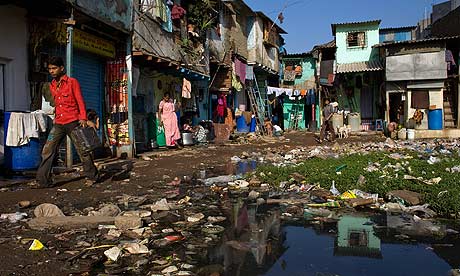
I don't agree with most of Prince Charles's pronouncements about architecture, but he's spot on when it comes to squatter communities. The Guardian has details of a speech the Prince gave at a conference at St James's Palace organized by his Foundation for the Built Environment.
Charles said squatter neighborhoods have "an underlying intuitive grammar of design that is totally absent from the faceless slab blocks that are still being built around the world to 'warehouse' the poor," adding, that shantytowns offer "more durable gains than those delivered through the present brutal and insensitive process of globalisation that is shaping so many aspects of how we live".
Also featured on the stage with Prince Charles was Jockin Arputham, the founder of India's inspirational National Federation of Slum Dwellers, who has been fighting the luxury plan for rebuilding Dharavi, Mumbai's largest squatter area.
Wednesday, February 04, 2009
police in paraisopolis
Police in Sao Paulo have occupied the Paraisopolis favela, the second largest squatter community in the city, the BBC reports. In typical fashion, what gains the headlines is the riot. The cause is in the 3rd paragraph: police shot and killed a local man they were trying to arrest. Sounds like there was no riot in the community until the police instigated one.
At the same time as the violence in Sao Paulo, Brazilian President Luis Ignacio Lula da Silva was in a favela in Rio, announcing a plan to stimulate the economy by building 500,000 apartments for poor people. The International Herald Tribune offers extremely bare bones details.
At the same time as the violence in Sao Paulo, Brazilian President Luis Ignacio Lula da Silva was in a favela in Rio, announcing a plan to stimulate the economy by building 500,000 apartments for poor people. The International Herald Tribune offers extremely bare bones details.
Thursday, January 29, 2009
Cambodian eviction

The Centre on Housing Rights and Evictions reports on a sudden, horrific eviction in Phnom Penh. More than 400 families were pushed out of their homes in Dey Krahorm, in the fastest growing part of the Cambodian capital, by a real estate company, with the assistance of the police.
COHRE lays out the duplicity:
1. The land at Dey Krahorm was granted to the community as a Social Land Concession in 2003.
2. In early 2005, a private company, 7NG, negotiated a contract with the then village chiefs of Dey Krahorm, effectively swapping the prime land in Dey Krahorm for a relocation site 15km outside of Phnom Penh.
3. Dey Krahorm residents have maintained that they were never consulted about the contract and never agreed to move away.
4. Despite community challenges, the local government awarded title to 7NG in 2006.
5. Negotiations between the community and the government were in the works as the eviction was carried out.
COHRE’s Executive Director, Salih Booker, called the eviction nothing more than "an attempt by 7NG to grab valuable land through fraud, threats and violence."
Tuesday, January 27, 2009
20,000 Caracas squatters safe--for now
The Mayor of Libertador, the municipality that encompasses the western part of Caracas, says that squatters in 241 apartment buildings will stay in their homes, the Latin American Herald Tribune reports. Mayor Jorge Rodríguez has issued a decree to ban evictions in the area, says the paper, which seems to stand against the squatters.
The squatters seem caught in the middle of a dispute between supporters and opponents of President Hugo Chavez. The former 'Chavista' mayor allowed the squatters to move in to several hundred vacant buildings in the city. In the last election, the opposition won, and took over the reins of city government, while Chavistas like Mayor Rodriguez won in some local government areas. The Chavistas seem to be trying to keep the squatters in, while the opposition may be currying favor with landowners and developers.
The squatters seem caught in the middle of a dispute between supporters and opponents of President Hugo Chavez. The former 'Chavista' mayor allowed the squatters to move in to several hundred vacant buildings in the city. In the last election, the opposition won, and took over the reins of city government, while Chavistas like Mayor Rodriguez won in some local government areas. The Chavistas seem to be trying to keep the squatters in, while the opposition may be currying favor with landowners and developers.
the trashing of Juba
Demolitions have started in Juba, capital of Central Equatoria state and Southern Sudan, the Sudan Tribune reports. "Illegally constructed shops with corrugated iron sheets, some of which are sometimes used for family accommodations at night, were demolished at Juba Market in the town center. Hundreds of people whose houses or shops were destroyed after they were moved out in the morning of the first day exercise were standing by looking worried as they watched their houses being demolished by bull dozers."
Many of those who are being chased out say they have tried for years to gain legal possession of their property. These people are being penalized because of the government's inept handling of land laws. As the article notes, "it is to a large extent difficult to obtain land in Juba through legal procedures because of unsettled jurisdiction over which level of government should be responsible for the capital and to handle its land issues."
Many of those who are being chased out say they have tried for years to gain legal possession of their property. These people are being penalized because of the government's inept handling of land laws. As the article notes, "it is to a large extent difficult to obtain land in Juba through legal procedures because of unsettled jurisdiction over which level of government should be responsible for the capital and to handle its land issues."
Monday, January 26, 2009
villa 31, or area 51
 The Economist and The Yale Globalist offer two takes on the Buenos Aires Mayor's fight against Villa 31, a squatter community in the downtown area of the Argentine capital. As the Yale piece points out, "The central location of the Villas [31 and its neighbor, known as 31 bis], next to one of the city’s main transportation hubs and surrounded by valuable downtown real estate, is one of the most desirable in the city." Which seems to be why Mayor Mauricio Macri is proposing to crack down on the community.
 The Buenos Aires Herald editorializes in favor of Macri's recent effort to prevent building materials from being brought into the neighborhood. The editorialist concludes,
No country or city can tolerate a society within a society, regardless of whether it is privileged or unprivileged — otherwise it becomes impossible for all citizens to have equal rights and responsibilities. How can anybody dream of a 'bullet train' heading out of Retiro Station with Villa 31 right next to it?But, despite the rhetorical slight of hand--no society within a society, whether rich or poor--the sad logic of development, endorsed by the paper, says the luxury uses staywhile the lower income community goes.
Hasn't anyone thought of allocating money to work with the residents to make the homes that are there meet local codes? (The buildings in the photo I've posted above (it comes from the Yale article, courtesy of the Taller Libre de Proyecto Social) are all made of reinforced concrete and brick, and hardly seem to merit the derision the Mayor and his minions are casting their way.) There are solutions that won't destroy the neighborhood and push out the residents. They don't want a city within the city....just the right to the city that every resident should have.
Saturday, January 24, 2009
but who are the real criminals
JoongAng Daily calls Nam Gyeong-nam, a leader of the Seoul squatter resistance, a "hard-line anti-poverty activist." Police are searching for him and apparently want to charge him in connection with the military assault on squatters early this week that turned into an inferno that left six dead.
Question: if, as the paper reports, Nam has been wanted since 2003, when he allegedly threw Molotov cocktails at a police station, shouldn't authorities have been aware that such weapons could have been in the building that they attacked this week? And, given that knowledge, shouldn't cops have proceeded with caution, instead of mounting an all-out assault? It sounds like the cops are trying to transfer the blame onto the victims here. It was the police action that made a bad situation worse.
Question: if, as the paper reports, Nam has been wanted since 2003, when he allegedly threw Molotov cocktails at a police station, shouldn't authorities have been aware that such weapons could have been in the building that they attacked this week? And, given that knowledge, shouldn't cops have proceeded with caution, instead of mounting an all-out assault? It sounds like the cops are trying to transfer the blame onto the victims here. It was the police action that made a bad situation worse.
Tuesday, January 20, 2009
people vs. planning
Authorities in Juba, capital of Southern Sudan, plans to embark on a demolition drive that will make thousands of people homeless, the Sudan Tribune reports.
Violation of the master plan is a sad excuse for destroying people's lives and livelihoods.
"The Central Equatoria state governor, Maj. Gen. Clement Wani Konga has announced that the demolition exercise was aimed at immediate recovery of grabbed land by unauthorized squatters, saying it was in accordance with the town’s Master Plan."The article refers to the demolition as a 'bulldozing exercise.'
Violation of the master plan is a sad excuse for destroying people's lives and livelihoods.
isn't there a better way ...
 ...than state-sponsored violence?
Six people are dead and 17 injured after Korean police stormed a squatter-occupied building in Yongsan, an area of Seoul slated for redevelopment,
the Korea Times reports. It was tactical squat: the squatters had occupied the building to protest a local redevelopment plan. And here's a terrible irony:
"The incident comes two days after President Lee Myung-bak replaced his police chief, who had been criticized for excessive police crackdowns on protesters."
Monday, January 19, 2009
sensible solution
 In Panama, a new law would provide land for squatters, reports
 La Estrella (the Panama Star). The idea is to pay landowners a fair price, then extend infrastructure and sell the land to the squatters. But the proposal doesn't address the groups that might be the majority of squatters, who have settled in parks and on other federally reserved land. They would be evicted under the proposal, housing minister Gabriel Diez said.
And here's another complication, as reported by the Star:
For many years squatters have invaded prime plots of land all over the country. The majority of the properties around the Pacific coast of Herrera, Veraguas and Los Santos do not have titles, just possessory rights, because nobody really knows who the owners are.
The proposed squatters bill will help to a certain extent to solve the housing problem in Panama, but on the other hand what will happen to those owners who want their land back to build a resort, or want to sell it to a third party or keep it within a family, will the government make those people sell it or evict the squatters.
Wednesday, January 14, 2009
no smiles for squatters
Bacolod City, the capital of Negros Occidental province in the Philippines, calls itself the 'City of Smiles.' But there are no smiles among squatters as the city is preparing to eject 3,000 of them, The News Today reports. The city seems inclined to find land for the squatters, but the articles makes abundantly clear that nothing is certain, and that property owners could begin the demolitions at any time.
100 years of squatting, one summary eviction
How much is 100 years of continuous occupation worth? If you like in Kolkata (Calcutta), five days notice before eviction and demolition. The Times of India reports that the squatters in Howrah actually work as recyclers for the Muncipality. But that apparently counts for nothing. A rickshaw decked out with a PA system broadcast the eviction news on January 8th. The squatters were given until this week to leave. There has been no court case, and there is no relocation plan.
"Three generations of my family have lived here," says Shanti Devi Paswan, one of the residents. "I don't what will happen if the eviction takes place. Who will rent a house to a scavenger?"
It's discrimination and a perversion of law that people who have been in continuous occupation for so long, and are actually providing a municipal service, can be thrown out like this.
Update here: Authorities have started demolition (razing more than 150 shops and factories) and the squatters are mobilizing.
"Three generations of my family have lived here," says Shanti Devi Paswan, one of the residents. "I don't what will happen if the eviction takes place. Who will rent a house to a scavenger?"
It's discrimination and a perversion of law that people who have been in continuous occupation for so long, and are actually providing a municipal service, can be thrown out like this.
Update here: Authorities have started demolition (razing more than 150 shops and factories) and the squatters are mobilizing.
Friday, January 09, 2009
iraq evicts
 The clock is ticking for squatters in Baghdad The UN news service IRIN reports that the government has set up a committee to set up "meetings between relevant government officials and the squatters to raise awareness and discuss the negative impact of squatting on government property." Squatters are supposed to leave their dwellings within 60 days. If they move, they may qualify for cash payments, IRIN reports, that could run between $850 and $4,300.
Sounds great, no?
Well, not really. The Associated Press reported three months ago that an average apartment in one still-dangerous area of Baghdad costs $400 a month. Home prices have doubled in the past year. If that kind of inflation continues, the seemingly generous payments would not count for much.
Meanwhile, the AP article continues, "in the U.S.-protected Green Zone, which houses the U.S. Embassy and Iraqi government offices, there are plans for luxury hotels, a shopping center and even condos."
Tuesday, January 06, 2009
war on drugs or war on squatters?
As The Washington Post reports, Rio's police have occupied Santa Marta, a favela overlooking the upper-middle class Botafogo neighborhood. Among the police strategies: banning moto taxis (the unlicensed motorcycle taxis that many residents depend on to get up and down the community's steep slope), depriving residents of pirated cable tv and internet service, and imposing curfews.
The reporter compares this strategy to the counterinsurgency strategy in Iraq. But this is not a war zone. Rio may be a violent city, but most of the shootings actually involve the police. Indeed, many favela residents (and some government officials) find the drug dealers more honorable than the cops. And, anyway, the police have done these kinds of occupations many times--invading favelas and terrorizing residents, all justified by the claim that they are trying to root out drug gangs--and they have always failed. Their actions, while temporarily preventing shootouts between rival gangs, actually kill the community in order to save it. As the article notes, so few people are out on the street that stores are closing in some favelas. And, though walking may be safer, there's nowhere to walk to. Here's a description of Santa Marta now:
And there's another, more sinister angle to the story: Santa Marta is controlled by the Comando Vermelho--the Red Command--one of three drug gangs operating in Rio. But from what I have heard, the police have historically been cozy with another drug gang--Amigos dos Amigos (Friends of Friends.) A cynic might say that the police are simply doing their friends in AdA a service by cracking down on the CV.
The reporter compares this strategy to the counterinsurgency strategy in Iraq. But this is not a war zone. Rio may be a violent city, but most of the shootings actually involve the police. Indeed, many favela residents (and some government officials) find the drug dealers more honorable than the cops. And, anyway, the police have done these kinds of occupations many times--invading favelas and terrorizing residents, all justified by the claim that they are trying to root out drug gangs--and they have always failed. Their actions, while temporarily preventing shootouts between rival gangs, actually kill the community in order to save it. As the article notes, so few people are out on the street that stores are closing in some favelas. And, though walking may be safer, there's nowhere to walk to. Here's a description of Santa Marta now:
The paths snaking among the houses were nearly deserted on a recent afternoon, unusual in such a densely packed community. As the search continues in the neighborhood and surrounding jungle for stashes of drugs or weapons, police regularly question residents about their activities. The neighbors don't like being outside for fear of getting hassled, said Alan Basilio, 27, a student on his way home.
"At this time of day, you'd normally see many more people outside, sitting around and talking," he said. "Daily life has changed a lot."
"Of course, since the police arrived there are no more gunfights, no more shooting," he said. "But the way it was before, we had freedom to go where we wanted, to do what we wanted, for as long as we wanted. I'm not sure how long it's going to be like this, but it seems like it could be a very long time."
And there's another, more sinister angle to the story: Santa Marta is controlled by the Comando Vermelho--the Red Command--one of three drug gangs operating in Rio. But from what I have heard, the police have historically been cozy with another drug gang--Amigos dos Amigos (Friends of Friends.) A cynic might say that the police are simply doing their friends in AdA a service by cracking down on the CV.
Friday, December 26, 2008
stealth of nations

Hey, squattercity denizens. My apologies for having been less than attentive to the blog in recent months. I am continuing to post on squatter issues. But I've also started a blog on the global reach of the informal economy, the subject of the book I am writing now. You can find that blog at http://stealthofnations.blogspot.com/.
Thursday, December 11, 2008
Finally, A Good Real Estate Deal: putting the homeless In foreclosed homes
A brilliant program from a Miami group vets homeless families and then moves them into foreclosed housing. The program is, at least technically, illegal. But no arrests have been made, and it seems a clearheaded way to prevent neighborhood deterioration while getting families desperate for housing into high-quality homes. FOXNews (yes, that Fox News) has the details.
"We're matching homeless people with people-less homes," Max Rameau, who heads Take Back the Land, the group organizing the move, told the Associated Press in a recent story. Rameau also has a blog at http://takebacktheland.blogspot.com/.
From an anonymous comment on one of my previous posts, I see that Miami New Times broke the story last month.
(Mea culpa: I was in Lagos, Nigeria when the anonymous poster sent me the New Times story, and I only just got around to following up on this.)
"We're matching homeless people with people-less homes," Max Rameau, who heads Take Back the Land, the group organizing the move, told the Associated Press in a recent story. Rameau also has a blog at http://takebacktheland.blogspot.com/.
From an anonymous comment on one of my previous posts, I see that Miami New Times broke the story last month.
(Mea culpa: I was in Lagos, Nigeria when the anonymous poster sent me the New Times story, and I only just got around to following up on this.)
Monday, October 13, 2008
the squatters we create
alJazeera Magazine offers a moving portrait of the mess that is Afghanistan today. The nation's capital, reporter Anand Gopal asserts, has become one large shantytown:
Gopal concludes with a message that could apply to all squatter communities around the world: "This is a war to be won by constructing roads, creating jobs, cleaning up the government, and giving Afghans something they've had preciously little of in the last 30 years: hope."
Kabul itself lies in tatters. Roads have gone unpaved since 2001. Massive craters from decades of war blot the capital city. Poor Afghans live in crumbling warrens with no electricity and often without safe drinking water. Kabul, a city designed for about 800,000 people, now holds more than four million, mostly squeezed into informal settlements and squatters' shacks.
Washington spends about $100 million a day on this war -- close to $36 billion a year -- but only five cents of every dollar actually goes towards aid. From this paltry sum, the Agency Coordinating Body for Afghan Relief found that "a staggering 40 percent has returned to donor countries in corporate profits and salaries."
Gopal concludes with a message that could apply to all squatter communities around the world: "This is a war to be won by constructing roads, creating jobs, cleaning up the government, and giving Afghans something they've had preciously little of in the last 30 years: hope."
Saturday, September 20, 2008
the cliff dwellers quandary
The New York Times follows up on the cliff collapse in Manshayet Nasser, a sprawling Cairo neighborhood of more than one million residents:
The police have cordoned off the neighborhood; they don’t want any prying reporters, foreign observers or charity groups to get in. “It’s a crisis,” barked one state security agent, when asked why the area was sealed. A crisis for the government seems to be what he meant.
On Sept. 6 a huge piece of this cliff broke off and crushed the lives below, poor people living on the edge of the city. So far, 101 bodies have been recovered, but the true scope of what happened remains hidden beneath massive rocks that rest where they fell.
Sunday, September 14, 2008
2000 homeless after fire
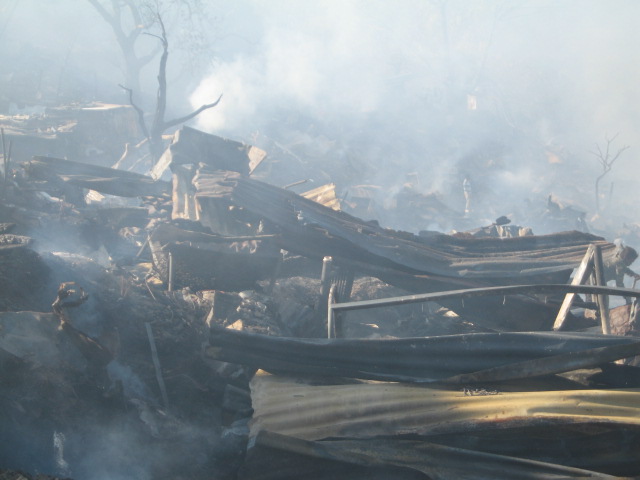
A candle left unattended for a few moments sparked a fire that destroyed at least 600 homes and left 2,000 people homeless in the Foreman Road squatter neighborhood of Durban, South Africa. One man died in the fire and three other people are still missing.
Another tragedy due to the policy that prevents shack dwellers from having legal electrical service. What's more, though the municipality promised to install fire hydrants around the community four years ago, the work was never completed, and the neighborhood had just one communal water tap.
Abahlali baseMjondolo, South Africa's outspoken squatter movement, has scheduled a City Wide Shack Fire Summit at Foreman Road on Monday 22 September 2008. Now the meeting will take place in the ashes of Foreman Road.
Sunday, September 07, 2008
not acts of god
An astounding figure: on average, there are ten fires a day in squatter communities throughout South Africa. This fact comes from "Big Devil Politics," an important new report by Abahlali baseMjondolo, the squatter-run community organization that started in Durban. To understand these fires, Abahlali writes, you have to understand this: "Shack fires are not acts of God. They are the result of political choices." The report is necessary reading, written with contained fury. It is an indictment of the policies that have led to hundreds of deaths in South Africa's squatter communities every year.
Saturday, September 06, 2008
Rock slide in Cairo shantytown kills 24 - Yahoo! News
An awful scenario: boulders the size of houses raining down on a shantytown in Cairo. AP has the details. But a significant news nugget is buried in the article:
So, once again, squatters are victimized by lack of investment in infrastructure.
1. "The reason the rocks keep falling is because there is no sewage system and their wastewater is eating away at the mountain," Hani Rifaat, a local journalist who has been following the issue, told AP from the site of the disaster.
2. Resident Mohammed Hussein said contractors have been working on shoring up the cliffs as they became increasingly unstable, but they could not complete their work until the government resettled the community below. "The contractor who is stabilizing the mountain asked the government to resettle everyone at least 32 miles from the mountain because he didn't want the rocks he was removing to fall on the people," Hussein told AP Television News. "The rocks are soaked with water and so are more brittle and prone to falling."
So, once again, squatters are victimized by lack of investment in infrastructure.
Sunday, August 31, 2008
charred remains
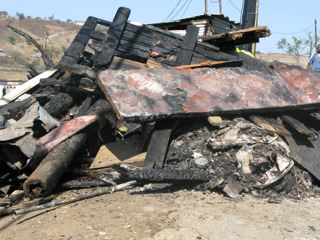 Eight people were buried this weekend after another disastrous fire in the Kennedy Road shack settlement in Durban, South Africa.
The municipality blames the squatters, who get drunk and knock over the candles. The squatters knock down that ugly slander. It is, rather, the municipality that is to blame, for its policy of refusing to allow electrification in the shack neighborhoods. And when the squatters pirate electrical service, the municipality dispatches the police to destroy the makeshift connections and arrest (and sometimes bludgeon) the offenders.
Here's a stark statement of the problem, from Abahlali baseMjondolo, the brave squatter mobilzation in eThekwini Municipality:
Let us be clear. People in houses [as opposed to wood and sheet metal shanties] also get drunk. Their children also like to play in the house. The difference is that they have electricity and so their houses do not burn when these things happen....The problem is not that we are stupid. We do not need training on how to avoid fires. The problem is that we do not have electricity. Electricity will save our lives. Most fires are caused by candles and paraffin stoves. If they don’t connect we must connect. If they will not connect us then they must not arrest and beat us for connecting ourselves. If democracy is for everybody then everybody needs to be safe in a democracy and we are doing the work of the government when we connect ourselves. When we connect ourselves we are making the democracy real. When we connect ourselves we are making everyone count the same. Anyone who says that electricity is a luxury that the poor do not deserve must spend one winter living in a shack and trying to survive the fires before they speak about what is a luxury and what is a necessity.
Tuesday, August 19, 2008
blame the victims
The Johannesburg Government now blames squatters for the fires that periodically devastate their communities. Here's what a spokesman for Johannesburg Emergency Management Services told the Star newspaper about a fire this past weekend that destroyed 1,000 homes in the Denver hostel squatter camp in southern Johannesburg: "In illegal informal settlements there are a lot of social factors that come into play. High on the list is drunkenness... where a person drinks and forgets to put out the candle... or they might leave a pot cooking on a stove and go and buy beer again."
Anyone who has spent time in squatter communities or other informal settlements knows that drunkenness is no more prevalent there than in society as a whole. The greater issue, which the Durban-based squatter organizing group Abahlali baseMjondolo has articulated many times, is South Africa's continuing effort to prevent squatters from gaining access to electricity: "As usual the poor must be blamed rather than the system that denies people decent housing and fails to, even as a minimal measure, electrify the shack settlements."
Anyone who has spent time in squatter communities or other informal settlements knows that drunkenness is no more prevalent there than in society as a whole. The greater issue, which the Durban-based squatter organizing group Abahlali baseMjondolo has articulated many times, is South Africa's continuing effort to prevent squatters from gaining access to electricity: "As usual the poor must be blamed rather than the system that denies people decent housing and fails to, even as a minimal measure, electrify the shack settlements."
Saturday, August 02, 2008
Calcutta wants to replace squatters with high rises
Another scheme to push out squatters, this time in Kolkata (Calcutta.) Apparently, the city government, recognizing that many squatter areas occupy valuable real estate in the center of town, has decided to allow multi-family reconstruction. This, of course, gives developers a massive financial incentive to drive as many as 1.5 million people from their homes. City Renewal, a blog maintained by people affiliated with the Howrah Pilot Project, gives a clear-eyed summary of the issues involved.
[thanks to Nila-kantha-chandra/Rama for sending this my way.]
[thanks to Nila-kantha-chandra/Rama for sending this my way.]
Rwanda's Capital's Crime
Demolition in Kigali as the government has razed the centrally located squatter community of Poor Kiyovu (so called to distinguish it for neighboring Rich Kiyovu.) Thus politicians work hand-in-hand with developers, and the people suffer. I suppose the good news is that the administration did at least promise to reimburse people for their losses. But, as this blog post points out, many have not received anything.
Here's the nub of the issue: "It seems that the government wishes to engineer a city in which Kigali residents and delicate-stomached foreigners will no longer have to suffer vulgar displays of poverty in the city centre. Its a loss for the city. These people were a major part of the life of the city centre. A much better strategy would have been for the city to have improved the property rights laws and infrastructure in poor Kiyovu to promote its development. Shame on the City of Kigali."
(thanks, Maurice, for sending this to me.)
Here's the nub of the issue: "It seems that the government wishes to engineer a city in which Kigali residents and delicate-stomached foreigners will no longer have to suffer vulgar displays of poverty in the city centre. Its a loss for the city. These people were a major part of the life of the city centre. A much better strategy would have been for the city to have improved the property rights laws and infrastructure in poor Kiyovu to promote its development. Shame on the City of Kigali."
(thanks, Maurice, for sending this to me.)
Sunday, May 25, 2008
Roma at risk
Silvio Berlusconi wastes no time. Italy has expelled 100 people after a sweep of immigrant squatter encampments, The New York Times reports.
See also: BBC and The Guardian.
The Guardian reports that the cabinet endorsed a new law that allows "confiscation of property let to illegal immigrants, a rule that could have instant and drastic effects on hundreds of thousands of foreigners known to be living in Italy without the right papers."
[a tip of the hat to Gabriel for pointing me to the links.]
See also: BBC and The Guardian.
The Guardian reports that the cabinet endorsed a new law that allows "confiscation of property let to illegal immigrants, a rule that could have instant and drastic effects on hundreds of thousands of foreigners known to be living in Italy without the right papers."
[a tip of the hat to Gabriel for pointing me to the links.]
Monday, May 19, 2008
deja vu all over again in South Africa
I don't mean to be snide. But some South African cities are reimposing some of the worst excesses of the apartheid era. That's what Marie Huchzermeyer, an architecture professor, argues in a recent issue of the newspaper Business Day.
In Durban, the legislature's policy of policing and fencing off of all vacant land and summarily evicting of any new land invaders, she writes, "reintroduces measures from the 1951 Prevention of Illegal Squatting Act, which was repealed in 1998."
She compares the determination to eradicate shack settlements, no matter the cost (and studies have shown that simply razing peoples homes and forcing them further out of town institutionalizes misery and makes poverty worse) with denying that the HIV virus causes AIDS.
In Durban, the legislature's policy of policing and fencing off of all vacant land and summarily evicting of any new land invaders, she writes, "reintroduces measures from the 1951 Prevention of Illegal Squatting Act, which was repealed in 1998."
She compares the determination to eradicate shack settlements, no matter the cost (and studies have shown that simply razing peoples homes and forcing them further out of town institutionalizes misery and makes poverty worse) with denying that the HIV virus causes AIDS.
squatting on the rise in the USA
It's a response to the sub-prime meltdown and the tragedy of foreclosures. People without homes while an enormous number of buildings are vacant. Reuters has details.
One sorry point about the article: it features no interviews with squatters themselves, but is almost entirely based on interviews with real estate brokers. This makes it seem like the squatters are manipulating the tragic situation for their own benefit. As if the banks and entities that have foreclosed are not. Some squatters may, indeed, be seeking to profit. But I'm sure there are others who simply need shelter.
To be, as Patrick Chamoiseau has written, is first and foremost to possess a roof.
One sorry point about the article: it features no interviews with squatters themselves, but is almost entirely based on interviews with real estate brokers. This makes it seem like the squatters are manipulating the tragic situation for their own benefit. As if the banks and entities that have foreclosed are not. Some squatters may, indeed, be seeking to profit. But I'm sure there are others who simply need shelter.
To be, as Patrick Chamoiseau has written, is first and foremost to possess a roof.
Friday, May 09, 2008
Whose South Africa?
Le Monde Diplomatique offers a clear-eyed perspective on the inequalities and inequities of the new South Africa, with special focus on the squatter communities.
Wednesday, April 30, 2008
So you want to squat...

A London service is publicizing the city's vast number of vacant buildings in the hope that people could squat them. The group features flyers and brochures that mimic real estate publications. Read about it in The Daily Mail.
[thanks to eagle-eyed Bryan of Subtopia for the link]
Friday, April 18, 2008
Istanbul destroys historic Roma community

Kristoffer Larsen, who is currently in Istanbul, is chronicling the municipal government's continuing effort to demolish Sulukule, a historic neighborhood in Istanbul that has been home to a Roma community for almost 1,000 years. He writes:
"They are tearing down houses randomly - 6 one morning - 3 the other day. The last week has been quiet - there are rumors among some people that the municipality are getting cold feet - but this is not confirmed. They are likely to carry on - despite the fact that no solution has been found for huge number of residents who are not able to pay for new houses.
There has been a desperate atmosphere some days - one lady started to destroy her own house (in which she has been living for 40 years, her whole life) because she knew that the buldozers would come the next morning."
Kristoffer took the photo last month, after one of the periodic demolitions.
On April 4, members of the US Helsinki Commission wrote to Turkey's Prime Minister R. Tayyip Erdoğan, expressing dismay over the organized bulldozing of the community. In a speech last month, however, Erdoğan was unapologetic: "Those criticizing the project will eventually say, 'We thank you for rescuing Sulukule from its ugliness and turning it into a modern place with restored historical streets.'"
Friday, March 21, 2008
a novel way to evict thousands
Just suspend the law. That's what the government of Chad did earlier this month. The edict of extraordinary powers meant that authorities in N'djamena, the country's capital, had no obligation to honor due process or any other rights.
The result: 1,000 families in poor neighborhoods around the city were evicted, and their homes destroyed.
"Under the presidential decree, public discussion of the evictions was banned and many key public defenders fled the country out of concern for their safely," the UN's Integrated Regional Information Networks news service reports. IRIN quotes N'djamena Mayor Mahamat Zène Bada as asserting that they now can build "schools and colleges, medical centres, libraries, sporting facilities, markets and bus stations."
Yeah, right.
With admirable restraint, IRIN points out that "it will be difficult start any projects as there are very few construction companies in the country due to the current insecurity, and there is questionable value of building libraries in a country where the majority of the population is unschooled and illiterate."
The result: 1,000 families in poor neighborhoods around the city were evicted, and their homes destroyed.
"Under the presidential decree, public discussion of the evictions was banned and many key public defenders fled the country out of concern for their safely," the UN's Integrated Regional Information Networks news service reports. IRIN quotes N'djamena Mayor Mahamat Zène Bada as asserting that they now can build "schools and colleges, medical centres, libraries, sporting facilities, markets and bus stations."
Yeah, right.
With admirable restraint, IRIN points out that "it will be difficult start any projects as there are very few construction companies in the country due to the current insecurity, and there is questionable value of building libraries in a country where the majority of the population is unschooled and illiterate."
Sunday, February 17, 2008
Back to the 19th century
On Thursday, Feb. 14, police descended on the Kennedy Road Settlement in Durban and began ripping out electrical hookups. They ripped out pirated service, and they ripped out legal service. They dug up wires that had been run underground.
Kennedy Road is one of the shack settlements that is part of Abahlali baseMjondolo, a squatter organizing group which has been battling with the Durban municipality for some time now. Its members have been arrested, imprisoned, harassed, and hurt. Now, with no advance warning, the municipality is attempting drive squatters back to the squalor in which the poor lived two centuries ago.
Welcome to the new South Africa!
As Abahlali said in a statement, "Electricity is not a luxury. It is a basic right. It is essential for children to do their homework; for safe cooking and heating; for people to charge phones, to be able participate in the national debate through electronic communication (TV discussion programmes, email etc); for lighting to keep women safe and, most of all, to stop the fires that terrorise us....Why is the government sending the police to force us to go backwards? Development was supposed to be about moving forwards."
For more about Abahlali and their courageous work, you can find a short video here.
Kennedy Road is one of the shack settlements that is part of Abahlali baseMjondolo, a squatter organizing group which has been battling with the Durban municipality for some time now. Its members have been arrested, imprisoned, harassed, and hurt. Now, with no advance warning, the municipality is attempting drive squatters back to the squalor in which the poor lived two centuries ago.
Welcome to the new South Africa!
As Abahlali said in a statement, "Electricity is not a luxury. It is a basic right. It is essential for children to do their homework; for safe cooking and heating; for people to charge phones, to be able participate in the national debate through electronic communication (TV discussion programmes, email etc); for lighting to keep women safe and, most of all, to stop the fires that terrorise us....Why is the government sending the police to force us to go backwards? Development was supposed to be about moving forwards."
For more about Abahlali and their courageous work, you can find a short video here.
Sunday, January 27, 2008
House in a Slum? You Can't Afford It. - washingtonpost.com
Dilip D'Souza decodes Mumbai's mystifying housing market and the programs designed to aid squatters in this wonderfully honest article from The Washington Post.
Saturday, January 26, 2008
Bangalore squatters protest
I missed this in late December: Squatters in Bangalore, who had occupied their community for two decades, protested after the municipality evicted them with no warning. They claim that the city sold off replacement housing rather than allocated it to them. The Hindu has details.
Friday, January 25, 2008
A sophisticated strategy in Manila
Philippine squatters have picketed the South Korean embassy, to protest a South Korean government-financed plan that calls for 50,000 families who live along the railroad tracks to be evicted. Manila's INQUIRER newspaper has the details. Sadly, the Korean Embassy refused to talk with the squatters or even receive a letter they were trying to deliver. The squatters say they're not against improving the railroad, but they want their rights to their homes respected and relocation plans to be developed. "Our only concern is the observance of the rights of the affected families," said Ted Añana, deputy coordinator of the Urban Poor Associates, which helped organize the demonstration.
Thursday, January 24, 2008
35 years and still no rights

The squatter community of Arnett Drive has been in the Reservoir Hills area of Durban for 35 years. Yet the municipality has launched a sudden and horrible eviction drive. It's an ugly reality of the new South Africa -- majority rule making life worse for the majority.
Update: A January 25 article from The Mercury (sadly hidden behind a subscription firewall on the web) reports that Abahlali baseMjondolo, the courageous Durban squatter organizing group, won a temporary injunction barring the municipality from engaging in more demolitions in this Reservoir Hills community. The interim ruling allows for a one-month reprieve. The matter will be back in court on the 21st of February.
Monday, January 14, 2008
A big year for the wrecking ball

This excellent article from Canada's Globe and Mail newspaper notes that governments in Mumbai, India and Istanbul, Turkey are set to demolish millions of squatter homes to make way for highrises, in a misguided attempt to modernize their cities.
In both cities, it seems like the government is using the rhetoric of improvement and redevelopment to shift land from being held by largely poor squatters to being owned by large real estate establishments. The impact on the squatters, it seems, is just collateral damage (see photo of Nehru Nagar in Mumbai).
Yet the article offers a modest way forward:
"The best plans generally let the slum dwellers themselves make the main decisions in planning their future. You should provide clean water, toilets, electricity, garbage collection and disposal, and maybe let people build their own houses if they can using materials that you can provide," says Aprodicio Laquian, the Filipino-Canadian planner who practically invented the idea of slum-dweller-designed urban rehabilitation in the 1960s and is now at the University of British Columbia.
"Eventually," Mr. Laquian says, "you want to make available a better sort of housing, a five-storey walk-up apartment, but planned according to the needs of the community, not by some central plan."
An amazing and simple statement of what ought to be the norm in urban development. Instead, it's a revolutionary thought. How many people need to get evicted before the world understands?
Tuesday, January 08, 2008
gypsies face the boot in Istanbul
Another example of eviction via redevelopment. Istanbul wants to spruce up for its 2010 debutante outing as "European Capital of Culture" by flattening the ancient and historic (and, admittedly, run down) area called Sulukule, which is occupied principally by the Roma. The plan calls for removing the historic homes on the land abutting the 1600-year-old Theodosian Walls and building $77,000 townhouses. "We are buying the houses from the present owners and they can move into brand-new lodgings as soon as they are finished, and pay off the difference over 15 years," the local Mayor crows.
But Sukru Punduk, a Sulukule resident who opposes the plan, thinks the municipality’s aim is to clear the area of its current Roma inhabitants. "Look at the models they’ve made of the new houses, little model people carrying laptops, middle-class people, not people like us," he says. It's a logical suspicion, considering that half the residents of Sulukule earn less than 500 lira ($427) a month.
Oh, wait, perhaps Countrywide Financial and Citibank can come in and give these good Turkish citizens some no documentation subprime mortgage love, then foreclose on them and ....
What's even more suspicious is that the government is also seeking to destroy nearby Gulsuyu, a former gecekondu (squatter) neighborhood that was legalized two decades ago. Why push Gulsuyu residents out? Because that neighborhood occupies a potentially prime piece of real estate high on a hill overlooking the Marmara Sea.
Eurasianet has the sordid details.
But Sukru Punduk, a Sulukule resident who opposes the plan, thinks the municipality’s aim is to clear the area of its current Roma inhabitants. "Look at the models they’ve made of the new houses, little model people carrying laptops, middle-class people, not people like us," he says. It's a logical suspicion, considering that half the residents of Sulukule earn less than 500 lira ($427) a month.
Oh, wait, perhaps Countrywide Financial and Citibank can come in and give these good Turkish citizens some no documentation subprime mortgage love, then foreclose on them and ....
What's even more suspicious is that the government is also seeking to destroy nearby Gulsuyu, a former gecekondu (squatter) neighborhood that was legalized two decades ago. Why push Gulsuyu residents out? Because that neighborhood occupies a potentially prime piece of real estate high on a hill overlooking the Marmara Sea.
Eurasianet has the sordid details.
Saturday, January 05, 2008
the new shantytown of people forced out of the shantytown
 The post-election violence in Nairobi has pitted neighbor against neighbor. These former residents of Mathare, a shantytown with a history that goes back more than half a century, on the were forced from their homes and have become squatters on the nearby airforce base (photo from guardian.co.uk).
Friends tell me that several swathes of Kibera were burnt, but they were hoping tensions would cool this weekend.
This much is sure: beyond finding a political solution, there's lots of mending to be done between neighbors.
Monday, December 31, 2007
Nairobi Shantytowns Erupt

 If Kenya's incumbent president, Mwai Kibaki, did not rig the election, asks challenger Raila Odinga, "why does he seclude himself in State House at dusk to be sworn in without the media, diplomats, observers and other Heads of States." For those who don't know the details, Odinga was leading in the polls in the lead up to the election, and was ahead by 1 million in the count just one day before the official results were announced. Once the election commission announced th results, the incumbent president was sworn in for a second term in a secretive 15-minute action and the government immediately imposed controls on the press.
The danger for Kenya is that the contested results, which outside observers said were tainted by fraud, exacerbate existing tribal tension. Kibaki is a Kikuyu, the dominant Kenyan tribe. Odinga is from the nation's second-largest tribe, the Luo. Kibera, the shantytown where I lived when I was doing the reporting for Shadow Cities, is in Odinga's parliamentary district and reports are that violence has broken out between Kikuyus and Luos in the community. Other shantytowns around Nairobi report riots and anger. The two photos, from The New York Times, show the extent of devastation in Mathare, Nairobi's second-largest shantytown.
You can view a disturbing video from the British newspaper The Guardian here.
The Nation, the country's largest newspaper, has details of Odinga's plans to contest the results.
****
later in the day update: The New York Times offers a New Years Eve view of the situation on the streets.
As the Times points out, "Mr. Kibaki now faces trouble not just on the streets, but in the Kenyan Parliament as well. More than half of his cabinet was voted out of office in a wave of seeming dissatisfaction with his government, and his party won about 35 seats in Parliament, while the opposition took nearly 100 seats."
This brings up an interesting issue: if we are to believe the results certified by the Election Commission, we have to believe that an overwhelming number of people split their ballots. If 100 opposition politicians were elected to Parliament and half of Kibaki's cabinet lost their parliamentary posts, is it truly credible that so many people voted against Kibaki's party's nominees for Parliament but for the incumbent president?
Tuesday, December 18, 2007
Losing faith
Johannesburg squatters take little interest in the current fight between Jacob Zuma and Thabo Mbeki for leadership of the African National Congress. "The ANC has done nothing for us," one squatter tellsReuters.
The article notes that people expected investment and empowerment after the ANC took control of the government, but 13 years later, there's not much to show for majority rule. "We can't even get a toilet, unless we can afford to bribe the authorities," another squatter said.
The article notes that people expected investment and empowerment after the ANC took control of the government, but 13 years later, there's not much to show for majority rule. "We can't even get a toilet, unless we can afford to bribe the authorities," another squatter said.
Monday, December 10, 2007
The dark side of micro-credit?
Are small-scale loans from Grameen Bank and other micro-credit institutions being used to fund dowry payments? That's the provocative assertion in this essay from openDemocracy: "While micro-credit has benefited large sections of the rural population in many ways, it has also worked against women's solidarity and contributed heavily to the inflation of dowry. Grooms' families are aware that money is available to brides' families more easily now, through Grameen Bank, the Bangladesh Rural Advancement Committee (BRAC) or other NGOs."
Wednesday, December 05, 2007
what's the world record for evictions?
Maybe China takes the gold, for evicting 1.5 million people to make way for next summer's Olympics in Beijing, according to the Committee on Housing Rights and Evictions. The AP has the details. COHRE gives Beijing, Slovakia and State Peace and Development Council of Burma its annual Housing Rights Violator Awards. Read COHRE's citations here.
Digital Cities
Subtopia, Bryan Finoki's revelatory blog on military urbanism, features a thoughtful post on one artist's digitally manipulated photos from the favelas, or what Bryan calls Squatter Imaginaries. Join the discussion about the role of art in revealing/questioning/documenting social fractures.
Monday, November 26, 2007
The squatter millionaires
It ought to be great news. On Thanksgiving Day (for those of you lucky enough not to be familiar with U.S. rituals, that occurred on Nov. 22nd this year), the Bill & Melinda Gates Foundation announced that they were giving $10 million to Shack/Slum Dwellers International, a major squatter organizing group in Mumbai, India.
But consider that SDI sometimes doesn't advance the interests of all squatters. In Durban, South Africa, the squatter group Abahlali baseMjondolo was threatened that it would be harassed by the government if it did not join SDI. Here's a note from a recent Abahlali press statement.
Abahlali asserts that SDI has created a coalition with the South African government while the government continues evicting many shack communities. Thus SDI is implicitly condoning those evictions. This is a serious charge.
So I say: Congratulations to the Gates Foundation for, as program officer Melanie Walker told writer Neal Peirce, triumphing over the "scary" prospect of giving $10 million to "people without a bank account." This is a welcome step and will no doubt help the organization draw attention to housing issues and inequities around the globe.
But the Gates Foundation should remember that there are hundreds of millions of squatters around the world who are not represented by SDI (indeed, the majority of the billion shanty dwellers on the planet aren't represented by the group.) They deserve recognition, too, and they certainly shouldn't get the shaft simply because they haven't joined SDI.
addendum, one day later:
And SDI should note that with money and success comes responsibility to be inclusive. SDI tends to only work with groups that embrace it's own 'savings-plan' version of organizing. But there are many communities that don't see saving money as the best organizing tool, particularly if they are facing immanent eviction. SDI now has an opportunity to broaden its vision and its reach.
But consider that SDI sometimes doesn't advance the interests of all squatters. In Durban, South Africa, the squatter group Abahlali baseMjondolo was threatened that it would be harassed by the government if it did not join SDI. Here's a note from a recent Abahlali press statement.
We were then told that if we wanted to be
able to meet with the government regularly and to be able to get
houses we must join SDI. The instruction was clear: stay on our own
and keep thinking and speaking for ourselves and be arrested, or join
SDI and be obedient and be rewarded. We refused to join SDI. We
announced this on the radio. Within days the arrests and beatings
started and they have not stopped since even though we are currently
suing the Minister of Safety & Security and even though we have
marched on the Sydenham Police. The money for SDI is not money for us.
Abahlali asserts that SDI has created a coalition with the South African government while the government continues evicting many shack communities. Thus SDI is implicitly condoning those evictions. This is a serious charge.
So I say: Congratulations to the Gates Foundation for, as program officer Melanie Walker told writer Neal Peirce, triumphing over the "scary" prospect of giving $10 million to "people without a bank account." This is a welcome step and will no doubt help the organization draw attention to housing issues and inequities around the globe.
But the Gates Foundation should remember that there are hundreds of millions of squatters around the world who are not represented by SDI (indeed, the majority of the billion shanty dwellers on the planet aren't represented by the group.) They deserve recognition, too, and they certainly shouldn't get the shaft simply because they haven't joined SDI.
addendum, one day later:
And SDI should note that with money and success comes responsibility to be inclusive. SDI tends to only work with groups that embrace it's own 'savings-plan' version of organizing. But there are many communities that don't see saving money as the best organizing tool, particularly if they are facing immanent eviction. SDI now has an opportunity to broaden its vision and its reach.
Where are Durban's street children?
Rounded up, yanked off the streets, and jailed by local authorities, because FIFA, the world soccer federation, met yesterday in the city, The Daily News asserts.
Monday, November 19, 2007
Three Cheers for Infrastructure
Mega Cities expert Janice Perlman makes a profound statement:
"The international funding agencies of investment institutions need to give more to urban development and less to rural development," said Perlman. "I’ve argued that the people who come to the city [and live in squatter developments] are the cream of the crop with the highest ambitions and aspirations. If given the chance, they would build middle-class communities. You can’t blame people for polluting the watershed if you don’t provide them with water infrastructure."
Perlman advocates integrating squatter developments into the surrounding neighborhoods. Rather than demolishing these self-made communities, she recommends connecting them to the city’s infrastructure by incorporating paved streets, steps, plazas and new facades as well as offering services such as clean water, sewage connections and electricity. If visually they’re more like the surrounding neighborhoods, these needy areas will be more likely to interact with the middle class nearby, she said.
Bone Hill
The Homeless Workers Movement is the urban branch of the Landless Workers Movement, the Brazilian group that has been seizing rural parcels from wealthy land barons and building new towns in rural Brazil. In Sao Paulo it has established several new communities, Le Monde Diplomatique reports. Oddly, the group has been recruiting its land invaders among people who live in some of the city's many other favelas. Still, the ideology sounds impressive:
The Sao Paulo community chose to call itself Bone Hill because, Silvestre said, "the homeless are a bone that sticks in the authorities’ throat."
Helena Silvestre, an MTST leader, described squats as a school for participatory democracy and a training ground for future community leaders: “We want to use a specific issue, housing, as the starting-point to help lay the foundations of real popular power.”
The Sao Paulo community chose to call itself Bone Hill because, Silvestre said, "the homeless are a bone that sticks in the authorities’ throat."
Sunday, November 18, 2007
let there be light!
I'm not usually a techno worshipping type, but here's a handy device that could transform people's abilities to get light without wasteful diesel generators or kerosene lanterns. It's called the GaiaLux Ecolight and has been entered in NASA's Create the Future design contest. Basically, it reuses discarded mobile phone chargers to get electricity to rechargeable batteries that in turn power a highly efficient LED bulb. It can be recharged on variable or low current and the batteries will run the light for 40 hours. It's a nifty idea that could reuse some of the 125 million phone chargers that are discarded every year as well as potentially providing affordable (and bright) lighting in places that need it.
A few follow-up questions for inventor John Barrie:
1. How much does the GaiaLux cost? Does the price make it within the reach of people with alarmingly low incomes? Are the materials and supplies that are necessary manufactured in the countries that might find uses for the light, or will they have to be imported?
2. How heavy is the light (because people who don't have their own electricity would likely need to carry it somewhere to recharge the batteries)?
3. Is it feasible to recharge the batteries through solar power?
A few follow-up questions for inventor John Barrie:
1. How much does the GaiaLux cost? Does the price make it within the reach of people with alarmingly low incomes? Are the materials and supplies that are necessary manufactured in the countries that might find uses for the light, or will they have to be imported?
2. How heavy is the light (because people who don't have their own electricity would likely need to carry it somewhere to recharge the batteries)?
3. Is it feasible to recharge the batteries through solar power?
Thursday, November 01, 2007
Plague of Fires Takes Another Life
"The terror of shack fires is everywhere and it will stay everywhere for as long as we are forced to live 13 people in one shack with candles and a paraffin stove because it has been decided that electricity is not for us and that we are not allowed to expand our shacks or to build new ones as our families grow."
Eloquent words from Abahlali baseMjondolo.
Eloquent words from Abahlali baseMjondolo.
Saturday, October 20, 2007
gentrifying Dharavi

The plan to demolish and resurrect Dharavi as a fully developed upper class zone is moving forward. But some recent newspaper articles put forth some interesting stories.
1. livemint reports that the Maharastra government's take from redeveloping Dharavi could be 500 percent higher than anticipated (as much as $2.5 billion), due to steeply rising land values. A hut in Dharavi today commands between Rs4,500 and Rs5,000 (approx. $125) a sq. ft while industrial and commercial sheds rent for up to Rs10,000-12,000 (close to $300) per sq. ft. This means a simple shanty, 10 feet wide and ten feet deep would cost $12,500 -- a fortune for the average squatter.
2. Meanwhile, Express India reports that the government still doesn't know how many people will be uprooted or will qualify for new housing under the Dharavi plan.
3. Twenty-five teenage girls in Dharavi have made short films about life in the community. Read a brief article about their efforts in Zee news.
goats patrol the social scrap heap
One San Francisco neighborhood is using goats to deter squatters: read about it here.
Wednesday, October 03, 2007
Roof Rights

Cairo's squatters have taken to the rooftops, as this dispatch from Reuters details. Rents down below can be 10 times as much as the price of roof space.
(thanks to Ted C. for the link)
Monday, October 01, 2007
'no power, no position, no fame, nothing'
An eloquent message from S'bu Zikode, of the Abahlali baseMjondolo Movement in South Africa:
Silencing the Right to speak, is Taking away Citizenship
Sunday 30 September 2007
Not only as a leader of the Movement of Abahlali, but also as an ordinary South African Citizen, as a parent, as a father and mostly a human being I am extremely hurt. My heart is torn apart when in my own country, in a broad daylight like on Friday the 28 September 2007 it is made so clear that the poor are not Citizens. When they try to sweep up us out of the cities it is clear that we are not citizens. When they beat us to stop us speaking it is clear that we are not citizens.
It is of a great concern that thousands of Abahlali baseMjondolo members have marched peacefully to the eThekwini municipal mayor Obed Mlaba and have been received with such violence. We marched to demand no power, no position no fame, nothing from his family. We only marched for the Right to life of the shack dwellers, the farm dwellers and thousands of forgotten citizens of this country in the name of democracy, in the name of a better life for all.
What a life without shame, without conscience, without respect for vulnerable groups in our society the elderly women and children. The presence of church leaders amongst the poor has had a far-reaching reason to those in need of a church. The biggest curse is that while praying, the innocents were started to be flooded with heavy forces of water, the strong church leaders stood very firm to shield the innocents. The heavy armed members of the SAPS started assaulting the church leaders, throwing teargas, beating helpless women, shooting old women and men at the back while running to their homes.
This event took place at about 12:15pm when the innocent marchers were still waiting for the mayor to receive the memorandum of demands as arranged with him. The march had complied with the Gathering Act of SA. Without any provocation or unruliness the police decided to act on the instructions of the Mayor of non compliance with the South African Law, because he thinks being at that position means being the law unto himself.
The incident took place in my presence. I had offered myself to represent the helpless so that they may see many more, so that they may not be alone while taking their pain for as long as they still believe that we all have all the Right to life. I think this is a difficult leadership style one needs to adopt to save so many lives. Thus I think it is enough that many of us are born and die in shack fires in jondolos, that we die through various diseases associated with unhygienic conditions from the poisonous air we breath in the jondolos, that we live and die with TB and HIV/AIDS as the research confirms that the shack settlements have the highest infection of the virus. People die because of crime, floods and storms; they die while trying to find toilets in the night. We are seeing no future to our children except to the children of those in authority like Mayor Mlaba. Some of us die while trying to speak truth to power, as we get shot while marching.
After a long shooting I had received a call from the Municipality saying that a representative is on his way to receive the memorandum. But already fourteen members were arrested, four were heavily shot and two were badly wounded. This was quite disturbing. Who was going to hand over the memorandum as the police under the command Sydenham Glen Nayager had already chased everyone? In the next ten minutes I received a call saying that I must bring the Memorandum in Baig's office as the official was very scared to come out. Then I said he must come out as most comrades have fled, wounded and harmless, and most police were gone still chasing people away down the roads. I had remained with a small group of less than one hundred with elderly people and pregnant women you couldn't flee.
Then we had no other choice but to face the remaining police and I read the memorandum loudly to Mr. Mzi Magubane who described himself as a senior Manager from the Dept. of Housing in eThekwini municipality. Magubane has been described by System Cele as another old liar. She said that when she was still a child 'this man used to deceive my father when he was still alive working in the Kennedy Road Committee, today he has come to bluff me.' So Bahlali your message was sent with another dishonest man with a history of lies.
Today we have to take care of our comrades who for no reasons were imprisoned; today we have to look for money to pay bail and lawyers to represent them in court for nothing. Today like other days we have to run around doctors and hospitals to try and support the shot and hurt comrades. Today like any other day we have stood together and planned an alternative, as we shall not allow any forces to force us silent. So as long as Amandla belongs to us we shall not fear. As long as democracy is used to further the political scores of the minority and as long as there is great inequality in our society Abahlali will stand together for the dawn of true democracy where everyone matters.
As challenges increase every day for the Movement one is for us to seek for justice to take its course. I will soon be writing to the Amnesty International for a wide range of legal support on this dirty behavior of SAPS. But all of this will not compromise any demands. We will make a follow up and engage the city in a progressive manner that seeks to see a remarkable social change for all. Our city and our country still need true leaders that do not run away from their responsibility like Mlaba. We need leaders that will act, as servants of the public not expect to be masters over the public like eThekwini mayor Obed Mlaba.
S'bu Zikode
Abahlali baseMjondolo Movement SA.
Silencing the Right to speak, is Taking away Citizenship
Sunday 30 September 2007
Not only as a leader of the Movement of Abahlali, but also as an ordinary South African Citizen, as a parent, as a father and mostly a human being I am extremely hurt. My heart is torn apart when in my own country, in a broad daylight like on Friday the 28 September 2007 it is made so clear that the poor are not Citizens. When they try to sweep up us out of the cities it is clear that we are not citizens. When they beat us to stop us speaking it is clear that we are not citizens.
It is of a great concern that thousands of Abahlali baseMjondolo members have marched peacefully to the eThekwini municipal mayor Obed Mlaba and have been received with such violence. We marched to demand no power, no position no fame, nothing from his family. We only marched for the Right to life of the shack dwellers, the farm dwellers and thousands of forgotten citizens of this country in the name of democracy, in the name of a better life for all.
What a life without shame, without conscience, without respect for vulnerable groups in our society the elderly women and children. The presence of church leaders amongst the poor has had a far-reaching reason to those in need of a church. The biggest curse is that while praying, the innocents were started to be flooded with heavy forces of water, the strong church leaders stood very firm to shield the innocents. The heavy armed members of the SAPS started assaulting the church leaders, throwing teargas, beating helpless women, shooting old women and men at the back while running to their homes.
This event took place at about 12:15pm when the innocent marchers were still waiting for the mayor to receive the memorandum of demands as arranged with him. The march had complied with the Gathering Act of SA. Without any provocation or unruliness the police decided to act on the instructions of the Mayor of non compliance with the South African Law, because he thinks being at that position means being the law unto himself.
The incident took place in my presence. I had offered myself to represent the helpless so that they may see many more, so that they may not be alone while taking their pain for as long as they still believe that we all have all the Right to life. I think this is a difficult leadership style one needs to adopt to save so many lives. Thus I think it is enough that many of us are born and die in shack fires in jondolos, that we die through various diseases associated with unhygienic conditions from the poisonous air we breath in the jondolos, that we live and die with TB and HIV/AIDS as the research confirms that the shack settlements have the highest infection of the virus. People die because of crime, floods and storms; they die while trying to find toilets in the night. We are seeing no future to our children except to the children of those in authority like Mayor Mlaba. Some of us die while trying to speak truth to power, as we get shot while marching.
After a long shooting I had received a call from the Municipality saying that a representative is on his way to receive the memorandum. But already fourteen members were arrested, four were heavily shot and two were badly wounded. This was quite disturbing. Who was going to hand over the memorandum as the police under the command Sydenham Glen Nayager had already chased everyone? In the next ten minutes I received a call saying that I must bring the Memorandum in Baig's office as the official was very scared to come out. Then I said he must come out as most comrades have fled, wounded and harmless, and most police were gone still chasing people away down the roads. I had remained with a small group of less than one hundred with elderly people and pregnant women you couldn't flee.
Then we had no other choice but to face the remaining police and I read the memorandum loudly to Mr. Mzi Magubane who described himself as a senior Manager from the Dept. of Housing in eThekwini municipality. Magubane has been described by System Cele as another old liar. She said that when she was still a child 'this man used to deceive my father when he was still alive working in the Kennedy Road Committee, today he has come to bluff me.' So Bahlali your message was sent with another dishonest man with a history of lies.
Today we have to take care of our comrades who for no reasons were imprisoned; today we have to look for money to pay bail and lawyers to represent them in court for nothing. Today like other days we have to run around doctors and hospitals to try and support the shot and hurt comrades. Today like any other day we have stood together and planned an alternative, as we shall not allow any forces to force us silent. So as long as Amandla belongs to us we shall not fear. As long as democracy is used to further the political scores of the minority and as long as there is great inequality in our society Abahlali will stand together for the dawn of true democracy where everyone matters.
As challenges increase every day for the Movement one is for us to seek for justice to take its course. I will soon be writing to the Amnesty International for a wide range of legal support on this dirty behavior of SAPS. But all of this will not compromise any demands. We will make a follow up and engage the city in a progressive manner that seeks to see a remarkable social change for all. Our city and our country still need true leaders that do not run away from their responsibility like Mlaba. We need leaders that will act, as servants of the public not expect to be masters over the public like eThekwini mayor Obed Mlaba.
S'bu Zikode
Abahlali baseMjondolo Movement SA.
Saturday, September 22, 2007
as if Dharavi hasn't changed in seven years
The Indian government has woken up to realize that many people have moved to Dharavi since 1995. Now, everyone living there prior to January 1, 2000, will be entitled to be rehoused by the developers seeking to remake the community as a high-price enclave. The Economic Times has the details.
But what about the people who moved in during the past seven-plus years?
I'm not a fan of the Dharavi redevelopment, which will uproot families (most will be banished to tiny and crude apartments in areas far further from the center of town and the places where they work), disrupt thousands of businesses, and generally privatize something that the people who live there should have control of. But still, if they're going to offer to rehouse people, shouldn't the developers rehouse everyone who lives there, no matter when they moved in.
Otherwise, the Dharavi plan simply amounts to a high-tech eviction.
But what about the people who moved in during the past seven-plus years?
I'm not a fan of the Dharavi redevelopment, which will uproot families (most will be banished to tiny and crude apartments in areas far further from the center of town and the places where they work), disrupt thousands of businesses, and generally privatize something that the people who live there should have control of. But still, if they're going to offer to rehouse people, shouldn't the developers rehouse everyone who lives there, no matter when they moved in.
Otherwise, the Dharavi plan simply amounts to a high-tech eviction.
Friday, September 21, 2007
'This is not democracy. This is not justice'
"I can't look after them while they are busy making children," developer Ricky Govender says of the South African squatters who are desperately trying to find a solution that will not render them homeless after decades of living on a ragged scrap of land called Motala Heights in Pinetown, just outside Durban.
"Ever since we became more aware of our rights and started fighting for them we have been living with this sense of threat from the landlord," responds resident Shamita Naidoo, who lives on a property adjacent to Govender. "He has sent me a letter saying I am prohibited from entering his land -- where my mother lives, in the house my parents built and where I was born. I will be arrested otherwise."
The city is cooperating with Govender and is attempting to force the squatters off their land with a vague promise of a new home 15 kilometers out of town.
The Mail & Guardian has the awful details.
The squatters have scheduled a march for civil & housing rights for Friday, 28 September 2007. "We are treated as if we do not belong in this country," the squatter organizing group Abahlali baseMjondolo said in press release. "We are treated as if the law is not for us, as if the land is not for us, as if the city is not for us, as if the electricity is not for us, as if the schools are not for us. This is not democracy. This is not justice. The City gives us no choice but to march."
"Ever since we became more aware of our rights and started fighting for them we have been living with this sense of threat from the landlord," responds resident Shamita Naidoo, who lives on a property adjacent to Govender. "He has sent me a letter saying I am prohibited from entering his land -- where my mother lives, in the house my parents built and where I was born. I will be arrested otherwise."
The city is cooperating with Govender and is attempting to force the squatters off their land with a vague promise of a new home 15 kilometers out of town.
The Mail & Guardian has the awful details.
The squatters have scheduled a march for civil & housing rights for Friday, 28 September 2007. "We are treated as if we do not belong in this country," the squatter organizing group Abahlali baseMjondolo said in press release. "We are treated as if the law is not for us, as if the land is not for us, as if the city is not for us, as if the electricity is not for us, as if the schools are not for us. This is not democracy. This is not justice. The City gives us no choice but to march."
Monday, September 17, 2007
who's failing to cooperate with whom?
Some South African squatters now face being penalized for refusing to "cooperate with government" if they protest their impending eviction, Martin Legassick writes in this article from The Cape Argus that has been posted to the Abahlali baseMjondolo website.
The squatters blocked the N2 freeway to protest the fact that they were being evicted to make way for N2 Gateway, a pet project of SA Housing Minister Lindiwe Sisulu. They also offered their own plan that would provide new housing without any forced evictions.
"Sisulu does not like the term 'forced removal,'" Legassick writes. "But what substantive difference is there in her present search for means of 'compulsion', from the apartheid government of the 1970s wanting to forcibly evict Crossroads residents out of Cape Town altogether?"
Good question.
Seems to me it's Sisulu and the government that is failing to cooperate with the squatters.
The squatters blocked the N2 freeway to protest the fact that they were being evicted to make way for N2 Gateway, a pet project of SA Housing Minister Lindiwe Sisulu. They also offered their own plan that would provide new housing without any forced evictions.
"Sisulu does not like the term 'forced removal,'" Legassick writes. "But what substantive difference is there in her present search for means of 'compulsion', from the apartheid government of the 1970s wanting to forcibly evict Crossroads residents out of Cape Town altogether?"
Good question.
Seems to me it's Sisulu and the government that is failing to cooperate with the squatters.
Wednesday, September 12, 2007
the new new orleans
I missed these pieces when they first came out.
an AP writer's editorial on New Orleans
and
and AP dispatch on squatting in New Orleans
What these emotionally wrenching articles show is the incredibly injustice of allowing New Orleans to rot.
I had the idea, right after Hurricane Katrina smashed through the city, that people should return to squat the land. I wanted activists to organize tent cities in the lower 9th and throughout the most devastated areas. The idea was tactical, not practical--the concept being to show the politicos and the rest of America that the people of New Orleans were refusing to relinquish their city. I thought that the idea of a shantytown right in the good old US of A would shame the country into action.
"No one knows exactly how many people have taken refuge in abandoned buildings, but unprecedented increases in trespassing arrests and vacant-building fires suggest there could be thousands" says the AP article.
The whole city is a shantytown. And does anyone out there care?
an AP writer's editorial on New Orleans
and
and AP dispatch on squatting in New Orleans
What these emotionally wrenching articles show is the incredibly injustice of allowing New Orleans to rot.
I had the idea, right after Hurricane Katrina smashed through the city, that people should return to squat the land. I wanted activists to organize tent cities in the lower 9th and throughout the most devastated areas. The idea was tactical, not practical--the concept being to show the politicos and the rest of America that the people of New Orleans were refusing to relinquish their city. I thought that the idea of a shantytown right in the good old US of A would shame the country into action.
"No one knows exactly how many people have taken refuge in abandoned buildings, but unprecedented increases in trespassing arrests and vacant-building fires suggest there could be thousands" says the AP article.
The whole city is a shantytown. And does anyone out there care?
Tuesday, September 11, 2007
ragpicking or recycling
How's this for an interesting fact: "More than 95 percent of New Delhi has no formal system of house-to-house garbage collection, so it falls to the city's ragpickers, one of India's poorest and most marginalized groups, to provide this basic service for fellow citizens."
That the situation in India's capital city, according to dispatch from the International Herald Tribune.
The city is planning to celebrate Gandhi's birthday on October 2nd by giving 6,000 ragpickers gloves, aprons and boots. The ragpickers, understandably, say they'd prefer wages, social security, pensions, health care, uniforms they hope will discourage police harassment, education for their children, and decent housing.
Given that most of the city has no sanitation services, the people in the rag trade are, in a sense, public servants. Shouldn't they be treated that way? "If we stop, who is going to do this work instead of us?" Mohamad Nazir, one of the ragpickers, told the Herald Tribune. "They know they won't find other people who are willing. Within two days the whole city would be stinking and filthy."
That the situation in India's capital city, according to dispatch from the International Herald Tribune.
The city is planning to celebrate Gandhi's birthday on October 2nd by giving 6,000 ragpickers gloves, aprons and boots. The ragpickers, understandably, say they'd prefer wages, social security, pensions, health care, uniforms they hope will discourage police harassment, education for their children, and decent housing.
Given that most of the city has no sanitation services, the people in the rag trade are, in a sense, public servants. Shouldn't they be treated that way? "If we stop, who is going to do this work instead of us?" Mohamad Nazir, one of the ragpickers, told the Herald Tribune. "They know they won't find other people who are willing. Within two days the whole city would be stinking and filthy."
what it takes to be a megacity
Once again, the World Bank has allocated around $200 million for 'slum upgrading' in Lagos, Nigeria, the Daily Sun reports. Nine communities--Agege, Ajegunle, Amukoko, Badia, Bariga, Ijeshatedo/Itire, Ilaje, Iwaya and Makoko--are supposed to receive new infrastructure and unspecified other improvements under the deal.
But what does this mean? What does the upgrading entail? And, given that the city supplies neither water nor electricity (most people with enough money sink boreholes to tap underground water and run diesel generators to get their electricity), what kinds of infrastructure improvements are contemplated. Further, what will happen to the current residents during and after the work? And, finally, why is this all taking place, as the newspaper notes, in order to "impact positively on Lagos as a whole in its quest to attain a mega city status?" What does that mean?
But what does this mean? What does the upgrading entail? And, given that the city supplies neither water nor electricity (most people with enough money sink boreholes to tap underground water and run diesel generators to get their electricity), what kinds of infrastructure improvements are contemplated. Further, what will happen to the current residents during and after the work? And, finally, why is this all taking place, as the newspaper notes, in order to "impact positively on Lagos as a whole in its quest to attain a mega city status?" What does that mean?
Sunday, September 09, 2007
'urban villages'


That's what the Chinese call haphazard and convoluted old urban neighborhoods that have historically functioned as places where migrants can get a foothold in the city.
I don't yet know the nature of land holdings in these communities, but I have visited several in Guangzhou. They are built quite like squatter communities--with lanes only wide enough for a bicycle cart and buildings with balconies that cantilever so far out over the alleys that two neighbors could have an affair without ever leaving their respective homes. Like squatter communities all over the world (and like Italian renaissance hill towns), the alleys sometimes make abrupt twists, jutting around this or that projecting building. It's possible to enter these communities and never figure out how to get out. They are full of surprising stores and restaurants and computer centers and tea shops and temples and groceries and beauty salons. Which is to say, they are full of life.
Guangzhou's 138 urban villages are almost all threatened by nearby luxury developments. Liede, a community hard by the Pearl River (and pictured in the photos above during the festival held when the River rises and washes over the neighborhood's embankments and into its streets and houses), has almost been emptied, and is slated to be destroyed by October 15th. Xiancun, not far away, is sandwiched between three luxury developments and is next for the wrecking ball. Shipai, which abuts the fancy Tianhe Commuter Shopping District, is still vibrant and fully functional, but the existence of this land so near to the new central business district must have some developers panting.
I don't think the Guangzhou authorities quite understand what will be lost if these communities go.
I'll write more on these fascinating communities as I learn more.
Friday, September 07, 2007
Irish land activism
Some squatters in Dublin have taken lucrative payouts to leave their homes. Others have filed adverse possession claims. The Irish Independent has details.
people vs. pine scent
Why are these disputes always binary. Trees vs. Squatters. That sort of thing.
I understand why Philippine authorities want to restore watersheds and green areas in cities. But the best way of doing this is not by demonizing squatters (see this article from the Inquirer) but by working with them. Yes, plant a million trees. But how about getting the squatters into the act and letting them plant the trees. Join with the squatters and watch environmental activism truly take root.
I understand why Philippine authorities want to restore watersheds and green areas in cities. But the best way of doing this is not by demonizing squatters (see this article from the Inquirer) but by working with them. Yes, plant a million trees. But how about getting the squatters into the act and letting them plant the trees. Join with the squatters and watch environmental activism truly take root.
Thursday, September 06, 2007
Metro Manila stomping on squatters
Two articles from the local press show that authorities in the Philippine capital are ripping down squatter settlements without working with these communities to find alternative solutions or to provide replacement housing.
The Inquirer
the Manila Times.
The Inquirer
the Manila Times.
the news from 4200 BC
There were squatters in urban Syria 6,200 years ago, according to new archaeological evidence reviewed in this article from Scientific American. Contrary to the traditional myth of kings founding cities, "the northern Mesopotamian metropolis at Tell Brak shows a more haphazard, perhaps squatter-promoted, growth pattern," the article notes. The dig at Tell Brak suggests that squatters occupied the urban periphery, much as squatters do around major cities in the developing world today. Then, the squatter communities grew towards the city as the city grew out to meet them. "Kings were quick to take credit for founding cities," archaeologist Jason Ur of Harvard University tells SciAm. "We're taking royal inscriptions at their word, which could be a bad thing to do."
Wednesday, September 05, 2007
blocked!
To all of you who wonder what has become of me and why the blog has been dormant for a month: I am in Guangzhou, China and am a victim of the 'great firewall of China' which seems to block all of blogger's services. If this post works, you can find me via email at: squattercity at yahoo dot com
Subscribe to:
Posts (Atom)

 Posts
Posts