Saturday, October 17, 2009

air war in the favelas


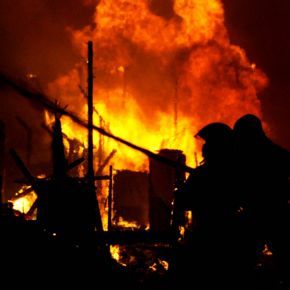
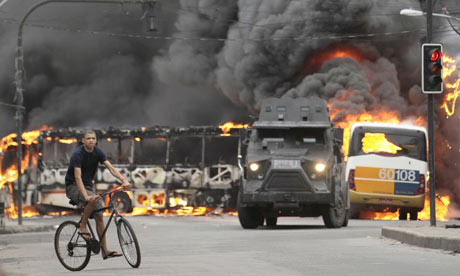
Bandidos in Rio shot down a police helicopter over the Zona Norte favela Morro dos Macacos after police apparently tried to intervene in a battle between two rival drug gangs--Amigos dos Amigos, which controlled the favela, and Comando Vermelho. (The picture here seems to show burnt out buses on the edge of the favela (hint: I don't know of any favelas that have traffic lights.) So far, authorities have said that 12 people have died.

The Guardian has details.


Two interesting facts:

1. "Hundreds of police officers descended on the area following the invasion" by the Comando Vermelho. This is significant because when I was in the favelas (eight years ago, which, I admit, in the fast changing world of the drug traffickers, can be considered ancient history), Amigos dos Amigos was known to be in cahoots with the cops. Indeed, a veteran police officer confirmed this to me. So no one should discount the possibility that the police were taking sides in this fight.

and

2. The drug gangs have "an increasingly sophisticated arsenal, including anti-aircraft guns and automatic rifles, often sourced from inventory intended for the Bolivian and Argentinian armies and smuggled into Rio." Isn't that a big story? These arms are undoubtedly stolen from official shipments. How can this be happening and isn't there a way for officials--including those in the U.S., which is most likely supplying the weaponry--to prevent it?

Thursday, October 15, 2009

the African National Congress vs. The People


Fresh from its victory in the Constitutional Court, Abahlali baseMjondolo now reports that five more of its leaders from the Kennedy Road community in Durban have been arrested. That makes 13 Abahlali members charged with crimes. Meanwhile, no one has been arrested or charged or even implicated in the recent violence that left 2 dead in Kennedy Road.

Now, an article in The Witness suggests a political motive in the attacks and arrests: the Kennedy Road group had pushed for new regulations reining in shebeens (informal bars), which have been open 24 hours a day in Kennedy Road. The community wants these places to close by 10. At the same time, local ANC leaders are irked by the political independence of Kennedy Road and Abahlali, which is a community organizing group and thus does not endorse candidates for office.

From the article:
The community’s new liquor regulations have angered local shebeen owners who found common cause with powerful ANC branch members who resent the loss of the powerful Kennedy vote bank. This is why the government immediately arrested eight members of Abahlali baseMjondolo a day or two after the attacks. This is why, this past weekend, they arrested another three members of the movement. This is why not a single shebeen owner or militia member has been arrested.


So it's a Nazi-style 'shebeen putsch' by the African National Congress in Kennedy Road.

Wednesday, October 14, 2009

SA Court overturns eviction statute!!!

Abahlali baseMjondolo has won a major legal victory: The Constitutional Court of South Africa has declared the KwaZulu-Natal Elimination and Prevention of Re-emergence of Slums Act illegal. The Act, cloaked as an attempt to moderate and mitigate bad housing conditions, actually made it easier for the government and owners to evict and eject squatters throughout the province.

You can read the court's judgment here, though oddly, the dissent comes before the controlling decision.

Tuesday, October 13, 2009

fire in SP favela leaves 1,000 homeless

An overnight blaze in a small favela called Diogo Pires, in the western zone of São Paulo, destroyed the entire community, the Associated Press reports.

There's more, in Portuguese, from Folha de São Paulo.

Thursday, October 08, 2009

'a profound disgrace to our democracy'

That's how Ruben Phillip, Anglican Bishop of Natal, characterized the violence against members of Abahlali baseMjondolo that left two people dead and a dozen injured. The Bishop made no bones about where blame lies: with local African National Congress cadres:
"The fact that the police have systematically failed to act against this militia while instead arresting the victims of their violence and destruction is cause for the gravest concern," he said, adding there were "credible claims that this militia has acted with the support of the local ANC structures. This, also, is cause for the most profound concern."
Religious Intelligence has more.

bahamas fire


A fire in 'The Mud,' a mostly Haitian shantytown in the Bahamas, has left 39 people homeless, The Tribune reports.

Backstory:
The Mud and neighbouring Haitian shanty town Pigeon Pea is thought to house around 3,000 Haitian migrants and Haitian Bahamians on an area of land opposite the main port in Marsh Harbour....
The settlements were established around 30 years ago and have been growing without any imposed health and safety regulations....
Many residents have legal status to live and work in the Bahamas....
Random raids orchestrated by the Immigration Department with support from the Royal Bahamas Defence Force attempt to crackdown on the illegal population, but have been shrouded in complaints of brutality....
Residents of the Mud claimed families were separated and residents were beaten, threatened and robbed by officers in the last large-scale raid in July.
This brings up an issue common throughout the world. Migrants, who arrive in a country as economic refugees, are unable to afford legal housing. Most of these people work. Quite a number of them are legal immigrants. But they are forced to live in precarious conditions for years. And then when the predictable fire breaks out, they often are the ones who get blamed.

homes of 400,000 people at stake

In the wake of the awful flooding two weeks ago that claimed 300 lives, a Philippine official has argued that 400,000 squatters must be relocated to make the city's drainage better. Agence France Presse has details.

Laguna Lake Development Authority chief Edgardo Manda told AFP, "I have made a strong recommendation to remove these people from the danger zones and not allow them to go back." He asserted that, "the authorities would probably need to erect barricades and station sentries in these areas."

Well, not if the politicians choose to work with the people to come up with appropriate solutions.

What's more, why are squatters the only ones asked to sacrifice. Consider: as the article notes, "chaotic urban planning, or no planning at all, exacerbated the crisis, particularly around Laguna where shantytowns, factories and housing developments have overtaken farms."

So what about the factories and housing developments? Is anyone proposing that they be evicted?

Wednesday, October 07, 2009

support Abahlali, support justice

Supporters of Abahlali baseMjondolo are circulating an important letter to South African President Jacob Zuma. It is designed to push for safety, security, democracy and an impartial investigation into the ethnic cleansing that took place last week in the Kennedy Road shack settlement.

You can read it and sign it here

Monday, October 05, 2009

a real view, maybe

Two Portuguese filmmakers have released a documentary about Complexo do Alemao, arguably the most notorious favela in Rio, The Latin American Herald Tribune reports.

"People have a stereotyped image of what a 'favela' is – they’re afraid of anything that comes from there, so our intention was just to eliminate the clichés and let people see the truth," moviemaker Mario Patrocinio said.

The film is scheduled to be released in early 2010, so we all will be able to judge for ourselves.

Friday, October 02, 2009

rights and wrongs

The metropolis of Accra seems poised to evict squatters in the communities of Sodom and Gomorrah and to push out the traders at Agbogbloshie market, the Joy newpspaer and Peace FM report.

Here's a doozie: while giving lip service to the human rights of squatters to live in better conditions, Alfred Okoe Vanderpuije, head of the Accra Metropolitan Assembly, told reporters that he is "in negotiations with the Electricity Company of Ghana, Ghana Water Company and other utility providers to halt the provision of their services to the slum."

So, in order to have them live better, he will cut off their water and electricity.

Let's call this two-faced approach what it is: duplicity.

Remember, this is the same politician who said in prior articles that there were plenty of vacant apartments that the squatters could rent in Accra.

The government is also pushing merchants at the local market further out of town, according to another article from Peace FM.

Wednesday, September 30, 2009

intimidation vs. organizing

A new video from Abahlali baseMjondolo documents the appalling violence in Kennedy Road and the uncommonly brave response of Abahlali's community leaders.

Tuesday, September 29, 2009

'we have been arrested, beaten, killed, jailed and made homeless'


Another amazingly eloquent statement from S'bu Zikode, President of Abahlali baseMjondolo. Despite having had his home and possessions wrecked and ransacked in the recent violence in Durban's Kennedy Road squatter community, Zikode sees the bigger picture. He has lost none of his humanity:

"The strength of the movement, the strength of those who are supposed to be weak and silent and powerless, is taken as a threat," he writes. "Our crime is a simple one. We are guilty of giving the poor the courage to organise the poor. We are guilty of trying to give ourselves human values. We are guilty of expressing our views.....We are calling for close and careful scrutiny into the nature of democracy in South Africa."

He signs his letter this way:
"Sibusiso Innocent Zikode
President of Abahlali baseMjondolo (and, consequently, political refugee)"

Monday, September 28, 2009

violence in Kennedy Road

Violence over the weekend in Durban's Kennedy Road shack settlement seems based on simmering resentments between Zulus, who dominate the community, and Xhosas, who are in the minority, South Africa's Daily News newspaper reports. Two people died, the News reported on Sunday

The squatter movement Abahlali baseMjondolo, which has long been active in Kennedy Road, reports that none of the perpetrators have been arrested or even detained, and asserts that the violence is continuing despite the presence of the police and ANC leaders. Apparently, one of the shacks that has been destroyed was home to S'bu Zikode, one of Abahlali's most vocal leaders.

Friday, September 25, 2009

a Kabul squatter community


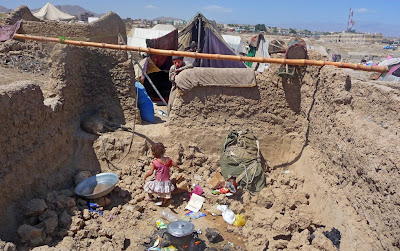
The Seattle Times visits a squatter community in Kabul. The back-story may be murky, but the truth is not: these are economic refugees, forced by the ravages of war, if not the violence itself, to leave their homes and come to Kabul, where at least they have a hope of survival.

Tuesday, September 22, 2009

a toxic scandal

In 1984, the Chilean government allowed processing company PROMEL to dump 21,000 tons of Swedish toxic waste near the city of Arica, in the far north of the country. Later, the government allowed shantytowns to be built almost directly on top of the waste.

LA NACIÓN (via The Santiago Times) reports that residents "were then plagued by a wide range of ailments, including arthritis, cancer and impotence. There was no explanation from the government until health authorities acknowledged the problem in 1998 and cleaned up much of the area’s waste. The government then declared the area contamination-free, although it failed to acknowledge the extent of the harm done to local residents by not disclosing results blood tests."

Now the Chilean government will relocated 1,800 families--but only homeowners will get benefits. And local residents say the government's relocation plan ignores 8,000 others who live in neighboring shantytowns.

The government estimates that the clean-up and relocation will eventually cost about US$600,000 per family. That's alot of money (the article suggests that it amounts to the largest residential relocation in Chile's history), but I wonder how much of that money is really going to the residents, and how much to the companies that are doing the environmental remediation.

ten thousand to be evicted

Ten thousand squatters occupying land near the airport in Monrovia, the capital of Liberia face eviction on October 1st, the Daily Observer reports.

"Most of us here came during the war and have absolutely no hope elsewhere. If we get abruptly removed from here, where do we go?" squatter leader Garmonyu W. Boe told the paper. "We cannot even afford to rent a room here in Monrovia since a single bedroom costs at least US$10. This is an amount that most of us cannot afford."

"There are no evacuation options from Government’s end. These people need to go to where they came from," Richlieu Williams, Director General of the Liberia Civil Aviation Authority, responded.

Friday, September 18, 2009

Bullets over Brazil


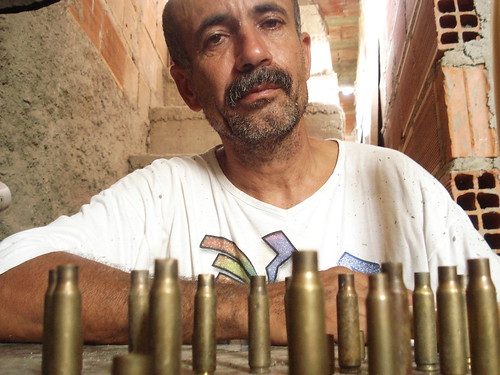
A fierce and impassioned take on the gun violence that plagues Rio's favelas, courtesy of Open Democracy. Refreshingly free of cant and nonsense. The article quotes a former Military Police leader acknowledging that the police are themselves involved in weapons trafficking.

And some observers feel that a culture of normal violence has been created.
"Arms no longer provoke fear in a population that is so used to bullets and the sound of gunfire," says peace activist Leonardo Pimentel from Jacarezinho favela, a few miles down the road. "Things you used to only see in Haiti, Gaza Strip or Iraq you see here now. There's a naturalisation of the presence of arms. When I was young every kid's dream was to be a police officer," he continues. "In the mind of young kids today the police are the enemy, because they killed their brother, their friend, their uncle. Their dream is to kill a police officer."


And there's this acknowledgement of the class-bound nature of the concern over violence:

William Alencar is a resident of the Favela do Timbau in the huge Maré complex. He is also a sociology graduate from Rio's prestigious Catholic University (PUC), where he studied on scholarship, and now works as a teacher. He illustrates the intersection between poverty and insecurity with the following example from his own life. "When I was an adolescent I was in a football team. Out of 15 people that were involved, 10 have since died. Out of the remaining five, I'm the only one to have studied at university. Violence itself hasn't increased [since then]," he believes. "Since the 1980s we have stories of violence. It's just that now there are heavier arms available and now violence has spread throughout the city. While the violence was within a space that wasn't affecting the Brazilian elite, that was fine. But when it started to arrive in the big streets, in the asfalto [asphalt - a synecdoche commonly used to refer to any urban areas outside the favelas], the [middle classes] started to get concerned."

slum clearance?


The UN has broken ground on its Kibera 'upgrade,' the BBC reports.

I know they say they're relocating people into new housing that will cost $10 (747 Kenyan shillings.) And I know the photo of the relocation housing looks basic but OK.

Still, the BBC doesn't say how far away the relocation housing is, and whether it is subsidized and for how long it will be subsidized, and whether it will make it more difficult for people to commute to their jobs.

Every time I see a bulldozer smashing into someone's home, I get a sinking feeling. What will become of the land in Kibera that the people are being asked to vacate?

(see also a related story here)

UPDATE: The Daily Nation has a somewhat more complete story about the start of relocation in Kibera. For instance, it notes that this is a pilot program of just 600 apartments, built at a cost of 500 million Kenyan shillings--or almost $7 million. That's $11,000 per unit.

Thursday, September 17, 2009

squatters invest in infrastructure

In Suva, the capital of Fiji, where one in five residents is a squatter, shantytown residents banded together to pave an important road. Radio New Zealand has details.

Wednesday, September 16, 2009

More 'Let them eat cake!' in Ghana

King Tackie Tawiah III, one of the traditional rulers of downtown Accra, is in favor of evicting squatters from Sodom and Gomorrah. That's the news from the Daily Guide. "Let the government take the boldness of steps in ensuring that Sodom and Gomorrah is rid of the squatters," he told the newspaper.