Thursday, January 21, 2010

Black Thursday


That's the day the big classified newspaper in Paris comes out with all the housing ads, and it's a horrible day for apartment seekers. The squatter group Jeudi Noir has now occupied #1 Place des Vosges. The Guardian calls it "a luxurious Parisian address which once housed Madame de Sévigné and Isadora Duncan." Jeudi Noir reports that the building has been empty for 44 years.

The Guardian's Jessica Reed writes: "It might be hard to immediately sympathise with squatters – the right to own property runs so deep in modern western society that anything challenging the status quo is bound to make waves. I would, however, question the intentions and principles of those willing to let their own buildings decay uninhabited for 40 years while homeless people die every winter from exposure. How to rationalise that? I struggle to find any excuse for leaving the most impoverished section of the population out in the cold, when buildings go unused and unlet for very long periods of time."

Four decades? Zut alors, it's about time someone took it over.

Cité Soleil


The Independent offers a clear-eyed view of the situation in the notorious Port-au-Prince shantytown.
"We don't have doctors, we don't have food, we don't have water," said Louis Jean Jaris, a 29-year-old resident. "The aid comes to Haiti, but it goes elsewhere. In Cité Soleil we are all victims, just like everyone else, but compared to the rest of the country, we are a low priority. To the people in power, we are not considered to be victims."

Black Hawk helicopters were thundering overhead yesterday, taking aid from the airport to desperate survivors. But the shanty town does not have an official food aid distribution post, and only one small water truck was to be found on the streets, surrounded by a fractious crowd.

Small amounts of supplies are of course available, to those who have money. But Cité Soleil's biggest employer, a garment factory, has yet to reopen, and most locals are instead forced to walk miles into central Port-au-Prince in search of handouts. So far, the dysfunctional international aid effort means they are very lucky to find any.
One significant thing the article doesn't say: whether Cité Soleil experienced much destruction due to the quake. There's no doubt that the people there are victims, just like everyone else, but I wonder if the smaller-scale structures of the squatter community were extensively damaged.

Thursday, January 07, 2010

can solar help squatters?


The Times of London thinks so.

It's an appealing idea: The NGO SolarAid has organized a program to bring solar panels and bulbs to Kibera, a community where most people have no electricity, and those that do have illegal hookups that short out regularly and barely power a feeble bulb.

A few caveats and thoughts:

1. cost: "the panels and attachments were sourced in Switzerland, where a well-wisher subsidised them to bring the price down."

2. Though it's not clear whether this is with the subsidy or without, "they cost about 2,500 shillings," which, according to the article, is the cost of about five months worth of kerosene. That works out to be $33, which is a huge amount for most people in Kibera. After all, Josephine Anangwe, the mother who is mentioned at the beginning of the article, survives on her husband's 750 shillings-a-week salary. So it would take 1/4 to 1/3 one month of her family's yearly earnings to buy the solar set-up. This is similar to what I discovered about stoves when I was living in Kibera. I bought a set-up offered at the local Total/Fina gas station--$50 for a small stove and a bottle of gas. That single gas bottle lasted me almost three months. Over the course of a year, the gas bottles would be cheaper than charcoal and kerosene, which most people used to light fires for cooking. But few in Kibera had $50 to pay for the stove. So they continued to cook with charcoal and kerosene. And this arrangement made me wonder: the tiny burner and gas bottle that I used when I lived in a gecekondu community in Turkey cost $8. Why was Kenya six times more expensive?

3. Though I have no idea if this is true, one commenter pointed out that kerosene fumes, though toxic, serve as a mosquito repellent and thus help reduce the prevalence of malaria & dengue and other insect-borne ailments.

4. A communal charger--perhaps available at a church or through a merry-go-round (a group of women who pool money)--might be a way to bring down the cost for a family.

Wednesday, January 06, 2010

evicted in Madrid


Police in the Spanish capital have moved against El Patio Maravillas, a building which has been occupied by squatters since 2007, Typically Spanish reports.

A similar action last year failed because of public resistance. What accounts for the difference this year, I don't know.

The squat apparently was a popular and busy cultural center, but people who lived nearby on Calle del Acuerdo in the university neighborhood called Malasaña routinely complained about noise.

Organizers of the squat have vowed on their website (in Spanish) to continue their organizing activities.

Thursday, December 24, 2009

fire in Sodom & Gomorrah


The Accra squatter community known as Sodom & Gomorrah has had its fourth fire of the year. This one claimed 2,000 structures, but no lives, Joy Online reports.

The squatters "had difficulty accessing water to bring the fire under control, because some of the [water] pipelines had been disconnected because they had been illegally connected," the article reports.

This, of course, is a form of official discrimination against these communities. Don't provide water and don't allow illegal connections to function either. This policy marks a war of attrition against squatters.

Sunday, December 13, 2009

a bridge too far

The Times of India asks if the 100-year-old Reay Road bridge, which was manufactured in the UK and assembled on-site in Mumbai, needs restoration.

The paper states, "Once the solid brick extensions and black plastic sheets covering the structure are removed, the bridge will seem more striking than the common wall of stone it appears to be."

Of course, for more than a generation, the bridge has also been home to hundreds of families. The Times of India calls it "a squatter's paradise."

But there is a history here. "My mother was born and raised on this bridge and now I am married into a family living here as well," one resident tells the paper. It may not be ideal to live in a makeshift shelter on a bridge, but you can't just trash homes people have lived in for generations in the name of historic preservation.

Monday, December 07, 2009

A new home in 1,178 years

That's how long it will take for all the residents of Kibera to receive new apartments in the current upgrading scheme if it continues at its current pace, Coastweek reports.

The article, by a reporter for the InterPress Service, also notes that the homes being built are actually shared apartments: two families sharing each two-bedroom apartment.

The article offers a sensitive portrayal of the complicated passions and position of the Nubians, Kibera's original residents, who have voiced some of the most vocal resistance to the UN's so-called upgrading project.

The Nubians were originally from North Africa and were conscripted into service in the British colonial armed forces. Ultimately settled in this valley on what was then the outskirts of Nairobi, documentary evidence suggests that the British government promised them title to at least some of the land on which they were living.

From the article:

The Nubian community has resisted moving into the new apartments and instead vowed to stay put in the informal structures until government gives them adequate compensation; the community is the most well-established in Kibera, with many families renting accommodation to other residents.

The Nubian community says they have never been consulted about the upgrade.

Yusuf Diab, secretary general of the Nubian Council of Elders, argues that the government and donors came into their community with a "know-it-all" approach and assumed all residents of Kibera live on less than a dollar a day and will eternally depend on handouts.

"We may live in this informal structures but that does not mean we do not have finances. We as a community stick to our culture of generations living together in one house. But this does not mean we are poor.

"If you come into our homes we have all the facilities that affluent people have and despite being informal we have enough room to accommodate our large families," he says.

He wonders how a household of up to five generations is expected to reside in one room sharing the toilet, bathroom and kitchen area with another family.

"This plan would turn us into government tenants for the rest of our lives."

Saturday, December 05, 2009

'from the inside'

Squatters in Buenos Aires have started their own newspaper, Inter Press Service reports. Desde Adentro (From the Inside) is written by residents of the community called Villa 1-11-14. Agustín Garone, one of the writer/editors, told IPS that the intent is to "generate an image that contrasts with the labels put on us by the big media outlets, which associate poverty with crime, and thus only generate negative views of the neighbourhood." Buenos Aires is a city of 13 million, and right now the paper has a tiny print run of just 3,000.

It's a great idea, and very necessary, even if they are starting small.

One caveat, though: IPS reports that Desde Adentro is financed by the Buenos Aires city government. So how independent can it be?

refugee camps are no refuge

There are now 160,000 Africans living in Yemen, the United Nations Reports. Awdal News Network has the story of the semi-permanent camps the UN runs outside of Yemeni cities. Many refugees report being told to leave the camps and go to the cities.

Yet life in the city is full of despair. "Refugees say they face constant discrimination. Abi Abyah al-Manah, an Ethiopian refugee who heads the Mandated Refugee Association in the capital San'a says Africans are subjected to arbitrary arrests, violence, sexual violence and extortion by the authorities and the local people."

Just say no in Rio

From Rio de Janeiro, two distressing tales:

1. Crack is expanding its hold, The Final Call reports. Shocking fact: "The amount of crack seized by the police this year in Rio was six times the total confiscated in 2008."

2. But here's what not to do about it: hire Rudy Giuliani. Brazzil reports that the Rio city and state governments are bringing in the former NYC mayor as a security consultant. Giuliani was wrongly given full credit for reducing crime in NYC. The biggest factors in the reduced crime rate, actually, were the disappearance of crack (this started before Giuliani took office) and the resurgence of immigration, which had dropped precipitously during the 70s and recovered only modestly in the 80s. A million new New Yorkers arrived in the 1990s, bringing their energy and a newfound stability to many previously dangerous neighborhoods.

Thursday, December 03, 2009

make 'em pay taxes

New Mumbai Mayor Shraddha Jadhav wants squatters and street hawkers to pay taxes, the Indian Express reports.

After winning the Mayoralty, Jadhav issued a press release that said, "All unauthorised industries, small business, slumdwellers and hawkers who are doing business or staying illegally should be made to pay taxes. A policy should be in place and this will also help the BMC [Brihan Mumbai Corporation, the official name of the municipality] raise its revenue"

It doesn't appear that the Mayor, who is a member of the Hindu nationalist Shiv Sena party, has an actual proposal to present to the council. And she certainly hasn't understood that if she expects squatters and vendors to pay taxes, they will understandably expect benefits from her government, rather than the harassment and demolition drives that have been the hallmark of previous administrations' policies.

Monday, November 30, 2009

NYC foreclosures

The Daily News highlights the situation in South Jamaica, where subprime loans and subsequent foreclosures have had harsh consequences on many streets.

The article's terminology is a bit misleading, though: most of the people quoted are not really squatters. They were renting the homes when the owners hit financial trouble and, essentially, abandoned the properties. So they are not squatters. They are tenants. And there ought to be a law that, when owners abandon a property, the tenants get the opportunity to keep the electricity on--because burning candles and kerosene lamps can lead to fires. If the owners walk away from the properties, the banks should also make an effort to keep the services on for the tenants who are left in dire conditions through no fault of their own.

Monday, November 23, 2009

denial in Delhi

Rather than do anything to improve the lives of squatters and street hawkers, the Mayor of the Indian capital wants to force them to get "bio-metric, bio-cryptic photo identity cards" and proposes to charge them 400 rupees--or almost $9 each--for the privilege.

Saturday, November 14, 2009

Manila eviction

780,000 squatters will soon lose their homes in the Philippine capital, Manila Standard Today reports.

There definitely need to be some changes to avoid more deaths due to flooding. But where will the city put these people? Don't they have rights? Shouldn't the city be working with them to find appropriate solutions?

Jakarta's Housing Shortfall


Jakarta needs about 70,000 housing units every year to cater to its growing population, but the city administration is only able to provide 20 percent of that figure. That's one of the facts contained in this worthy article from The Jakarta Globe.

'Soweto' in Rome


Ponte Mammolo is a mostly Eritrean shantytown in the center of Rome. SF Bay View has the details, including a short youtube clip.

Check out this horrific detail: in order to avoid detection and deportation if they are arrested, these immigrants often try to remove their fingerprints so they cannot be identified:
There are three ways commonly used to remove fingerprints. Refugees burn their own fingerprints and palm prints with a lit cigarette. This painstaking and slow process can take several hours. It leaves their fingers and hands in constant pain and unusable. Soon blisters appear and infection can spread.

Another method used by many refugees is to place their hands directly over a gas, charcoal or electric stove or immerse them in scalding water to remove their fingerprints and palm prints. This is no less painful than using a lit cigarette.

The third process requires rub sandpaper against their skin. It may seem comparatively less painful, but not so. Two or three days of rubbing their fingers and palms with sand paper to entirely remove the top skin leaves their hands raw and bloody.

Sunday, November 01, 2009

Going Dutch

The Netherlands seems poised to demolish the 1970s law that made squatting legal so long as a building had been vacant for a year.
'On Thursday, a parliamentary majority consisting of centre-right parties voted in support of the so-called Squatting Ban, a bill drafted by Christian Democrat MP Jan ten Hoopen. Housing Minister Eberhard van der Laan has already let it be known that he will not stand in the way of the bill. While not a fervent advocate of the ban, he regards non-occupancy as "an issue that's too important to be left to the squatters".'

Radio Netherlands Worldwide
has the sad details.

Saturday, October 17, 2009

air war in the favelas


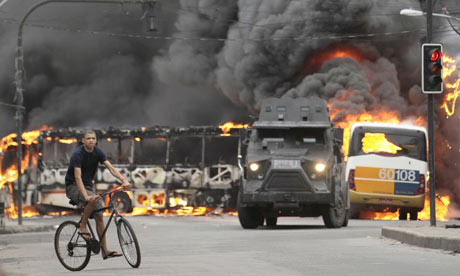
Bandidos in Rio shot down a police helicopter over the Zona Norte favela Morro dos Macacos after police apparently tried to intervene in a battle between two rival drug gangs--Amigos dos Amigos, which controlled the favela, and Comando Vermelho. (The picture here seems to show burnt out buses on the edge of the favela (hint: I don't know of any favelas that have traffic lights.) So far, authorities have said that 12 people have died.

The Guardian has details.


Two interesting facts:

1. "Hundreds of police officers descended on the area following the invasion" by the Comando Vermelho. This is significant because when I was in the favelas (eight years ago, which, I admit, in the fast changing world of the drug traffickers, can be considered ancient history), Amigos dos Amigos was known to be in cahoots with the cops. Indeed, a veteran police officer confirmed this to me. So no one should discount the possibility that the police were taking sides in this fight.

and

2. The drug gangs have "an increasingly sophisticated arsenal, including anti-aircraft guns and automatic rifles, often sourced from inventory intended for the Bolivian and Argentinian armies and smuggled into Rio." Isn't that a big story? These arms are undoubtedly stolen from official shipments. How can this be happening and isn't there a way for officials--including those in the U.S., which is most likely supplying the weaponry--to prevent it?

Thursday, October 15, 2009

the African National Congress vs. The People


Fresh from its victory in the Constitutional Court, Abahlali baseMjondolo now reports that five more of its leaders from the Kennedy Road community in Durban have been arrested. That makes 13 Abahlali members charged with crimes. Meanwhile, no one has been arrested or charged or even implicated in the recent violence that left 2 dead in Kennedy Road.

Now, an article in The Witness suggests a political motive in the attacks and arrests: the Kennedy Road group had pushed for new regulations reining in shebeens (informal bars), which have been open 24 hours a day in Kennedy Road. The community wants these places to close by 10. At the same time, local ANC leaders are irked by the political independence of Kennedy Road and Abahlali, which is a community organizing group and thus does not endorse candidates for office.

From the article:
The community’s new liquor regulations have angered local shebeen owners who found common cause with powerful ANC branch members who resent the loss of the powerful Kennedy vote bank. This is why the government immediately arrested eight members of Abahlali baseMjondolo a day or two after the attacks. This is why, this past weekend, they arrested another three members of the movement. This is why not a single shebeen owner or militia member has been arrested.


So it's a Nazi-style 'shebeen putsch' by the African National Congress in Kennedy Road.

Wednesday, October 14, 2009

SA Court overturns eviction statute!!!

Abahlali baseMjondolo has won a major legal victory: The Constitutional Court of South Africa has declared the KwaZulu-Natal Elimination and Prevention of Re-emergence of Slums Act illegal. The Act, cloaked as an attempt to moderate and mitigate bad housing conditions, actually made it easier for the government and owners to evict and eject squatters throughout the province.

You can read the court's judgment here, though oddly, the dissent comes before the controlling decision.