The death toll from the rolling monsoon waters in Maharastra -- the heaviest rains in a century, according to official statements, has reached 700, rediff.com reports. And read how 18 squatters died due to the mistaken rumor of a tsunami approaching Mumbai.
It's time for the city to get serious about sewers and drainage.
Friday, July 29, 2005


Thursday, July 28, 2005
Monsoon Update
Strong rains can be deadly, as squatters in India found this week. As this AP dispatch on Yahoo! notes, two days of fierce downpours (37.1 inches of rain in one day) have caused landslides and killed more than 500 people in Maharastra state. Now, false rumors of bursting dams have claimed several more lives in a squatter area on the outskirts of the city.
Here's a roundup of monsoon damage from the Times of India. And here's a column from the tabloid Midday.
Here's a roundup of monsoon damage from the Times of India. And here's a column from the tabloid Midday.
Wednesday, July 27, 2005
Mumbai Out of Bounds for Workers, Slum Dwellers -- But Politicians Cash In
Despite a six-month respite in Mumbai's drive to demolish squatter neighborhoods, the Inter Press Service News Agency points out that gentrification continues apace as the city's former textile mills have been sold off at astoundingly high prices. "Last week, the new, unabashedly pro-rich, approach was confirmed when a chunk of 243 hectares of prime property owned by defunct textile mills was sold to the very politicians who had made their careers opposing such sales," reporter Sandhya Srinivasan wrote. The article provided no documentation that politicos are involved in the land grab, but other reports (see sify.com) noted that one property, Kohinoor Mill, was bought by a concern promoted by Manohar Joshi., a leader of the Shiv Sena, the political party that ruled Mumbai until last year.
Zimbabwe Police Resume Drive to Raze Slums
Despite a serious verbal strafing from a UN envoy and a commitment from UN Secretary General Kofi Annan to visit the country,The New York Times reports that Zimbabwe has resumed its efforts to crush squatter homes in and around the capital. Here's an Associated Press dispatch, along with several other articles questioning Zimbabwean strongman Robert Mugabe, courtesy of zimbabwesituation.com.
Tuesday, July 26, 2005
A false raid on Rocinha?
Xico Vargas, a writer for the web site no minimo, suggests (in Portuguese) that the recent police raid and shootout with drug dealers in Rocinha was a charade. Citing the plethora of equipment, including armored cars, motorcycles, helicopters, not to mention 1,000 police on foot, he claims that if the authorities were serious about capturing the drug lord known as Bem-Te-Vi they would have. Indeed, he says, Bem-Te-Vi and his partner Soul were drinking whiskey and beer in the Valao (a neighborhood of Rocinha) while the police made sure to have their shootout "a secure distance away." He calls the police action "a grand choreography" staged for the newspapers and TV cameras.
(Thanks to Gabriel Ponce de Leon, who is always hip to all interpretations, for sending me this clip.)
(Thanks to Gabriel Ponce de Leon, who is always hip to all interpretations, for sending me this clip.)
Truth Telling on Zimbabwe
The New York Times editorializes on Zimbabwe demolitions and also reports that UN Secretary General Kofi Annan will visit Zimbabwe to personally view the devastated communities and converse with Zimbabwean President Robert Mugabe.
Monday, July 25, 2005
Mugabe fiddles, Zimbabweans burn
The Toronto Star offers an article on the demolitions in Zimbabwe. The reporter found this quote from the country's information minister, George Charamba, in the magazine New Africa: "What Zimbabwe has sought to do is remarkably mundane to a point of not being newsworthy. Clearance of slums is an abiding feature and dynamic of urban settlement, in fact as mundane as the appearance of slums themselves."
Lovely: The fact that 700,000 people have been made homeless and five to 15 percent of the economy destroyed by government decree is humdrum stuff.
In other matters, UN envoy Anna Tibaijuka's report on Zimbabwe is now available in a pdf version here.
Here's one of her key findings: "the Government clearly violated its own national laws and the constitutional rights of its people, and that those responsible must be brought to account...it remains the strong recommendation of the Special Envoy that the culprits who have caused this man-made disaster are best handled and brought to book under Zimbabwean national laws." And also: "evictions took place before alternatives could be provided, thereby violating human rights and several provisions of national and international law." Strong words from the usually circumspect UN.
Another interesting observation in the report: one-third of the people evicted are immigrants who never became citizens of Zimbabwe. Instead, they are long time residents who came to Zimbabwe from neighboring countries seeking work. Tibaijuka recommends that these people immediately be made citizens and given rights.
Oddly, though most observers (and most newspapers) translate Zimbabwe's Operation Murambatsvina as "Operation Drive Out Trash," the UN doesn't. Tibaijuka instead prefers "Operation Restore Order." Does anyone know the reason for this discrepancy?
Lovely: The fact that 700,000 people have been made homeless and five to 15 percent of the economy destroyed by government decree is humdrum stuff.
In other matters, UN envoy Anna Tibaijuka's report on Zimbabwe is now available in a pdf version here.
Here's one of her key findings: "the Government clearly violated its own national laws and the constitutional rights of its people, and that those responsible must be brought to account...it remains the strong recommendation of the Special Envoy that the culprits who have caused this man-made disaster are best handled and brought to book under Zimbabwean national laws." And also: "evictions took place before alternatives could be provided, thereby violating human rights and several provisions of national and international law." Strong words from the usually circumspect UN.
Another interesting observation in the report: one-third of the people evicted are immigrants who never became citizens of Zimbabwe. Instead, they are long time residents who came to Zimbabwe from neighboring countries seeking work. Tibaijuka recommends that these people immediately be made citizens and given rights.
Oddly, though most observers (and most newspapers) translate Zimbabwe's Operation Murambatsvina as "Operation Drive Out Trash," the UN doesn't. Tibaijuka instead prefers "Operation Restore Order." Does anyone know the reason for this discrepancy?
Sunday, July 24, 2005
Bidonvilles
A while back I was interviewed by a Philippe de Rougemont, a reporter for Switzerland's Datas news agency. His article appeared in Switzerland and is now available (in French for all you francophones) on the web at the datas news agency's site.
More on what to do in Zimbabwe
The Zimbabwe government has asked South Africa for $1 billion to stave off economic collapse, according to this article from South Africa's Sunday Times via allAfrica.com. South African President Thabo Mbeki has till now refrained from criticizing Zimbabwe's Robert Mugabe. But, in the wake of the UN's conclusion that Zimbabwe's drive against squatters created "a man-made disaster," Mbeki may have to take a stance.
In another development, the article cites an International Monetary Fund spokesman as suggesting that Zimbabwe could be kicked out of the Fund because it has fallen massively behind on its loan payments.
In another development, the article cites an International Monetary Fund spokesman as suggesting that Zimbabwe could be kicked out of the Fund because it has fallen massively behind on its loan payments.
Saturday, July 23, 2005
Returning Home to Rubble
"I am sitting like a butterfly or like a bird that stays in the tree. No house, no seat." So says Gertrude Musaruro, who lost her home in Zimbabwe's ruthless drive against squatters and is now sleeping on the ruins of what she used to call home, in thisWashington Post article.
In the former squatter community of Porta Farm (itself a relocation camp of people evicted from Harare more than a decade ago for Queen Elizabeth's visit to Zimbabwe), new temporary building-types are emerging: "Old pieces of thatch roof and rusty scraps of sheet metal were fashioned into tiny houses. One 15-year-old girl sewed plastic lime bags into a tent that fit over a frame of branches."
Squatters are incredibly determined and resourceful. Though their houses may look precarious and may lack basic public amenities, squatters treasure their abodes and communities as much as any legal occupant. The squatters will rise up and build, over and over, even facing brutal government opposition. Come to think of it, that's a pretty decent definition of courage and patriotism.
In the former squatter community of Porta Farm (itself a relocation camp of people evicted from Harare more than a decade ago for Queen Elizabeth's visit to Zimbabwe), new temporary building-types are emerging: "Old pieces of thatch roof and rusty scraps of sheet metal were fashioned into tiny houses. One 15-year-old girl sewed plastic lime bags into a tent that fit over a frame of branches."
Squatters are incredibly determined and resourceful. Though their houses may look precarious and may lack basic public amenities, squatters treasure their abodes and communities as much as any legal occupant. The squatters will rise up and build, over and over, even facing brutal government opposition. Come to think of it, that's a pretty decent definition of courage and patriotism.
Friday, July 22, 2005
Zimbabwe Showed 'Indifference to Human Suffering,' UN Envoy Says
UN Habitat head Anna Tibaijuka calls upon the Mugabe government to stop demolishing homes and to pay reparations to those who have lost their homes, according to this dispatch from allAfrica.com (you can read a BBC dispatchhere.)
Tibaijuka said Zimbabwe's pledge to provide land for the displaced was not feasible given the country's current economic condition, particularly as it assumes that local governments will provide access roads, highway infrastructure and basic services to enable displaced people to build new homes.
The toll of the Zimbabwe government's action: 700,000 people evicted; 2.4 million impacted.
Though the UN's bureaucratic language can seem repressed, the report moved Kofi Annan to say that Zimbabwe had done "a catastrophic injustice" to its poorest citizens. Strong words from the UN Secretary General.
Even with this damning report, there's a question hanging out there for all who care about housing and civil rights: Now what?
Tibaijuka said Zimbabwe's pledge to provide land for the displaced was not feasible given the country's current economic condition, particularly as it assumes that local governments will provide access roads, highway infrastructure and basic services to enable displaced people to build new homes.
The toll of the Zimbabwe government's action: 700,000 people evicted; 2.4 million impacted.
Though the UN's bureaucratic language can seem repressed, the report moved Kofi Annan to say that Zimbabwe had done "a catastrophic injustice" to its poorest citizens. Strong words from the UN Secretary General.
Even with this damning report, there's a question hanging out there for all who care about housing and civil rights: Now what?
Thursday, July 21, 2005
Shootout in Rocinha, protesting residents block traffic on the nearby expressway
The Viva Favela website reports (in Portuguese) on a shootout last Friday between cops and drug traffickers in Rocinha. Apparently, the military police invaded the favela because they wanted to interrupt the birthday celebration of the chief of trafficking, Erismar Rodrigues Moreira (known on the street as Bem-Te-Vi.) One resident was shot in the leg in the 3-hour standoff. The war between traffickers and the police in Rocinha has claimed five lives. This time around, some Rocinha residents blocked a nearby highway tunnel in protest against the violence. The community was set to have a meeting about the violence today. I'll try to post more when I know more.
Tuesday, July 19, 2005

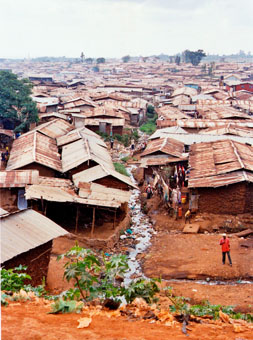
The sprawling squatter city of Sultanbeyli, on the outskirts of Istanbul. Sultanbeyli is an independent squatter metropolis. Though no one owns, the city has a popularly elected government (yes, a squatter mayor in the 7 story squatter City Hall!) and a massive bureaucracy providing public works and other city services.


Sunday, July 17, 2005
The cities of tomorrow are the squatter cities
I'm very sorry to have taken a week off, but I was attending the TEDGlobal conference in Oxford, England (I know, I know: it's not impossible to post things from overseas....but, hey, I needed a break.)
Here's a BBC NEWS dispatch about my presentation and a few others on urbanism at the conference. And here's how to find out about TED.
I'll post some photos and new political info about squatters early this week.
Here's a BBC NEWS dispatch about my presentation and a few others on urbanism at the conference. And here's how to find out about TED.
I'll post some photos and new political info about squatters early this week.
Saturday, July 09, 2005
Zimbabwe: World Anger Mounts
Will it make a difference? This story from Zimbabwe's Financial Gazette notes that even usually moribund bodies like the African Union are troubled by Robert Mugabe's decision to drive out urban squatters. Outside of Africa, New Zealand's Foreign Minister called Zimbabwe a "rogue" state as is talking about tough sanctions.
The article leaves one key item until the 2nd last graf: the $3 trillion investment in housing the government says its poised to make? It's unbudgeted.
Doesn't that just make you feel better.
The article leaves one key item until the 2nd last graf: the $3 trillion investment in housing the government says its poised to make? It's unbudgeted.
Doesn't that just make you feel better.
Friday, July 08, 2005
A way forward in Bangkok
Several Thai squatter communities are designing, funding, and managing their own improvements, according to this report from the United Nations.
A new level of chutzpah
A Zimbabwean official tells an international housing seminar that his country has invested 3 trillion dollars in the relocation of the squatters whose comes have been destroyed. The demolition, he insists, was part of the country's housing plan. Sometimes it's just hard to keep a straight face when reading things.
Subscribe to:
Posts (Atom)

 Posts
Posts