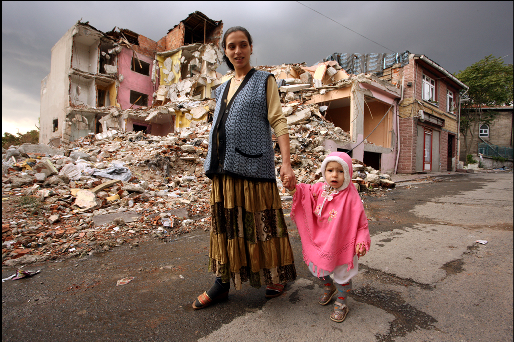
A 17-year-old girl was shot dead by the police at a demonstration by Cato Manor squatters in Durban, South Africa. The Daily Maverick has the tragic story of the death of Nqobile Nzuza.
The squatters suggest that it was outright murder. The police contend they felt their lives were in danger and shot into the crowd. Either way, there's no defense for shooting people exercising their constitiutional rights.
According to the police, the officers involved used "necessary force." KwaZulu-Natal Provincial Commissioner Lieutenant General Mmamonnye Ngobeni said, "We acknowledge and respect that the public has a constitution right
to demonstrate but the police also has a constitutional mandate to
maintain law and order. Violent protests are not acceptable and the
police has responsibility to protect property and lives during these
violent protests."
Apparently, the police in Durban think this gives them a license to kill the poor.
For more background on the awful history of violence on the part of the authorities in Durban and the ongoing dirty war being waged against the courageous squatter organizing group Abahlali baseMjondolo, read this article.
Tuesday, October 01, 2013
Wednesday, August 07, 2013
proud of being a squatter
“What we all want is to live with dignity. This means for me to able to be proud of who I am – a slum dweller.”
Those are the words of Bright Dzila, a resident of Old Fadama, the largest shantytown in Accra.
Think Africa Press offers a sympathetic account of the decade-long fight this neighborhood of 80,000 people alongside the Odaw River and the Korle Lagoon has been waging to stave off eviction and be allowed to live in freedom and dignity.
Tuesday, July 02, 2013
tons of money, but who benefits?
China has allocated $5.73 billion for upgrading shantytown neighborhoods this year, China Daily reports. For some perspective, that's more than ten times the yearly budget of UN-Habitat.
Of course, if the past is any indication, China will probably use the money for demolition, destroying longstanding communities to make way for luxury highrises.
Saturday, June 22, 2013
the World Cup runneth over
The Guardian offers a view of the Brazilian street demonstrations from Fortaleza, capital of the northeastern state of Ceará and, according to the United Nations, the 5th most unequal city in the world.
Money quote:
For Forteleza's poor, the World Cup has meant changes including the forced removal of 5,000 people from communities Lagoa da Zeza and Vila Cazumba to areas without schools, and fears that the tournament will increase exploitation of children in a city that has been trying to shake off its reputation for sex tourism.
Money stat:
While 133,000 people in Fortaleza live in extreme poverty, 1/3 of them without any sanitation services, the city spent $230 million to renovate the local soccer stadium.
Money quote:
For Forteleza's poor, the World Cup has meant changes including the forced removal of 5,000 people from communities Lagoa da Zeza and Vila Cazumba to areas without schools, and fears that the tournament will increase exploitation of children in a city that has been trying to shake off its reputation for sex tourism.
Money stat:
While 133,000 people in Fortaleza live in extreme poverty, 1/3 of them without any sanitation services, the city spent $230 million to renovate the local soccer stadium.
Thursday, June 20, 2013
squatter water torture
Let's hope that Bangladesh follows through on this promise to bring water pipes to every Dhaka shantytown and squatter community in the next two years. As I said in a recent talk at TEDx Hamburg (not online yet, but it will be soon): if government's won't provide water, it's socially good for squatters to steal it. Two million people a year die of water borne diseases--and, whether squatters steal municipal water or government brings it, providing potable water to neighborhoods that have previously been denied it could save hundreds of thousands of lives.
Monday, June 03, 2013
Istanbul at war with itself
| what passes for redevelopment, Sulukule, Istanbul, 2009 |
This factoid was buried in a New York Times article about the Taksim Square protests in Istanbul.
For years, the government of Tayyip Erdogan has taken an oddly punitive attitude towards poor neighborhoods. They were part of his power base, but also areas that politicians selected for eviction and what was very loosely called redevelopment. Roma neighborhoods like Sulukule, Avcilar and Tarlabasi were among those in the cross hairs.
By 2009, 12,000 people had been forcibly removed from their homes -- but millions more were threatened as city officials proposed to 'rebuild' more than a million homes.
The government's methods were questionable, as the New York Times article suggests: As one Avcilar merchant told the paper, “One day we just got a notice, and bam, before we could put up a proper fight, 300 to 400 police came and held us back from intervening with the bulldozers that knocked down our restaurant. They said we didn’t have deeds for the property, but we do. We showed them. They argued that we only had a deed for part of the property, so they knocked the rest down.”
Of course, the majority of title deeds in Turkey are partial -- conveying what is called hisseli tapu, an ill-defined right to a shared interest in a parcel. By this standard, almost every neighborhood in Istanbul could be considered at risk of eviction and demolition.
Up until now, the Erdogan demolitions have succeeded because they destroyed neighborhoods with little political swat. Now officials have turned to Taksim--a popular crossroads for young people and tourists--and there's more pushback. In respose, Erdogan called the protestors "looters" and "bums" and denounced "a menace which is called Twitter."
A Hurriyet columnist suggests that the roots of the current protest stem from "the so-called “table operations” nearly two years ago and the symbolic tiny streets were “cleared off” from tables serving alcohol."
The suggestion seems to be that this is part of Erdogan's social war against secularism. But the eviction drives over the past five years suggest that this is a far wider war for the shape and soul of the historic city.
Saturday, May 18, 2013
eviction depiction
Brazil's plans for the 2014 World Cup and 2016 Olympics have forced 30,000 people from their homes and is making Rio de Janeiro "an even more unequal city, which will exclude thousands of families
and destroy entire communities," a study by a consortium of non-profits has concluded.
"Our fears are being confirmed. The benefits and social legacy that are so widely trumpeted really hide a dark legacy: an elitist, segregated and unequal society. It is a sad thing to see," said Orlando Alves dos Santos Jr., a sociologist and urban planner and one of the coordinators of the study issued by the Comité Popular da Copa e das Olimpíadas. In particular, the reports authors contend, investments and evictions for the two sporting events seem designed to push poor people to the outskirts--and this can be seen in a vast ramp-up in property values all around Rio.
The report concludes that the two events amount to "a project that will appropriate the majority of benefits for a select few economic and social agents."
Inter Press Service has details.
"Our fears are being confirmed. The benefits and social legacy that are so widely trumpeted really hide a dark legacy: an elitist, segregated and unequal society. It is a sad thing to see," said Orlando Alves dos Santos Jr., a sociologist and urban planner and one of the coordinators of the study issued by the Comité Popular da Copa e das Olimpíadas. In particular, the reports authors contend, investments and evictions for the two sporting events seem designed to push poor people to the outskirts--and this can be seen in a vast ramp-up in property values all around Rio.
The report concludes that the two events amount to "a project that will appropriate the majority of benefits for a select few economic and social agents."
Inter Press Service has details.
Tuesday, May 14, 2013
the ultimate in favela tourism
Now there are two cable cars in Rio de Janeiro: Pao de Azucar and Complexo do Alemao. The Associated Press, via Philly.com has details.
Monday, April 29, 2013
Monday, March 04, 2013
Corrala Utopía
The Guardian reports on the real occupiers--an organization of a network of squatted buildings in Spain. Learn more, in Spanish, here.
Money quote from the article:
There are now 5 million umemployed people in Spain. That's the Labor Ministry's number. Not to worry: the official statistics agency lists more than 6 million people as unemployed in the country--which means more than 1/4 of the country's working population is out of work, and the economy's set to contract by 1.4 percent this year.
For a contrasting tidbit, it's been a good year for Amancio Ortega, the Spaniard whose Inditex empire includes the global fast-fashion firm Zara. He's now the 3rd wealthiest man in the world, worth $57 billion.
Money quote from the article:
In 2010 Spanish banks foreclosed on more than 100,000 households. Macarena, the district of Seville in which Corrala Utopía stands, now has the highest eviction-rate in the city. Yet in Seville's greater metropolitan area alone an estimated 130,000 unsellable, unrentable homes are lying empty.It's simple math: thousands of families made homeless, not through any fault of their own, but because they were victimized by the financial crisis and continuing austerity budgets + thousands of unsellable, unrentable homes = a natural match.
There are now 5 million umemployed people in Spain. That's the Labor Ministry's number. Not to worry: the official statistics agency lists more than 6 million people as unemployed in the country--which means more than 1/4 of the country's working population is out of work, and the economy's set to contract by 1.4 percent this year.
For a contrasting tidbit, it's been a good year for Amancio Ortega, the Spaniard whose Inditex empire includes the global fast-fashion firm Zara. He's now the 3rd wealthiest man in the world, worth $57 billion.
Thursday, January 31, 2013
is is demolition one of the millennium development goals?
A dozen buildings in Monrovia have been demolished in a so-called clean up drive as Liberia is set to host a high-level UN panel on the millennium development goals later this week.
“We want to make this city the greenest and cleanest city in West Africa,” Monrovia Mayor Mary Broh told the UN's Inter Press Service.
Money quote: The two contrasting images of a meeting of world leaders at a five-star hotel in downtown Monrovia as blocks away locals decry the demolition of their homes raises questions about the purpose and substance of the meeting and the implications it will have for this post-war country, student activist Janjay Gbarkpe told IPS.
Indeed. If this doesn't make you angry, and doesn't make you question whether the UN's Millennium Development Goals are serious or meaningful, what the hell will? As the protestor's sign says, with dignified understatement, "All is not well."
“We want to make this city the greenest and cleanest city in West Africa,” Monrovia Mayor Mary Broh told the UN's Inter Press Service.
Money quote: The two contrasting images of a meeting of world leaders at a five-star hotel in downtown Monrovia as blocks away locals decry the demolition of their homes raises questions about the purpose and substance of the meeting and the implications it will have for this post-war country, student activist Janjay Gbarkpe told IPS.
Indeed. If this doesn't make you angry, and doesn't make you question whether the UN's Millennium Development Goals are serious or meaningful, what the hell will? As the protestor's sign says, with dignified understatement, "All is not well."
Tuesday, January 15, 2013
Gentrification hits Vidigal
The BBC reports on the massive property boom in Rio's favelas. A huge rise in prices is pushing people out. To what extent is this fueled by the Olympics and the World Cup?
Friday, December 14, 2012
'living on Chiney man land until him decide fi run we'
That's the desperate situation of squatters in Jamaica. With a close-to 50 percent increase in the number of families living as squatters over the past decade, the government is turning punitive. Dr Morais Guy, minister without portfolio in the Ministry of Transport,
Works and Housing, says the government is proposing to implement a modern
trespass act to replace the permissive 160-year-old law that dates to the end of slavery.
The Gleaner reports on the difficult situation of several squatters in Rasta City, a shack community in Clarendon.
Question for the government: if more and more people are becoming squatters, how do you expect turning them into criminals will help?
The Gleaner reports on the difficult situation of several squatters in Rasta City, a shack community in Clarendon.
Question for the government: if more and more people are becoming squatters, how do you expect turning them into criminals will help?
Rome: Open for Squatting
According to government statistics, there are 2,850 squatter-occupied buildings in Rome. Reuters reports on one, a former public archives building which is now occupied by 140 families. Mariangela Schiena and her boyfriend
Henok Mulugeta moved in six months ago, after they lost their retail jobs. Unemployment among young people has passed 35 percent and those who do have jobs are often hired only on temporary contracts with limited benefits.
The squatters are pooling their money and sprucing up the building for Christmas. Schiena and Mulugeta have been working cash-in-hand jobs as cleaners and have managed to furnish their room with appliances, a television (complete with cable subscription), and a video game console.
The danger is that Rome is also enforcing more evictions -- pushing people from 176 buildings in 2011. This is a 12 percent increase from the number of squatter-occupied buildings the city vacated in 2007.
The government claims its combination of tax hikes and spending cuts will ultimately end the economic hardship. But the street-level view is not so rosy. Said Schiena, "All my friends are losing their jobs from one day to the next. I don't think this crisis is over."
Henok Mulugeta moved in six months ago, after they lost their retail jobs. Unemployment among young people has passed 35 percent and those who do have jobs are often hired only on temporary contracts with limited benefits.
The squatters are pooling their money and sprucing up the building for Christmas. Schiena and Mulugeta have been working cash-in-hand jobs as cleaners and have managed to furnish their room with appliances, a television (complete with cable subscription), and a video game console.
The danger is that Rome is also enforcing more evictions -- pushing people from 176 buildings in 2011. This is a 12 percent increase from the number of squatter-occupied buildings the city vacated in 2007.
The government claims its combination of tax hikes and spending cuts will ultimately end the economic hardship. But the street-level view is not so rosy. Said Schiena, "All my friends are losing their jobs from one day to the next. I don't think this crisis is over."
Monday, November 12, 2012
Spain's squatter solution
The New York Times may avoid the word in the headline, but there's no hiding what this article is about: After the collapse of the housing bubble and the ruthless austerity imposed by the Eurozone, Spain is experiencing a a huge ramp up in evictions and homelessness -- and squatting is one of the solutions.
The article starts with the story of Francisco Rodríguez Flores, 71, and his wife, Ana López Corral, 67, their daughters, and their grandkids. When their daughters lost their jobs, they were evicted and came home to live with their parents. But when the parents fell behind on their own mortgage payments, the whole extended family was evicted from their small Seville apartment. They wound up living in the hallway and in a van. Now, they are part of a group squatting in a luxury apartment block that had been vacant for three years.As The Times reports, "There is no electricity. The water was recently cut off, and there is the fear that the authorities will evict them once again. But, Mrs. López says, they are not living on the street — at least not yet."
There's simply no reason why families -- including senior citizens -- should be condemned to a life on the street when there are, as the paper reports, 2 million vacant apartments around the country.
The article starts with the story of Francisco Rodríguez Flores, 71, and his wife, Ana López Corral, 67, their daughters, and their grandkids. When their daughters lost their jobs, they were evicted and came home to live with their parents. But when the parents fell behind on their own mortgage payments, the whole extended family was evicted from their small Seville apartment. They wound up living in the hallway and in a van. Now, they are part of a group squatting in a luxury apartment block that had been vacant for three years.As The Times reports, "There is no electricity. The water was recently cut off, and there is the fear that the authorities will evict them once again. But, Mrs. López says, they are not living on the street — at least not yet."
There's simply no reason why families -- including senior citizens -- should be condemned to a life on the street when there are, as the paper reports, 2 million vacant apartments around the country.
Friday, October 12, 2012
razings continue in Rio
Homes destroyed to widen a path. Communities ripped apart. This has become the daily threat to 1/5 of the population of Rio de Janeiro, where officials are pushing to tear apart the fabric of the city and its favelas. Rio on Watch reports on some of the latest outrages. In particular, Theresa Williamson and her worthy group CatComm, also report that Babilônia, an 80-year-old favela on the hill above Leme and Copacabana Beach, is under threat. Residents are being asked to sign away the rights to their hillside homes, with only the purported promise of a unit in a horrible housing project 2 hours out of town.
CatComm and Rio on Watch offer legal representation to these beleaguered homesteaders and want to create a community journalism program so people can document the threats to their longstanding communities live, as they happen. It's an extremely important cause.
Wednesday, September 12, 2012
squatter librarians
In what appears to be a tactical shift since the British government made it a criminal act for squatters to take over derelict residential properties, squatters have occupied and re-opened the Friern Barnet library in North London, which had been closed by the local council. According to The Guardian, 270 local libraries around the country have been shuttered due to budget cuts. The Barnet council has said it wants to sell this library site to a developer. The squatters haven't said what they'll do if the council goes through with its plan, but the new squatter library opened to the public yesterday, and local residents, who have been fighting to keep the library open, seem quite happy with the take-over.
"One action is worth 1,000 words," said Mike Gee, who has collected 7000 signatures on a petition to keep the library open. "I fully endorse what the squatters have done but I am concerned about the situation. Does the council pay a librarian to do an honest day's work or does the council chief executive, who is on 10 times a librarian's salary, get volunteers to do the job for free?"
Monday, August 13, 2012
what providence?
In a New York Times Op-Ed, Theresa Williamson, of RioOnWatch.org, and Maurício Hora, of Favelarte, document how Rio de Janeiro's Olympic plans involve the destruction of most of the first favela, Morro do Providência.
Here's a frightening detail: "at the very top of the hill, some 70 percent of homes are marked for eviction — an area supposedly set to benefit from the transportation investments being made. But the luxury cable car will transport 1,000 to 3,000 people per hour during the Olympics. It’s not residents who will benefit, but investors."
Seems like a gold medal solution--but Rio seems determined to pave Providência and put up a parking lot.
Here's a frightening detail: "at the very top of the hill, some 70 percent of homes are marked for eviction — an area supposedly set to benefit from the transportation investments being made. But the luxury cable car will transport 1,000 to 3,000 people per hour during the Olympics. It’s not residents who will benefit, but investors."
Their proposal is inclusion: "Rio is becoming a playground for the rich, and inequality breeds
instability. It would be much more cost-effective to invest in urban
improvements that communities help shape through a participatory
democratic process. This would ultimately strengthen Rio’s economy and
improve its infrastructure while also reducing inequality and empowering
the city’s still marginalized Afro-Brazilian population"
Seems like a gold medal solution--but Rio seems determined to pave Providência and put up a parking lot.
Friday, July 20, 2012
senior squat
Leave it to the older generation to establish Berlin's newest squat. The Guardian has the story.
Tuesday, July 17, 2012
home wrecking in Makoko
Sahara Reporters on the government-led demolition drive in Makoko, the lagoonside squatter community in Lagos. To all the commenters on the SR site who say it's a good thing because of degraded conditions there: whatever happened to consultation, to working with the population, to understanding that no matter how difficult living conditions might be, these are people's homes, where they have put down roots, where they have all their social capital. Kicking people out, demolishing what they have spent their meager savings building, is not humanitarian and not democratic. It's inhuman and totalitarian.
Governor Babatunde Fashola has a history of this. He wants to change Lagos in hurry--but destroying street markets and demolishing people's homes with no due process and no warning and no attempt to work with the citizens to make their lives and living conditions better is heartless--and, I'd bet, unconstitutional.
(praise be to Chika for the link!]
Governor Babatunde Fashola has a history of this. He wants to change Lagos in hurry--but destroying street markets and demolishing people's homes with no due process and no warning and no attempt to work with the citizens to make their lives and living conditions better is heartless--and, I'd bet, unconstitutional.
(praise be to Chika for the link!]
Subscribe to:
Posts (Atom)