Tuesday, May 02, 2006
horribly unhealthy
Reuters reports on the impact of the drought in East Africa on sewage run-off in Kibera.


Monday, May 01, 2006
removal or renewal
KwaZulu Natal Province in South Africa is hot to punish squatters. This dispatch from the Sunday Tribune of 30 April (subscription only, thanks to Richard for emailing the text) asserts that the local housing minister is seeking to create a special security force to demolish illegal constructions. Similar units--known as 'red ants' because of the red coveralls they wear--are much maligned and feared in other provinces of South Africa. It seems like the new South Africa is embarking on a war on the poor.
******
******
KZN push for an end to slums
April 22, 2006
By Xolani Mbanjwa
The KwaZulu-Natal government is pushing for legislation that will give
local authorities the power to eradicate the proliferation of slums.
MEC for Housing and Local Government Mike Mabuyakhulu this week tabled
the Prevention of Re-emergence of Slums Act which, if passed, will be
the first of its kind in the country. Its aim is to eradicate shack
settlements by 2010, ahead of the 2020 target set under the Millennium
Development Goals.
Mabuyakhulu said he wanted the law to be passed before the end of the
current financial year. He wants municipalities to employ special units
similar to the so-called Red Ants - the shack settlement-clearing
security guards in Gauteng which are used to demolish illegal settlements.
The MEC said it had become clear over the past 12 years that housing
needs were evolving, bringing new challenges.
His visit to the Housing Conference in Kenya, involving all housing
ministers in Africa, prompted the department to "vigorously maximise
housing options if slums and informal settlements are to be eradicated".
"Our diplomatic approach is not working. We are now taking a stronger
approach," he said.
More than R500 million had been budgeted for slums clearance programmes
in 2005 and this year and a portion of the money had been used to clear
illegal shacks in areas such as Clare Estate in Durban.
"There is a huge need for housing in KwaZulu-Natal, and in Durban, in
particular, which has the biggest number of slums.
Trends all over the world show that the biggest cities attract slums.
The problem with housing is that when we relocate people to low-cost
houses, almost immediately new slums are erected elsewhere," said
Mabuyakhulu.
Development experts, however, have reacted to the proposed legislation
with apprehension.
Dr Richard Ballard, researcher at the University of KwaZulu-Natal
School of Development Studies, said, "Similar proposals have been kicked
around, but it is the first time that attempts have been made at enacting
such a law.
"It worries me, because with this legislation you're not addressing the
actual housing problem, but addressing it at the wrong end." Ballard
said people wanted to access economic opportunities closer to the city
because of jobs.
"I am not likening the ANC government to the apartheid government, but
this is what the apartheid government used to do to deal with similar
problems.
Why are we going back to those methods? It would seem that
policy-makers are more worried about the image of the city than the poor. It seems
as if they are punishing the victims of the system that brought them
there in the first place."
In his budget speech last year, Mabuyakhulu said an audit undertaken by
his department had identified about 250 000 slums and informal
settlements, about 80 000 of which were found in the greater Durban area.
Last year the department was able to complete about 40 000 low-cost
houses in the province and now aimed to build 250 000 by 2010, with 49 000
units under construction.
Since 1996 the KwaZulu-Natal government has built more than 500 000
houses.
Appealing for parliamentarians to support the proposed legislation,
Mabuyakhulu said, "It is my honour to announce that the department has
conducted an audit and compiled a schedule of existing slums.
This schedule has guided the department in its drive to eradicate slums
and existing informal settlements with a balanced focus on urban and
rural slums . . . We are convinced that without such an intervention, our
slum clearance programme will be an exercise of futility."
Mabuyakhulu also announced an increase in the housing subsidy this year
from R31 929 to R36 538.
Lennox Mabaso, spokesman for Mabuyakhulu, said the new Act would be
piloted and "it is likely to have an impact on other existing legislation.
People will no longer erect shacks and claim ownership of property
within 24 hours. It will put an end to 'Shark Farming'."
Friday, April 28, 2006
'death of freedom'
Five thousand people attended Durban's 'death of freedom' rally. The Mercury reports. Here's a quote all South Africans should remember, from S'bu Zikode, one of the leaders of the squatter organizing group Abahlali baseMjondolo:
"How can we celebrate freedom when we only hear tales of freedom or see people's lives changed for the better in other parts of the country, but never in our communities? We cannot celebrate, we have nothing to be cheerful about. We are the forgotten people who are expected to be content with sharing five toilets among 5 000 people. How can a community of 5 000 people celebrate when it is expected to make do with six [water] taps?"
In the past, Abahlali members have been brutally punished by police when they have attempted to exercise their right to public protest. This time, thankfully, everything apparently went off without a hitch.
Wednesday, April 26, 2006
housing projects for squatters
The administration in India's capital, says it will build 10,000 apartments in the next two years to replace the city's burgeoning shantytowns, Express India reports. Of course, this will not come close to keeping up with the city's projected population growth.
the human rights of corporations
Back in November, I blogged about a European Court of Human Rights decision that a successful adverse possession claim over some property had violated a corporation's 'human' rights. Now the case is being appealed to Europe's top rights panel. The Financial Times has a brief report.
at it again

Zimbabwe's still going after squatters, this time burning down a 200-family settlement in Masvingo city. ZWNEWS.com reports.
Tuesday, April 25, 2006
police state tactics against squatters
A politician in the South African Province of KwaZulu Natal is proposing a new law that has apartheid-era resonance: the "Prevention of the Re-emergence of Slums Act." It would make it a crime for squatters to seize unused land--and, undoubtedly, would require a new police force to patrol the areas where squatters might invade.
Such an act is based on a fundamental misconception of why shantytowns form. People don't live in crude shacks because they want to. They don't come to the city thinking, "Here's the future I'm looking forward to: I'll go to Durban and live in a mud or tin hut without water and electricity. That sounds great." They come to the city hoping desperately to find a job. And they move into shantytowns because there are no other options. No one builds housing they can afford.
Of course, some of the rhetoric about the proposal attempts to make it sound well-intentioned: The Act "would recognise the existing slums for upgrading and outlaw the erection of new slums," said Local Government, Traditional Affairs and Housing MEC Mike Mabuyakhulu. "We will never win the war on the eradication of slums if we do not vigorously maximise our housing options and prevent the erection of new slums....The envisaged act seeks to achieve this. We are convinced that without such an intervention our slum clearance programme will be an exercise in futility."
The bottom line, however, is this: criminalizing the erection of new squatter communities is a police-state ordinance not a housing policy.
Monday, April 24, 2006
Dharavi Deal Moves Forward
The math seems a bit skewed: the Mumbai government has knocked down 169,184 huts in Dharavi for redevelopment out of which 25,591 tenements have already been constructed." DNA (Daily News & Analysis) reports.
Water most expensive for city's poorest
"In one month I pay just about as a family that has access to tap water pays in a year," a Mexico City squatter tells El Universal. The profit that goes to the water dealers, so the article reports, amounts to 20 times the average minimum wage.
Shack blaze leaves 250 homeless
In South Africa: a fire in a Durban squatter community. What the article doesn't say: that the government's policy of preventing squatters from getting electrical hookups was what really caused the blaze. Squatters with electricity wouldn't be using candles.
Saturday, April 22, 2006
squatters come up with own rehab plan
A visionary approach, led by squatters, to demolish their huts which were getting uncomfortably close to the runways of Mumbai's airport and create a new community right nearby. Many of the squatters work at the airport and feel commuting would be a great harm to their lives. Interestingly, the squatters are being advised by P.K. Das, an architect who is also a leader of Nivarra Hakk Suraksha Samiti, an aggressive pro-squatter agitating group. Mumbai Newsline reports.
unFreedom day
A dozen years on, it's time for irony, not celebration: April 27th in Durban, South Africa.
Abahlali BaseMjondolo, a terrific new squatter community organization, has joined with several tenant groups to lead a day of mourning for the new South Africa. As the groups explain in their press release:
The unFreedom day festivities will begin at 12 noon at St. John’s church on Rippon Road in Claire Estate in Durban, S.A.
Abahlali BaseMjondolo, a terrific new squatter community organization, has joined with several tenant groups to lead a day of mourning for the new South Africa. As the groups explain in their press release:
The first democratic elections were held in South Africa on 27 April 1994. The promise of that day was equality, a vision that all South Africans might be able to share the country’s wealth, that all would be equal under the law, that all would have inalienable rights. That day is commemorated as "Freedom Day", and its memory celebrated in a national holiday each April 27th. As years have gone by, the hope has turned to bitter irony. Twelve years after the first democratic elections, the gap has increased between the rich and the poor!
What are we fighting for?
Decent Houses for All in the City
Free Basic Services
Basic Income Grant for All
Unconditional access to all resources of this land
Rights for All informal workers
A health, clean environment
Equality for All, including all vulnerable groups (women, children, sick/disabled).
What are we against?
Forced Relocations
Evictions
Water and Electricity Cut offs
Lying Politicians
Pollution
State Repression, police brutality and impunity
Land Theft
The unFreedom day festivities will begin at 12 noon at St. John’s church on Rippon Road in Claire Estate in Durban, S.A.
Friday, April 21, 2006
the demolition fascists

Nangla Machi, a self-built settlement of 40,000, was destroyed by the Delhi authorites a few weeks back. MidDay offers this moving response.
Probably over a third, perhaps more, of urban India is composed of slums, but they are everywhere regarded as non-city, an illegitimate, invalid parasite onto what a city should be, a stigma on our image.
Why are slums, so integral, so important and so economically useful to the city in its entirety always, everywhere regarded as being so not-city.
Are our conceptions of cities too idealised to accommodate its greatest reality? Do we view cities as being so non-village or non-poor that we don’t like the very idea, let alone the reality of how its poorest live?
...
They are in fact what our cities should be — hospitable, inventive, resilient and full of survivors and entrepreneurs. In order to save our cities we need to save our jhuggis. This is the slogan that greeted all visitors to Nangla Machi, the city that is no more.
Tuesday, April 18, 2006
The real estate deal called Dharavi
This says it all: "International players will start bidding for Dharavi." It's from an article in the Financial Express, which notes that 535 acres of land in Dharavi, Mumbai's largest squatter community, will be auctioned for a likely price of Rs 4,000 and Rs 7,000 per sq ft. (between $90 and $150 per square foot) Says one developer: "The land at Dharavi is flat and horizontal. Whenever such land is redeveloped, a lot of area is released for development of skyscrapers."
Sound like a squatter's worst nightmare.
Sound like a squatter's worst nightmare.
Erdogan shows hypocrisy on gecekondu issue
Turkey's Prime Minister R. Tayyip Erdogan, who is presiding over massive squatter demolition in Ankara, was himself a land invader in an Istanbul squatter community. That's the word from Mustafa Mutlu, a columnist for the newspaper Vatan, as translated by the Turkish Daily News.
Vatan's Mutlu examines Erdogan's latest condemnation of those who build and dwell in illegal gecekondus (shanties) this week. Speaking at the 6th Congress on Housing, Erdogan was quoted as saying: "And to those who try and raise sympathy for these people by saying, 'Those poor and miserable people had a house, and now it's been taken away from them,' I say how are these people poor and miserable by your account? This [gecekondus] is a racket. We are providing homes for YTL 200 monthly payments. Let them go and use these apartments." Mutlu notes that this is by no means Erdogan's first tongue-lashing of gecekondu owners and builders. He recalls words from Erdogan in October of 2004, when the premier announced that gecekondus in Ankara were to be razed to the ground.
Noting that he will stand by the veracity of these words by Erdogan, Mutlu goes on to highlight the particular hypocrisy contained in this stance, asking: "Who was the politician who built a gecekondu on forestland in Sultanbeyli? Does anyone remember? Yes, it was the prime minister himself." Mutlu then recalls a court case against Erdogan for illegally constructing a villa in Sultanbeyli in 1986. He also reminds readers about how Erdogan received a 10-month prison sentence for violating the Forest Law in 1990 but that the sentence was converted into a fine and in 1998 the entire episode was expunged from the record.
How the squatters won
It's a story bound to warm Hernando de Soto's heart: The Jamaica Gleaner reports on a Jamaican squatter community that resisted government-led eviction efforts and whose residents now have the title deeds to their lots.
But before you can say "the blessings of private property be upon you," note this: most residents are improving their homes with loans from the government's National Housing Trust, not with mortgages from private banks. This is not liberating dead capital, a la de Soto; it's a subsidy program. The same money could have been given to the same people when they were squatters--and their homes would have been improved sooner.
But before you can say "the blessings of private property be upon you," note this: most residents are improving their homes with loans from the government's National Housing Trust, not with mortgages from private banks. This is not liberating dead capital, a la de Soto; it's a subsidy program. The same money could have been given to the same people when they were squatters--and their homes would have been improved sooner.
Thursday, April 13, 2006
Even the smaller cities
One in four residents of Berhampur, a city of 290,000 people in just inland from the Bay of Bengal in India's Orissa state, is a squatter, according to this article from The Statesman. This may indicate a sea change in urbanization, as smaller cities, too, begin to grow at unprecedented rates.
Sunday, April 09, 2006
more murambatsvina?
Word in Harare is that the city government will start knocking down the informal kiosks and homes people have built since last year's demolition drive. Thousands of families are living in 'holding camps' around the city after the massive uprooting of 800,000 people during last year's 'operation drive out trash.' By the end of this month, thousands more may be rendered homeless or jobless. The UN's IRIN News reports.
Friday, April 07, 2006
demolition, then a deal

Real estate types are the same all over the world. They use fear to get what they want.
Squatters on the beach in Fiji were resisting a tourist development on the land they occupied. They went to court for a stay of demolition while the facts were sorted out. But the developer didn't wait. He tore down a squatter's hut before the court had a chance to hear arguments. After witnessing the demolition, the squatters agreed to move, the Fiji Times reports.
Thursday, April 06, 2006
A city of contrasts

Rocinha, the largest and most urbanized favela in Rio de Janeiro, is full of contrasts. In parts, it has the infrastructure and commercial development of the legal city. But far up the hill, some still live in wooden shacks with unpaved streets and no electricity. Viva Favela reports, in Portuguese.
Wednesday, April 05, 2006
A U.S. shantytown

Voice of San Diego offers a three-part look at a squatter communtiy of Mexican immigrants in Carmel Valley.
Here are two eye-catching quotes:
Over the past few years, the men have been squeezed further and further into the valley. Now, they are cornered. The small patch of land where they currently live is bounded to the east and the south by protected city parkland, to the north by a freeway and development, and to the west by land they have already been evicted from...............
Inside the camps, about 200 people -- nobody knows for sure how many -- are living in conditions that can only be described as Third World. The migrants have no running water, no electricity and no permanent structures to shelter under. They wash their bodies and their clothes in the same sulfur-yellow stream that carries the run-off of farms and houses down the valley. Most simply go to the bathroom behind the nearest bush.
Migrants have lived in their shanty town of cobbled-together shacks in Carmel Valley for more than two decades. Bathing in a nearby stream and surviving on the fringes of one of the world's most affluent societies, the men have carved an existence by working on nearby farms, laboring on construction sites and working illicitly for private homeowners.
The men have been a vital cog in San Diego's economy for a long time. For decades, barely a strawberry or tomato has been picked in the county that has not been touched at one point by the hands of an undocumented migrant. Few of the vast swathes of new homes that stretch from the ocean to the desert were not built or beautified in some way by the workmanship of these men.
Part 1
Part 2
Part 3
"We do not want their help or money, we want a solution to our problem."
That's what a Delhi squatter whose home was destroyed in a fire that claimed 1,500 shanties in the Indian capital's Yamuna Pushta area tells the Indo Asian News Service (via Qatar's Gulf Times.) After a fire last year, squatters were given $100 and told to fend for themselves. Now the squatters want a permanent solution.
$1 per square foot
The island nation of Dominica plans to sell land to squatters in 25 communities for EC$1 per square foot, according to this article from Caribbean Net News. That's about 30 to 80 percent off market land prices, the news service reports. The government is waiving any additional fees and the squatters will have two or three months to ante up.
As I remarked in a previous post, this still may be too expensive for many squatters.
I hope Caribbean Net News or some other paper actually goes and interviews squatters to determine if the price is right.
As I remarked in a previous post, this still may be too expensive for many squatters.
I hope Caribbean Net News or some other paper actually goes and interviews squatters to determine if the price is right.
Monday, April 03, 2006
Let's hope
Kenya President Mwai Kibaki reports that the country will spend Sh880 billion (or approximately $11 billion U.S.) on upgrading shantytowns. But what is upgrading? "Improving accessibility to basic services such as shelter, water, education, health, security and income generating activities" can mean all sorts of things.
The Kibera upgrading has been talked about for years. I'd like to know specifically what Kibaki's government is doing. Let's hope its doing something constructive.
The Kibera upgrading has been talked about for years. I'd like to know specifically what Kibaki's government is doing. Let's hope its doing something constructive.
Rocinha & Vidigal to be legalized!
15,000 families will get titles to their homes in Rocinha and Vidigal under a new plan announced by the Brazilian government, O Globo reports (in Portuguese.)
Raquel Rolnik, of the Ministry of Cities, reports that a legal survey is already in the works for 1,800 families in Parque Royal, and that all-told, 22,000 families in Rio's favelas will get legal titles. After the city does an official survey, people in the community will have the right, collectively or individually, to file for usucapiao -- usucapio in English -- which essentially converts possession into the legal title to property.
A related article notes the difficulties involved in putting usucapiao to work. These can include problems describing the urban fabric (for instance when someone has built their house on the roof of a friend's house) and legal difficulties involving the various claimants and heirs of disputed pieces of property. And another sidebar discusses the delays in providing titles to Ladeira dos Funcionarios, a small favela in the northern Rio neighborhood of Caju. This favela has long been organized and urbanized. I visited Ladeira dos Funcionarios in 1999 and found it to be a well-organized community. The residents assocation had already passed a height limit on newly constructed buildings and was seriously considering a moratorium on all new construction to prevent overdevelopment. Yet, despite strong organizing efforts, it has been almost three years since they were promised title deeds and fewer than 1/4 of the residents have actually received them. (note: you may be required to register for globo's site to read these articles.)
Thanks to Alex for writing me about this. Memo to Alex and all who speaks Portuguese better than I do: feel free to correct any mistakes I have made or to translate more of the details from these articles. And Rocinha residents: do you know anything about this? Keep us up to date!
Sunday, April 02, 2006
Kyrgyzstan squatters
Land seizures are on the way in Bishkek, the capital of Kyrgyzstan. This report from the Benjamin Banneker Center for Economic Justice and Progress details how, in the difficult post-Soviet environment, "between 200,000 and 300,000 people made it to the outskirts of the capital and quickly built improvised houses. Some 15 years on, many of these huts stand without fences, with plastic bags for windows, garbage flying around freely. Most do not have basic conveniences such as electricity, water or rubbish collection."
Sounds familiar.
Sounds familiar.
Thursday, March 30, 2006
Mumbai's land mafia
This report, from the 24-hour news channel NDTV shows how squatters are forced to pay off politicians and their cronies to get a foothold in the city. Here are some chilling words: "occasional demolitions make it easier for slumlords to make a profit."
demolition in Istanbul

Police sprayed tear gas and used water cannons against against squatters in the Sariyer/Derbent neighborhoods, Hurriyet reports. This is interesting, as Sariyer is a reasonably well-off neighborhood, and not the kind of far-flung area where squatters normally thrive.
Young slaves of Mumbai

Hidden in the squatter communities of Mumbai: workshops that depend on the slave labor of thousands of children. The Indian newsweekly Frontline reports.
Wednesday, March 29, 2006
One every second
That's the number of people moving to squatter communities in the world's cities, according to this piece by Jennifer Rowell, the urban adviser for Care International, in The Guardian. It's a shocking statistic (though I've done the math, and it's actually too low: the reality is that 2 people become squatters every second.) Rowell writes: "People in many slums are treated as though they have no rights to education, to clean water or to fight eviction. But those rights are theirs. And, as their numbers grow, so too does the need for urgent solutions." I'd second that, with this proviso: the people themselves are the root of the solution.
Rowell's piece was a response to a heartfelt piece on urbanization in China, which you can read here.
[thanks to Edesio for the link]
Rowell's piece was a response to a heartfelt piece on urbanization in China, which you can read here.
[thanks to Edesio for the link]
Absolutely!
A UN official has endorsed secure land rights for squatters in Africa. "For the majority of our people, land is vital for survival," Abdoulieh Janneh, Executive Secretary of the UN Economic Commission for Africa said in a speech at the opening of a four-day workshop on 'Land Policy in Africa.' "Therefore, a meaningful structural economic transformation that results in employment and improved living standards for the majority of Africans will partly depend on securing land rights to millions of our people."
Demolition drive relaunched in Mumbai
Twenty-four hour TV new channel NDTV reports that the state government is again demolishing home in India's commercial capital. This is simply unconscionable. The city must respect squatters -- and that means, at the very least, not engaging in summary demolition and, instead, working with squatters to come up with alternate plans. Even the reporter understood: "Clearly, the problem of encroachments in the long run requires a much deeper solution."
Where are the leaders?
Where are the leaders?
One Small Project
Archinect offers a terrific interview with Ball State U Architecture professor Wes Janz.
For more on Wes Janz and his approach to development, visit his group site: One Small Project.
The leftover is a potent category; synonyms include waste, debris, rubbish, as well as surviving, unconsumed, and outstanding. Someone or something typically seen as worthless can be understood simultaneously to be worthwhile.
I like this shifted perspective. Is a "slum" a place of poverty and pain, as well as a place of vibrancy and life? What will the self-builder teach me, an architect? Am I the homeless one? Have I lost my way?
Now, I’m working bottom-up, one person and one small project at a time, taking seriously the displaced family, the claimed space, the scavenged brick. It’s the cascading energies of small responses and helping moments that interest me.
For more on Wes Janz and his approach to development, visit his group site: One Small Project.
rip off
Hundreds of squatters in Berhampur, India were chiseled out of their meager savings by unscrupulous operators who promised them a chance at 'free' land--for a fee. Read all about it in The Statesman.
I saw a similar cheat take place in Kenya -- where people handed over large amounts of money to be assured a place in a United Nations-backed redevelopment plan. It was, of course, pure thievery.
These kinds of things happen in areas where governments are corrupt and ward bosses regularly take money. When corruption is the norm, people are more apt to believe that these criminal 'pay to play' schemes are legit.
Tuesday, March 28, 2006
Gentrification in Istanbul
After a ban on foreign ownership was lifted, the price of property in Turkey's largest city jumped 85 percent last year. This year prices are predicted to almost double again, according to this Reuters article . And here's something that ought to concern all gecekondu residents: "potential redevelopments of Istanbul's shantytowns and earthquake-vulnerable buildings could also fuel growth."
Redevelopment is one of those great real estate code words. It means eviction and replacement with high priced housing.
Redevelopment is one of those great real estate code words. It means eviction and replacement with high priced housing.
a pretty good trick
Sixty squatters are studying at Cape Town's College of Magic, the International Herald Tribune reports.
In another South African news story, squatters in Durban have sued after their homes were bulldozed by a private developer.
In another South African news story, squatters in Durban have sued after their homes were bulldozed by a private developer.
Sunday, March 26, 2006
Police torch 1,200 squatter homes
In Kenya, police are moving against squatters who have built their homes on the margins of national parks and forests. The East African Standard (via allafrica.com) has the details.
Saturday, March 25, 2006
Displacement fears
Squatters in Ahmedabad say a riverfront development project, intended to beautify the city, will destroy their homes and livelihoods, Express India reports.
"We have been living here since before the country got its independence," squatter leader Mohan Bundela told the news agency, adding that luxury development in the area came long after the squatters had taken the riverbanks. "Leaders and politicians want us here for their votebanks. But we are not supposed to seek proper relief and rehabilitation. This has to change,"
"We have been living here since before the country got its independence," squatter leader Mohan Bundela told the news agency, adding that luxury development in the area came long after the squatters had taken the riverbanks. "Leaders and politicians want us here for their votebanks. But we are not supposed to seek proper relief and rehabilitation. This has to change,"
score one for Rhino
The squatters of Rhino can sleep easier now, as the Federal Tribunal rejected the landlord's argument for a provisional eviction. Swissinfo reports (in French.)
Wednesday, March 22, 2006
misery loves company
Squatters aren't the only ones living without water, sewers and electricity. In Nairobi, the Inter Press Service reports, middle class housing is going up all around town without any infrastructure at all. "Developers are erecting buildings before authorities have laid on certain basic infrastructure," the news service says. "Besides an absence of piped water and electricity, there are no access roads; developers simply create their own - while finding ways of tapping water and electricity from miles away."
It seems that true power lies in the hands of the real estate developers.
It seems that true power lies in the hands of the real estate developers.
Tuesday, March 21, 2006
Shootout in Rio favela
Less than a week after the army occupied the city's favelas, a gunfight between the cops and bandidos in a Rio squatter community leaves eight dead, BBC NEWS reports.
Delhi squatters protest demolition
It's about time: Thousands of Delhi squatters take to the streets to protest demolition. "I have been living in my house for the past 30 years and now the authorities have asked me to vacate the place," a fruit vendor told NewKerala.com.
Squatters say they account for 2/3 of the city's population--and in a democracy, that ought to give them some power. India is a democracy, isn't it?
Squatters say they account for 2/3 of the city's population--and in a democracy, that ought to give them some power. India is a democracy, isn't it?
Sunday, March 19, 2006
City Vision
After the elections at the beginning of this month, the Democratic Alliance outmaneuvered the African National Congress to take control of Cape Town's City Hall. This letter to a South African news agency tells why:
These are words local governments in every mega-city in the developing world should take to heart.
the ANC has failed to deliver on its promises....You cannot ask people after many years of struggle and ten years of freedom what needs to be done.
The issue now is doing it.
In Cape Town we want land, we do not have land.
We want decent houses or flats and not just toilets and shacks.
We want to stay around Cape Town, not in marginalized squatter camps anymore. We want free education, jobs and grants for unemployed people, grants for all sick people and children under 18 years. People want a fighting government that is committed to redistribution of wealth and not just promises about economic development.
Economic development is a liberal theory which serve the interests of the very same white people who stole our wealth.
These are words local governments in every mega-city in the developing world should take to heart.
latest favela chic: classical music
Now planned for Heliopolis, a Sao Paulo favela: a $6.6 million classical music center. As a former French Horn player, I'm all for music training. But I wonder whether a massive investment like this is the way forward. In tandem, there should be some concrete benefits for all Heliopolis residents.
Perhaps sewers, water, legal electricity would be good ideas. The community should organize to demand these things in concert with the new concert facility.
Perhaps sewers, water, legal electricity would be good ideas. The community should organize to demand these things in concert with the new concert facility.
Saturday, March 18, 2006
Former soldiers confess to stealing weapons
The skinny from Rio: two ex-soldiers confess that they helped steal 11 guns from a military depot. They told authorities they were working with some drug traffickers from the notorious Complexo do Alemao favela. But here's an odd detail: ten days after the theft, the guns were rusty. Sounds like a comedy of errors to me. The traffickers have lots of guns. They don't need eleven more. And if they did need them, they wouldn't let them rust. The details just don't add up.
Friday, March 17, 2006
Treating More Than Just HIV/Aids
The UN's IRIN News Service offers a peek at AIDS treatment and counselling in Kibera. I hope this story is not just wishful thinking, because when I was in Kibera, there was an incredible amount of stigma regarding AIDS. I urged a good friend of mine to get tested after his cousin died of AIDS. He refused, saying that he did not want to become "a walking coffin."
"We have come to take your souls"

There's a local arms race in Rio de Janeiro.
"Imagine an official armored vehicle, emblazoned with a skull and a sword, with police who come in shooting – first at the streetlights, then at the neighbourhood’s residents… this is the caveirão. An eleven-year-old boy had his head torn off his body by shots which came from the caveirão – and we, the residents, still have to prove that it was the police."
That's a resident of Rio's Caju community, quoted in Amnesty International's report trashing Brazilian authorities for using caveirões--armored vans turned into military assault vehicles (the word itself means 'big skulls')--in their operations in the densely populated favelas.
Amnesty says that the use of caveirões is creating an arms race, which ratchets up the violence in the favelas: "In response to the caveirão, drug gangs have reportedly been buying sophisticated grenade launchers and high-powered rifles to penetrate the caveirão’s armor.
In a related story, here's the latest on the guns stolen from the military and recovered after an armed siege of several favelas: two soldiers have confessed that the heist was an inside job. Note, though, that the guns were not found in a favela, but rather in the woods off a road in ritzy Sao Conrado.
Wednesday, March 15, 2006
my god martha, they're stealing electricity!

One of the sad facts of life as a squatter is that it's extremely difficult to get legal electrical service. Though this BBC NEWS article begins by pointing the finger at squatters in India's capital, a power company official says that the firm actually loses more money from middle class Delhi residents who tamper with their meters that it does from unauthorized squatter hook-ups.
I applaud Tata power for offering a flat rate for squatters to be able to get legal electricity, but 179 rupees a month is expensive for many squatters, particularly if it will only power a light bulb and a fan. I knew Mumbai squatters who worked two jobs and earned as little as 800 rupees a month. How can that family justify paying more than 20% of their income for electricity?
Tuesday, March 14, 2006
favela farce
The Brazilian army ended its siege of 10 favelas without having recovered 11 guns that sparked the massive military incursion into several Rio de Janeiro squatter communities, The Independent reports. (See also: Reuters and the Associated Press.)
As I have noted before, the fact that the drug gangs get their weapons from the military has been well-known for years. As I report in my book, a military policeman with decades of experience in the favelas, told me that his squad routinely seizes crates of brand new weapons--assault rifles, grenades, handguns, etc.--that have come straight from the military.
It's also true that 99 percent of favela residents are not involved in the drug trade. Still, they prefer the traffickers to the cops or the army because the drug dealers are communitarian and invest in their hillside neighborhoods. I'm sure that the celebrations as the army pulled out involved more than jubilant drug dealers.
Now that the tense confrontation is over, here's a question I'd like the Brazilian media to answer. With all the guns that have been commandeered by the drug gangs over the years, why did the military suddenly go crazy over 11 guns that were stolen ten days ro so ago? There's got to be more to the story.
Monday, March 13, 2006
Great idea, one caveat
The government of the island paradise of Domenica has promised that it will sell land to squatters for 37 cents a square foot. "Every Dominican will have a piece of Dominica," vowed Prime Minister Roosevelt Skerrit.
Terrific! My one caveat: with 30 percent of its people living in poverty and 23 percent unemployment, even that discounted rate might be prohibitively expensive for the average squatter.
Terrific! My one caveat: with 30 percent of its people living in poverty and 23 percent unemployment, even that discounted rate might be prohibitively expensive for the average squatter.
Shantytowns as a New Suburban Ideal
New York Times architecture critic Nicolai Ouroussoff meets Teddy Cruz, an architect who thinks of Tijuana's shantytowns as a new suburban ideal.
Here's a representative quote
Absolutely!
Here's a representative quote
As Tijuana has expanded into the hilly terrain to the east, squatters have fashioned an elaborate system of retaining walls out of used tires packed with earth. The houses jostling on the incline are constructed out of concrete blocks, sheets of corrugated metal, used garage doors and discarded packing crates — much of it brought down by local contractors and wholesalers from across the border.
Once such a settlement is completed, it is protected from demolition under Mexican law — and the government is eventually obliged to provide plumbing, electricity and roads to serve it. In Mr. Cruz's view, the process is in some ways a far more flexible and democratic form of urban development than is the norm elsewhere.
Absolutely!
Thursday, March 09, 2006
search for stolen guns

With checkpoints on Rio de Janeiro's highways and a stormtrooper presence in nine favelas, Brazil's army pressed its search for eleven guns stolen from a local army depot, the Associated Press reports.
But, as the article notes, this "massive sweep to recover a handful of weapons" is, to put it mildly, "unusual" and, despite the presence of 1,500 troops, the army has yet to find any of the stolen guns.
That the traficantes have serious weaponry--often stolen from the armed forces--is nothing new. It has been known for years. The question is, why all the fuss now, particularly over ten assault rifles and a 9mm pistol?
Why isn't the army looking inside itself? The thieves were dressed in army regulation camouflage uniforms. How did they get them? And they apparently moved in and out of the arms depot with ease. How did that happen?
Given that the military is looking in favelas controlled by the Comando Vermelho, including Morro do Providencia and Mangueira, this would lend credence to rumors that the authorities actually favor a rival drug gang called Amigos dos Amigos.
So far, one teenager has been gunned down, caught in the crossfire between the army and the drug dealers at Morro do Providencia, not far from Rio's famed central railway station.
Tuesday, March 07, 2006
with organizing, the future is now
Thirty-two squatter communities in Pune (outside Bombay) have gained a degree of legitimacy by organizing. Now they have a public budget and can avoid the petty corruption of local officials. Express India has the details in this brief story.
soldiers search favelas for lost weapons
The Brazilian military has sent 1,500 soldiers into Rio's favelas to search for a dozen weapons that were stolen late last week. Bloomberg has details. There's something strange here. At the same time that people in the favelas are opening hotels catering to tourists (see previous post), the news is full of shootouts between Brazil's drug gangs.
So Mangueira is barricaded in. Morro do Providencia is full of unrest. The army is using armored personnel carriers against Brazilian citizens. An ugly, ugly scene. As one cop confessed to me, the army is in on the arms trade and the drug trade. So all of this is perhaps a charade.
So Mangueira is barricaded in. Morro do Providencia is full of unrest. The army is using armored personnel carriers against Brazilian citizens. An ugly, ugly scene. As one cop confessed to me, the army is in on the arms trade and the drug trade. So all of this is perhaps a charade.
asfaltização, 2
Now it's a home in Chapeu Mangueira, on the hill overlooking Leme and Copacabana Beach, that has been transformed into a hotel. The Guardian reports.
Check out the price: £13.40 a night. That's about $23. Sure it's cheaper than Copacabana. That means that renting one room for a week, this family would earn more than my landlord in Rocinha charged me for a whole apartment for a month.
Perhaps it's inevitable but there is a risk to this profiteering--that it will ultimately make the community less affordable.
Monday, March 06, 2006
a different conception of property rights
You might not expect a real estate article in the Washington Post Sunday Magazine to offer much of interest about different conceptions of property rights around the world. But Steve Hendrix's entertaining piece on how he became the owner of a seaside villa in Guatemala offers some items that might make people rethink their fiendish devotion to the right of property in land.
Forget the colonialist implications (he's aware of them) and revel in the joys of customary ownership:
Forget the colonialist implications (he's aware of them) and revel in the joys of customary ownership:
It is, as it turns out, illegal for foreigners to own waterfront property in Guatemala. Armand [who functioned as his real estate agent] said not to worry. "It is an old law," he said. It came out "Eeet eeeze zan old law" in his beguiling Grenoble accent. The regulation traditionally has had more to do with coastal defense than with lakeside properties.
We also would not get a deed to the land, or any of the other ironclad niceties that are such a comfort to American property owners and their nervous-Nellie bankers. The land would remain officially "owned" by the local village; we would get something called a "transferable right of possession." Land title reform is just beginning in Guatemala. Armand said not to worry. "Here it is normal," he said. "It is a small village. Everybody will know it is your property."
....
In the United States, a modern real estate transaction contains within it every transaction that ever went before -- and went wrong. Every lead-paint lawsuit, disputed deed and property-line catfight is reflected in the hours of certificates, waivers and addenda you are forced to sign at the closing table. There are dozens of them, culminating in the ultimate litigious absurdity, the form that pledges you to come back and sign any forms they may have forgotten to give you. The overwhelming emotion of new homeowners in America is writer's cramp.
Not so in Guatemala. The contract that indentured us to a tiny piece of Latin America came as a single Word attachment and was about four pages long, double-spaced. We couldn't read it, of course, but we ran it through a free Internet translation engine and assured ourselves that our names were spelled correctly. Otherwise, it remained gibberish. ("Both comparacientes declare, one after the other that in the terms briefed in this writing the obligations accept for himself that of the same one are derived.")
invisible to the decision-makers

The Voice of San Diego shows how degraded conditions in the colonias of Tijuana are directly related to environmental degradation there and miles away in San Diego. A welcome change: the environmentalists working on cross-border issues do their best not to blame the residents.
the right way to relocate squatters
The Venezuelan government is taking an active role in relocating squatters who live in areas where landslides are a risk, the Daily Journal reports. Though replacement housing may not be available right away, at least the government is working with people to provide a mechanism for getting them out of homes in gullies and other areas that will likely wash out in rainstorms. In 1999, 50,000 people may have died in a round of terrible landslides on the outskirts of Caracas.
Sunday, March 05, 2006
when the dump is the key to life
Picking through the refuse of Manila's garbage dumps is an industry that employs 150,000 people, most of them squatters.
Gangs fight for Brazilian slum
KnightRidder reports something contrary to what my Rocinha friends say. In previous posts, Rocinha residents said that the six people who died in the Comando Vermelho invasion were all bandidos--the bad guys. This article suggests that five were simply innocents caught in the crossfire.
Could my Rocinha readers please respond?
And here's something revealing: "The day of the shootout, hundreds of state police officers responsible for patrolling slums such as Rocinha were at a pre-Carnaval beach barbecue about an hour away. Law enforcement officials admitted days later that they'd received tips about the planned invasion but had been unable to prevent the fighting, even though the invaders had crossed much of the city in a heavily armed convoy of vans from another slum above the tourist-packed neighborhood of Copacabana."
In other words, the cops didn't want to intervene, which only serves to fuel people's suspicions that the cops are on the take from the drug gangs and thus are part of the problem, not part of the solution.
Rio readers: let me know what's going on.
Saturday, March 04, 2006
asfaltização

An enterprising Rio de Janeiro favela resident has created a hotel in Pereira da Silva, a favela that is above Rua Pereira da Silva in the the middle class neighborhood of Laranjeiras, according to this Reuters report.
While this may bring money to the favela, it's part of a process that favela dwellers call asfaltização--the asphalt world coming to the informal world of the favelas. It's the favela version of gentrification--and some feel that it does not bode well for the future of the favelas. After all, if five people stay at the hotel for $15 a night, it would only take two nights for the hotel owner to earn more than what my landlord in Rocinha charged for a whole month.
I'm not against individual gain, but given that math, it may be tough for favelados to keep their homes.
Friday, March 03, 2006
DEVELOPMENT-KENYA: Portrait of a Shantytown
A somewhat overdone portrait of Kibera, from Inter Press Service News offers the view of one family. Still, it's a rather privileged example: if Paul Opiyo truly earns $20 a day at his job, that would be ten times more than many Kibera residents earn. The descriptions are a bit over the top (Kibera does not stink from the moment you walk into the community) but there's much here that's shockingly accurate.
The article ignores the potential power in incrementalism. If, as it notes at the end, residents are skeptical of all the NGOs because they haven't made a damn bit of difference in the community, it's also because those groups concentrate on these big ideas like upgrading. A single paved road in Kibera would save dozens of lives because ambulances and emergency vehicles could get into the community (today, if you're sick, you have to be hauled out of the community in a wheelbarrow). Laying city water pipes, even in one part of the community, would mark a huge improvement in people's lives. Going in and doing an official and totally transparent analysis of structure ownership would reveal the network of payoffs and corruption that allow the shantytown to flourish and permit rich people to own the mud huts and rent them to Kibera residents for a massive profit. For instance, I know for a fact that an official of the federal justice ministry owned a number of huts in Kibera, and was busily involved in evicting people who were not from his tribe and gauging tenants for too much in rent. That man simply ought to be given this choice: 'give the huts to their residents or you will be fired.' What he is doing is incompatible with justice.
The article ignores the potential power in incrementalism. If, as it notes at the end, residents are skeptical of all the NGOs because they haven't made a damn bit of difference in the community, it's also because those groups concentrate on these big ideas like upgrading. A single paved road in Kibera would save dozens of lives because ambulances and emergency vehicles could get into the community (today, if you're sick, you have to be hauled out of the community in a wheelbarrow). Laying city water pipes, even in one part of the community, would mark a huge improvement in people's lives. Going in and doing an official and totally transparent analysis of structure ownership would reveal the network of payoffs and corruption that allow the shantytown to flourish and permit rich people to own the mud huts and rent them to Kibera residents for a massive profit. For instance, I know for a fact that an official of the federal justice ministry owned a number of huts in Kibera, and was busily involved in evicting people who were not from his tribe and gauging tenants for too much in rent. That man simply ought to be given this choice: 'give the huts to their residents or you will be fired.' What he is doing is incompatible with justice.
Thursday, March 02, 2006
How?
UN-Habitat chief Anna Tibaijuka reveals that her agency is changing its focus from improving conditions in slums to preventing them altogether. Scoop has the scoop. It's a worthy goal. But how? Master planning (which essentially involves criminalizing any deviations from the plans) simply shunts poor people to less valuable turf. Perhaps the world has to confront a tremendous fiction we've all come to accept: the idea that there's actually something called a housing market, fueled and regulated by supply and demand.
a different view of the police
Kibera residents in danger of losing scarce open space for a police substation take to the mud streets. The East African Standard reports.
Tuesday, February 28, 2006
demolition drive in Gujarat
Eight people, including some city council members, were arrested after squatter protests in Rajkot, a city of 1.2 million people, ExpressIndia reports. The city authorites have embarked on a rapid demolition drive against 3,000 squatters.
Evictions in Angola
BBC NEWS reports that Angolan squatters are being evicted to make way for the middle class. The head of Luanda's Planning agency tells the Beeb that this is necessary to avoid complications. "If we allow the land to be built on in this way it's going to complicate things in the future."
And homelessness is a better complication?
And homelessness is a better complication?
squatters and the vote
"Do you think we want to live like this? We don’t," says Patrick Ntuli, who lives in a small encampment of 200 families with one water tap. Amazingly, he's been in the city five years--and there have been no improvements. More from Durban, on the eve of South Africa's municipal elections. The Citizen reports.
Monday, February 27, 2006
'No house, no vote' say squatters
While it's great that squatters are using the upcoming South African elections to pressure for more services, I hope that 'we won't vote' is not the best strategy they have. iafrica.com has a brief report on a recent demonstration in Durban
Sunday, February 26, 2006
another false urban 'cleanup'
Missed this a month ago: SWAZILAND tries its hand at Mugabe-style blitz against squatters, from IRIN News.
Saturday, February 25, 2006
Faux Shantytowns in New York
New Yorkers and tourists will be treated to a fake refugee camps in two of the city's largest refuges: Central Park and Prospect Park. The New York Sun reports that the faux tent cities will be set up in the parks this coming September by Doctors Without Borders.
While I have nothing against publicizing the fact that 33 million people have been uprooted by war (see refugeecamp.org, this does seem strange. Where does advertising end and action begin?
While I have nothing against publicizing the fact that 33 million people have been uprooted by war (see refugeecamp.org, this does seem strange. Where does advertising end and action begin?
threat to reporter covering squatter eviction
A Filipino police chief allegedly harassed a reporter covering a squatter eviction. The International Freedom of Expression Exchange reports.
Friday, February 24, 2006
bridges to the 21st century

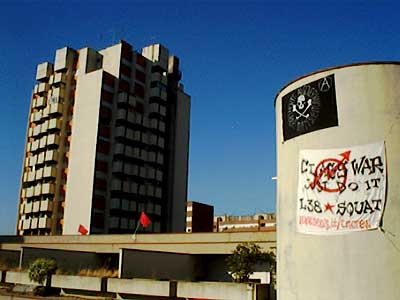
Modernism doesn't age well. Here, on the southern lip of Rome, Laurentino 38 was sketched out in the 70s as a futuristic urban utopia. Today it's a highway to nowhere, and 11 pedestrian bridges have been taken over by squatters. Now the local administration in the Italian capital wants to knock three of the structures down. Where will the squatters go? No one knows. Wanted in Rome has some details.
Seems like there is some indigenous organizing going on. See: L38 squat, ponte d'incontro and diario, all in Italian. L38 also offers some cute photos of their dogs.
land and vote
Should squatters be allowed to vote? That's what Fiji's Housing and Squatter Settlement Department director Dharam Lingham wants to know, the Fiji Times reports. The newspaper notes, with a bit of a harrumph, that squatters actually serve as town council members in some areas.
I look forward to the day that a country elects a squatter president. Then, perhaps, we can stop talking about whether it's OK to deny a fundamental right to people simply because they don't own land.
I look forward to the day that a country elects a squatter president. Then, perhaps, we can stop talking about whether it's OK to deny a fundamental right to people simply because they don't own land.
Wednesday, February 22, 2006
Neighbours rally round squatters
BBC NEWS reports that one North London neighborhood actually likes its squatters.
Fighting evictions, even in Venezuela
Where's Hugo Chavez when they need him? The Daily Journal reports that squatters in 30 buildings have gone to court to stall the Metro Caracas Mayor's plan to have police and national guard evict them.
land for squatters...but what's the price
This brief from Radio Jamaica notes that the government is buying 83.4 acres of land to rehouse squatters. But if, as is reported, it wants the 200 squatter families to reimburse the $52.5 million purchase price, each parcel will cost $262,500.
Just a guess, but I'd reckon that if they had that kind of money, these families wouldn't be squatters in the first place.
Just a guess, but I'd reckon that if they had that kind of money, these families wouldn't be squatters in the first place.
Tuesday, February 21, 2006
Creating a New Orleans shantytown?
Not exactly about squatters, but about a plan of social engineering that seems destined to create squatters: The New Orleans Housing Authority, which is now managed by the federal government, plans to prevent tenants who do not have a job or have no prospect of a job from moving back into their homes. The New Orleans Times-Picayune reports that three members of the City Council have endorsed the plan.
"At some point there has to be a whole new level of motivation, and people have got to stop blaming the government for something they ought to do." That's City Council President Oliver Thomas talking.
Now wait a sec. This is a city where politicians and public authorities failed to do their jobs. Piles of trash and debris still line many streets. No electricity in many neighborhoods. No phone service too. They haven't made a deal to get thousands of trailers installed so people can move back.
Can somebody say chutzpah? There's no question that people who move back to New Orleans are going to have to work hard to rebuild their lives and their city. But they are the victims here. Demonizing them before they get back home is downright ugly.
Dignity restores a man born poor
Gawad Kalinga, a religiously linked program in the Philippines, builds housing for squatters. Founder Tony Meloto understands the natural evolution of squatter communities. But he offers this controversial thought: "If you want to bring the country out of poverty, give the poorest of the poor a middle class environment so they have middle class aspirations. The problem of poverty is not economic, it is behavioral." The Philippine Daily Inquirer, via INQ7, has the story.
Thursday, February 16, 2006
Wednesday night invasion

More violence in Rocinha: Five residents die as dealers from Morro da Providência, Cantagalo and Pavão-Pavãozinho try to take back Rocinha. The cops are out in force. It sounds like a continuation of the war between the Comando Vermelho (which used to control Rocinha) and Amigos dos Amigos (which controls Rocinha now.)Globo reports, in Portuguese.
Thanks to Gabe for the link.
Wednesday, February 15, 2006
Organizing squatters
Under a decree signed in 2002 by President Hugo Chavez, squatters in Venezuela can get title deeds, if they create self-governing bodies called Urban Land Committees. So far, according to the country's Technical Office for Urban Land Tenancy and Regularization, there are now 5,212 of these committees across the country, each representing an average of 147 families. That means that approximately 766,000 families now have control over their homes: individual title deeds plus responsibility to participate in the urban land committees.
Sounds like a tremendously promising program. I'd like more details, particularly as things work out over time: will these communities organize and win services. Will they unite to preserve and improve their lives? Or will this hybrid attempt to have private ownership and community control founder because the interests of the individual may not jive with the wider interests of the community?
Sounds like a tremendously promising program. I'd like more details, particularly as things work out over time: will these communities organize and win services. Will they unite to preserve and improve their lives? Or will this hybrid attempt to have private ownership and community control founder because the interests of the individual may not jive with the wider interests of the community?
Blaming the favelas...again
So the state police intend to occupy three favelas near Copacabana Beach during this weekend's Rolling Stones concert, Reuters reports.
This will only be seen as a provocation. After all, huge celebrations/concerts on Copacabana Beach have been an annual tradition for new year's eve for several years now, and have been largely peaceful affairs. Why blame the favelas for violence that hasn't happened?
This will only be seen as a provocation. After all, huge celebrations/concerts on Copacabana Beach have been an annual tradition for new year's eve for several years now, and have been largely peaceful affairs. Why blame the favelas for violence that hasn't happened?
South Africa: will things be better for squatters after the election?
With elections set for March 1st in South Africa, squatters appear ready to continue to support the African National Congress, according to this dispatch from News24. But they are frank about their disappointments. "We've always voted and we will this time as well," said one. "But we've never seen any difference. There have just been promises, but no change."
The statistics are dire:
Both the ruling ANC and the upstart Democratic Alliance claim that they will efficiently deliver services and crack down on corruption. But no one on the ground seems to believe them.
The statistics are dire:
"In Cape Town alone, there are an estimated 260 000 families on the waiting list for housing. Less than 12 000 new homes were built in 2004, down from a 1997-98 peak of 43 800.
Nationwide, the number of households in shacks rose from 1.45 million to 1.84 million - a 26% increase, according to housing ministry figures since the country's first all-race elections in 1994. This was despite the government spending nearly R30bn to build about 1.8 million new homes in just under 12 years."
Both the ruling ANC and the upstart Democratic Alliance claim that they will efficiently deliver services and crack down on corruption. But no one on the ground seems to believe them.
Tuesday, February 14, 2006
charcoal dust...
...plus macadamia, coffee, rice husks and sawdust equals a new fuel that is an alternative to deforestation. Armed with $132,000 from the World Bank, a Canadian non-profit is working with a community group to sell these new-fangled briquettes in Kibera. I didn't find the article on the web, so here it is, from Agence France Presse:
Kenyan slum-dwellers benefit from new energy scheme
12 February 2006
Agence France Presse
Copyright Agence France-Presse, 2006 All reproduction and presentation rights reserved.
NAIROBI, Jan 12, 2006 (AFP) -
An innovative waste-recycling firm has teamed up with residents of Kenya's largest slum to produce a pocket-friendly energy alternative in a bid to create jobs and conserve the environment.
Chardust, an alternative energy company, with the help of Nairobi-based Makina Umoja Usafi na Maendeleo (MUUM), a garbage collection programme, has begun converting waste into an affordable, environmentally sound energy source.
John Njuguna and Canadian ecologist Elsen Karstad founded Chardust in 2000 with the aim of producing a substitute to wood charcoal, the manufacturing of which is illegal in Kenya and contributes to climate change and land degradation.
"We started in a crude way to see how to (convert) waste into chunks that can be used as a source of energy in households," said Njuguna. "But being a new product, it required educating people about its importance."
With the help of a 132,000-dollar (110,000-euro) World Bank grant, a new initiative encourages residents of Kibera, home to roughly a third of Nairobi's three million population, to collect charcoal dust to sell to the company for processing into briquettes.
To ease the dependency on wood-based energy, Chardust and MUUM set up two charcoal dust collection and briquette sale sites in Kibera two months ago and intends to create six more and expand to other areas of the city.
"This project has helped me," said Mary Minayo, 47, who sells briquettes to residents at a kiosk in the slum. "I now have a job and am able to provide for my family comfortably."
Minayo, a mother of five who formerly ran a produce stall, can now rely on a steady monthly salary of 4,000 Kenyan shillings (56 dollars, 46 euros) for her work on the project.
The salvaged charcoal dust is brought to a factory on the outskirts of Nairobi where 70 employees grind the waste with macadamia, coffee, rice husks and sawdust into a mix to form the briquettes that burn longer and cleaner than charcoal.
"They are smoke-, smell- and spark-free," said Martin Murwa, 22, who was among the 80 percent of Kenyans who depend on wood as their primary source of energy.
The lower ash product, sold at a fraction of the cost of charcoal, has taken hold in the Kenyan market, appearing on the shelves of the country's leading supermarket chains, and nets an annual revenue of 11.5 million shillings (161,000 dollars, 133,500 euros).
In addition, a number of poultry farm, hotels, lodges and restaurants buy directly from Chardust, which produces about 7 tonnes of the eco-friendly briquettes each day.
Charcoal production and other industrial uses of wood have shrunk the country's forests by more than 80 percent since the country's won indepedence from Britain in 1963, according to the environment ministry.
fiji follow-up
The Fijian government has offered to pay half the costs of new lots for squatters who have been served with eviction notices, the Fiji Times reports. This is a major step, even if, so far, only 530 squatter families have qualified. Still, I wonder how much land costs in Fiji. The example cited by the Assistant Minister for Housing and Squatter Resettlement, Joji Banuve, suggests that a single lot would cost $14,000, meaning a squatter would pay $7,000, or more than a year's income.
Saturday, February 11, 2006
Photo Finish
A decade and a half ago, a Reuters photographer started a program to give garbage dump kids their own cameras. "I figured out that you can do things rather than just observe them and that you don't have to know all the answers," she says. Reuters reports on her program, Fotokids, which now is working with 85 children in four cities in Guatemala and Honduras.
Cameras for the poor: I know of a number of programs like this--and they all seem to be doing good things. Still, I keep wishing that, beyond the artistic vision, there was an organizing component in them. It's one thing to give a kid a camera and a taste of the outside world. It's another to give that same kid additional tools that broaden the horizon for structural change.
Cameras for the poor: I know of a number of programs like this--and they all seem to be doing good things. Still, I keep wishing that, beyond the artistic vision, there was an organizing component in them. It's one thing to give a kid a camera and a taste of the outside world. It's another to give that same kid additional tools that broaden the horizon for structural change.
Guardian Unlimited | Special reports | Brutal divide: fortified town plays on middle class fear of crime
"It is a brutal juxtaposition: inside the fence, pastel-coloured two-storey homes in Cape Dutch, English Tudor or Tuscan styles, neatly divided into seven suburbs with names like Beaulieu, Cape Heritage and Tuscana Close. Walk outside the wire and within metres you are in a sea of tin shacks." With these words, The Guardian reports on a strange South African development: a fortified citidel for the middle class. The developer is throwing off a few benefits for the locals--some 200 concrete block houses. Of course, those new homes are outside the security fence. It's a return to medieval values--a sort of demesne approach, the lords and the serfs, separate and unequal. Is it better than nothing? Yes. But a solution? No way.
Friday, February 10, 2006
Favelas in Fiji
New Zealand has promised to increase aid to Fiji to help the island nation deal with 82,350 people living in 182 squatter settlements across the country. Astoundingly, that's almost ten percent of the country's population.
Thursday, February 09, 2006
Rhino update
Correspondent Philippe de Rougemont (Datas and other Swiss newspapers) just wrote me with an update on Rhino, Geneva's most well-known squat--
News on the Geneva (Switzerland) squatter front:
The state prosecutor, Daniel Zappelli elected 2 years
ago is a "zero tolerance" fan. He decided to stop 33
years of tolerance towards squatters in Geneva, in a
recent speech and through everything that was in his
power to do.
But this time even the cantonal authorities say he's
gone too far. He said he would use force to evict
squatters, forgetting that the police is not submited
to his orders, but to the police department headed by
an elected politician.
Why did he get so mad? Because the Rhino aquatters
appealed to the federal tribunal against
his messy evacuation order, on formal grounds, and
won. Then the administrative tribunal in Geneva agreed
with the federal tribunal. Zapelli hit the ceiling
when he heard that.
Reminder: The first modern squats began in 1972 in
Geneva. Since then there has been a sometimes
informal, sometimes explicit doctrine ruling squats:
as long as an owner is not using his house or
building, then it is legitimate for squatters to live
in them. When the owner proves that he will either
mend the house, rent out flats or either sell it, then
the evacuation notice is given and the squatters
leave.
Now that's history, at least as long as Zappelli
stays.
To conclude, there is still a hunger for more comunal
living, there is a huge lack of housing and prices are
going up. So the reasons for a new squatter phenomenon
in Geneva are still very much present.
And Rhino people ?
They benefit from this quarrel between the prosecutor
and the government, and they are on the winning side
for the time being. You can only guess waht will
happen, on one side private property is guaranteed in
the constitution, on the other, the "zero tolerance
fan" has no jurisdiction over the police to force them
to evacuate squatters.
I'm blown away by the capacity these Rhinos seem to
have to avoid the eviction.
********
If you read French, here are two links to articles on the squatter standoff from swissinfo:
le procureur général tancé à propos des squats
Conflit naissant entre judiciaire et politique
Mumbai demolitions
One man's triumph is his neighbor's tragedy. Though the residents of Santacruz (west) in Mumbai were getting flooded out, their solution--to rip down almost 1,000 huts erected by squatters around storm drains--seems a bit extreme, particularly since only half the squatters were relocated prior to demolition. DNA - Daily News & Analysis reports.
Wednesday, February 08, 2006
Manila promises to re-house railway squatters
More than 10,000 squatters will be relocated from communities along Manila's railway lines, according to this dispatch from the Manila Standard. The residents will have to pay 200 pesos a month for the new homes (about $4.) Monthly carrying costs will more than triple of the course of a 30-year mortgage. Let's hope the government acts honorably here and follows through on this commitment.
Too many people, too few homes
Baltimore Sun reporter Scott Calvert visits Diepsloot (Deep Ditch), a squatter community 15 miles north of Johannesburg. The community, the site of riots a year and a half ago, is home to 150,000 strivers who have recently arrived to seek better jobs in the mega-city.
Money quote: "Up to 12 million people live in crude shelters lacking basic services - a quarter of the country's population, and a 50 percent increase from a decade ago."
Money quote: "Up to 12 million people live in crude shelters lacking basic services - a quarter of the country's population, and a 50 percent increase from a decade ago."
Monday, February 06, 2006
Rage at Kenya's corrupt elite
The Telegraph meets the Mungiki, a strange and violent bunch that has grabbed power in some of the squatter areas of Nairobi. "Their standing in their ghetto strongholds has risen in the wake of a huge corruption scandal that has rocked the administration of President Mwai Kibaki in recent weeks," the newspaper reports.
When I was in Nairobi, the Mungiki reportedly controlled several matatu [minibus] routes and exacted tribute from all the drivers. They were rumored to be violent and corrupt, albeit on a slightly smaller level than Kenya's government officials. Still, I rode a matatu to Gitare Marigo and Dandora at a time that Mungiki violence was said to be high and didn't witness anything. Luck? Perhaps. Or perhaps the newspapers don't really know what's happening in poor communities and take all their info from the police, who are also notoriously corrupt.
When I was in Nairobi, the Mungiki reportedly controlled several matatu [minibus] routes and exacted tribute from all the drivers. They were rumored to be violent and corrupt, albeit on a slightly smaller level than Kenya's government officials. Still, I rode a matatu to Gitare Marigo and Dandora at a time that Mungiki violence was said to be high and didn't witness anything. Luck? Perhaps. Or perhaps the newspapers don't really know what's happening in poor communities and take all their info from the police, who are also notoriously corrupt.
The high fashion squat
Fashion Model Helena Christensen is supporting the squatters of Christiania in their effort to keep their commune at the heart of Copenhagen, the Telegraph reports. The government claims to harbor no ill will to the squatters, but wants to allow development, condos, and higher income rentals in the area. Of course, this may not jive well with a community that has its own rules to ban cars, stealing, guns, bulletproof vests and hard drugs, and has created its own monetary system.
And why is a fashion model entering the dispute? Well, I had never heard of Helena Christensen (apparently she's been a Victoria's Secret catalog regular), but anyone who headlines her web site with this quote can't be all bad:
"In modeling, there is no point in trying to prove you have a brain, so why even bother? I'd sooner save the energy for something more meaningful."
World's best cricket museum for Dharavi
Developer Mukesh Mehta has big plans for Dharavi, Mumbai's largest squatter community. First he envisioned a Bollywood walk of fame. Now it's a cricket museum. Despite the good words, here's my underlying fear: that the land pressures and ramp up in values that's bound to come with this kind of 'big real estate' plan will wind up excluding the very people this plan is supposed to benefit: the squatters themselves.
Friday, February 03, 2006
Metropolitan
The Independent reports on a massive fire in a squatter community in Bangladesh that has left thousands homeless. But here's a provocative detail from the article: fire department sources tell the paper that the bulk of the shanties consumed by the flames belonged to two men, Sadek Khan and Mohammed Ali. I want to know more about those guys.
And, the article notes something else remarkable: the people are already rebuilding.
And, the article notes something else remarkable: the people are already rebuilding.
Finally, some sensible talk
The East African Standard, in an editorial about the government's burning of thousands of homes belonging to squatters in the Mount Elgon forest in Kenya, eloquently states what ought to be world policy toward squatters who encroach on environmentally sensitive land:
The Daily Nation reports that the government now promises to relocate the squatters. But, shouldn't that have all been planned out and discussed long ago? Burning people's homes and belongings is no solution at all.
The squatters in Government forests must go, but they should not be flushed to the wilderness since this is tantamount to feeding the cycle that created them, which cannot be broken by might. The only way out is to set aside land to settle the landless and protect forests from fresh encroachment. There is also need for radical land reforms because there’s enough land for all Kenyans.
The Daily Nation reports that the government now promises to relocate the squatters. But, shouldn't that have all been planned out and discussed long ago? Burning people's homes and belongings is no solution at all.
Thursday, February 02, 2006
Dharavi is now a realty gold mine
Some major developers (including one firm from California) are competing for a piece of the planned redevelopment of Mumbai's largest squatter community, Daily News & Analysis reports.
One of the reasons: the plan offers developers almost 3 times the density of normal Mumbai developments. And this in a city where the housing market is incredibly tight. Clearly there's money to be made in Dharavi.
But will this kind of speculation help poor people? The track record isn't good.
Here's another take on the plan, from the Times of India.
No pay phones
In a little noticed decision from two weeks back, Brazil's largest telephone company won a court ruling that it is not required to install phones in Rio's favelas. This ridiculous ruling--based on a mistaken, outsider's view of what life is like inside the favelas--is a piece of legalized discrimination. There are lots of 'asfalto' operations (businesses owned by outsiders) that are operating in Rocinha and other favelas that never had to pay a 'vig' to the traffickers. Beer distributors have no problem distributing to the favela. Building supply firms too. The power company has run legal electric lines and sends employees to read the meters. But, somehow, the community is too dangerous for the phone company?
Wednesday, February 01, 2006
Violence vs. Health
Here's the lead, from a Reuters article: Violence in the slums of Rio de Janeiro is thwarting efforts to combat an outbreak of the dengue fever, which has killed two people and sickened more than 400 in the last six weeks, officials said on Tuesday.
"There are temporary suspensions of inspections in some slum areas with various types of conflicts," a city health spokeswoman said. "That is done in order not to put in danger the lives of inspectors and residents."
Globo newspaper quoted residents of Vigario Geral, one of Rio's most violent slums, as saying they had not received a single dengue inspection since 2004, despite numerous requests for inspectors.
The sad thing here is that officials working on important projects like this are welcomed in the favelas, particularly if they work in mutiroes--mutual aid groups sponsored by the favela residents. Police raids and gang wars are not everyday occurences, so it should be possible, working through residents associations, for the inspectors to get there. If they don't want to go, favela residents should vote the current administration out.
Class contrasts
Poor struggle in shadows of India's richest city. A Reuters reporter confronts Mumbai's dual realities--wealth and squalor--and the people who have suffered at the hands of a government-initiated eviction plan.
Subscribe to:
Posts (Atom)

 Posts