Sunday, September 07, 2008
not acts of god
An astounding figure: on average, there are ten fires a day in squatter communities throughout South Africa. This fact comes from "Big Devil Politics," an important new report by Abahlali baseMjondolo, the squatter-run community organization that started in Durban. To understand these fires, Abahlali writes, you have to understand this: "Shack fires are not acts of God. They are the result of political choices." The report is necessary reading, written with contained fury. It is an indictment of the policies that have led to hundreds of deaths in South Africa's squatter communities every year.


Saturday, September 06, 2008
Rock slide in Cairo shantytown kills 24 - Yahoo! News
An awful scenario: boulders the size of houses raining down on a shantytown in Cairo. AP has the details. But a significant news nugget is buried in the article:
So, once again, squatters are victimized by lack of investment in infrastructure.
1. "The reason the rocks keep falling is because there is no sewage system and their wastewater is eating away at the mountain," Hani Rifaat, a local journalist who has been following the issue, told AP from the site of the disaster.
2. Resident Mohammed Hussein said contractors have been working on shoring up the cliffs as they became increasingly unstable, but they could not complete their work until the government resettled the community below. "The contractor who is stabilizing the mountain asked the government to resettle everyone at least 32 miles from the mountain because he didn't want the rocks he was removing to fall on the people," Hussein told AP Television News. "The rocks are soaked with water and so are more brittle and prone to falling."
So, once again, squatters are victimized by lack of investment in infrastructure.
Sunday, August 31, 2008
charred remains
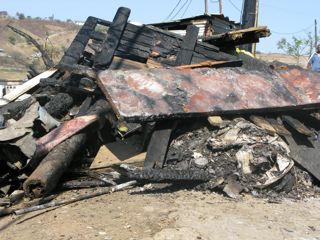 Eight people were buried this weekend after another disastrous fire in the Kennedy Road shack settlement in Durban, South Africa.
The municipality blames the squatters, who get drunk and knock over the candles. The squatters knock down that ugly slander. It is, rather, the municipality that is to blame, for its policy of refusing to allow electrification in the shack neighborhoods. And when the squatters pirate electrical service, the municipality dispatches the police to destroy the makeshift connections and arrest (and sometimes bludgeon) the offenders.
Here's a stark statement of the problem, from Abahlali baseMjondolo, the brave squatter mobilzation in eThekwini Municipality:
Let us be clear. People in houses [as opposed to wood and sheet metal shanties] also get drunk. Their children also like to play in the house. The difference is that they have electricity and so their houses do not burn when these things happen....The problem is not that we are stupid. We do not need training on how to avoid fires. The problem is that we do not have electricity. Electricity will save our lives. Most fires are caused by candles and paraffin stoves. If they don’t connect we must connect. If they will not connect us then they must not arrest and beat us for connecting ourselves. If democracy is for everybody then everybody needs to be safe in a democracy and we are doing the work of the government when we connect ourselves. When we connect ourselves we are making the democracy real. When we connect ourselves we are making everyone count the same. Anyone who says that electricity is a luxury that the poor do not deserve must spend one winter living in a shack and trying to survive the fires before they speak about what is a luxury and what is a necessity.
Tuesday, August 19, 2008
blame the victims
The Johannesburg Government now blames squatters for the fires that periodically devastate their communities. Here's what a spokesman for Johannesburg Emergency Management Services told the Star newspaper about a fire this past weekend that destroyed 1,000 homes in the Denver hostel squatter camp in southern Johannesburg: "In illegal informal settlements there are a lot of social factors that come into play. High on the list is drunkenness... where a person drinks and forgets to put out the candle... or they might leave a pot cooking on a stove and go and buy beer again."
Anyone who has spent time in squatter communities or other informal settlements knows that drunkenness is no more prevalent there than in society as a whole. The greater issue, which the Durban-based squatter organizing group Abahlali baseMjondolo has articulated many times, is South Africa's continuing effort to prevent squatters from gaining access to electricity: "As usual the poor must be blamed rather than the system that denies people decent housing and fails to, even as a minimal measure, electrify the shack settlements."
Anyone who has spent time in squatter communities or other informal settlements knows that drunkenness is no more prevalent there than in society as a whole. The greater issue, which the Durban-based squatter organizing group Abahlali baseMjondolo has articulated many times, is South Africa's continuing effort to prevent squatters from gaining access to electricity: "As usual the poor must be blamed rather than the system that denies people decent housing and fails to, even as a minimal measure, electrify the shack settlements."
Saturday, August 02, 2008
Calcutta wants to replace squatters with high rises
Another scheme to push out squatters, this time in Kolkata (Calcutta.) Apparently, the city government, recognizing that many squatter areas occupy valuable real estate in the center of town, has decided to allow multi-family reconstruction. This, of course, gives developers a massive financial incentive to drive as many as 1.5 million people from their homes. City Renewal, a blog maintained by people affiliated with the Howrah Pilot Project, gives a clear-eyed summary of the issues involved.
[thanks to Nila-kantha-chandra/Rama for sending this my way.]
[thanks to Nila-kantha-chandra/Rama for sending this my way.]
Rwanda's Capital's Crime
Demolition in Kigali as the government has razed the centrally located squatter community of Poor Kiyovu (so called to distinguish it for neighboring Rich Kiyovu.) Thus politicians work hand-in-hand with developers, and the people suffer. I suppose the good news is that the administration did at least promise to reimburse people for their losses. But, as this blog post points out, many have not received anything.
Here's the nub of the issue: "It seems that the government wishes to engineer a city in which Kigali residents and delicate-stomached foreigners will no longer have to suffer vulgar displays of poverty in the city centre. Its a loss for the city. These people were a major part of the life of the city centre. A much better strategy would have been for the city to have improved the property rights laws and infrastructure in poor Kiyovu to promote its development. Shame on the City of Kigali."
(thanks, Maurice, for sending this to me.)
Sunday, May 25, 2008
Roma at risk
Silvio Berlusconi wastes no time. Italy has expelled 100 people after a sweep of immigrant squatter encampments, The New York Times reports.
See also: BBC and The Guardian.
The Guardian reports that the cabinet endorsed a new law that allows "confiscation of property let to illegal immigrants, a rule that could have instant and drastic effects on hundreds of thousands of foreigners known to be living in Italy without the right papers."
[a tip of the hat to Gabriel for pointing me to the links.]
Monday, May 19, 2008
deja vu all over again in South Africa
I don't mean to be snide. But some South African cities are reimposing some of the worst excesses of the apartheid era. That's what Marie Huchzermeyer, an architecture professor, argues in a recent issue of the newspaper Business Day.
In Durban, the legislature's policy of policing and fencing off of all vacant land and summarily evicting of any new land invaders, she writes, "reintroduces measures from the 1951 Prevention of Illegal Squatting Act, which was repealed in 1998."
She compares the determination to eradicate shack settlements, no matter the cost (and studies have shown that simply razing peoples homes and forcing them further out of town institutionalizes misery and makes poverty worse) with denying that the HIV virus causes AIDS.
squatting on the rise in the USA
It's a response to the sub-prime meltdown and the tragedy of foreclosures. People without homes while an enormous number of buildings are vacant. Reuters has details.
One sorry point about the article: it features no interviews with squatters themselves, but is almost entirely based on interviews with real estate brokers. This makes it seem like the squatters are manipulating the tragic situation for their own benefit. As if the banks and entities that have foreclosed are not. Some squatters may, indeed, be seeking to profit. But I'm sure there are others who simply need shelter.
To be, as Patrick Chamoiseau has written, is first and foremost to possess a roof.
Friday, May 09, 2008
Whose South Africa?
Le Monde Diplomatique offers a clear-eyed perspective on the inequalities and inequities of the new South Africa, with special focus on the squatter communities.
Wednesday, April 30, 2008
So you want to squat...

A London service is publicizing the city's vast number of vacant buildings in the hope that people could squat them. The group features flyers and brochures that mimic real estate publications. Read about it in The Daily Mail.
[thanks to eagle-eyed Bryan of Subtopia for the link]
Friday, April 18, 2008
Istanbul destroys historic Roma community

Kristoffer Larsen, who is currently in Istanbul, is chronicling the municipal government's continuing effort to demolish Sulukule, a historic neighborhood in Istanbul that has been home to a Roma community for almost 1,000 years. He writes:
"They are tearing down houses randomly - 6 one morning - 3 the other day. The last week has been quiet - there are rumors among some people that the municipality are getting cold feet - but this is not confirmed. They are likely to carry on - despite the fact that no solution has been found for huge number of residents who are not able to pay for new houses.
There has been a desperate atmosphere some days - one lady started to destroy her own house (in which she has been living for 40 years, her whole life) because she knew that the buldozers would come the next morning."
Kristoffer took the photo last month, after one of the periodic demolitions.
On April 4, members of the US Helsinki Commission wrote to Turkey's Prime Minister R. Tayyip Erdoğan, expressing dismay over the organized bulldozing of the community. In a speech last month, however, Erdoğan was unapologetic: "Those criticizing the project will eventually say, 'We thank you for rescuing Sulukule from its ugliness and turning it into a modern place with restored historical streets.'"
Friday, March 21, 2008
a novel way to evict thousands
Just suspend the law. That's what the government of Chad did earlier this month. The edict of extraordinary powers meant that authorities in N'djamena, the country's capital, had no obligation to honor due process or any other rights.
The result: 1,000 families in poor neighborhoods around the city were evicted, and their homes destroyed.
"Under the presidential decree, public discussion of the evictions was banned and many key public defenders fled the country out of concern for their safely," the UN's Integrated Regional Information Networks news service reports. IRIN quotes N'djamena Mayor Mahamat Zène Bada as asserting that they now can build "schools and colleges, medical centres, libraries, sporting facilities, markets and bus stations."
Yeah, right.
With admirable restraint, IRIN points out that "it will be difficult start any projects as there are very few construction companies in the country due to the current insecurity, and there is questionable value of building libraries in a country where the majority of the population is unschooled and illiterate."
Sunday, February 17, 2008
Back to the 19th century
On Thursday, Feb. 14, police descended on the Kennedy Road Settlement in Durban and began ripping out electrical hookups. They ripped out pirated service, and they ripped out legal service. They dug up wires that had been run underground.
Kennedy Road is one of the shack settlements that is part of Abahlali baseMjondolo, a squatter organizing group which has been battling with the Durban municipality for some time now. Its members have been arrested, imprisoned, harassed, and hurt. Now, with no advance warning, the municipality is attempting drive squatters back to the squalor in which the poor lived two centuries ago.
Welcome to the new South Africa!
As Abahlali said in a statement, "Electricity is not a luxury. It is a basic right. It is essential for children to do their homework; for safe cooking and heating; for people to charge phones, to be able participate in the national debate through electronic communication (TV discussion programmes, email etc); for lighting to keep women safe and, most of all, to stop the fires that terrorise us....Why is the government sending the police to force us to go backwards? Development was supposed to be about moving forwards."
For more about Abahlali and their courageous work, you can find a short video here.
Sunday, January 27, 2008
House in a Slum? You Can't Afford It. - washingtonpost.com
Dilip D'Souza decodes Mumbai's mystifying housing market and the programs designed to aid squatters in this wonderfully honest article from The Washington Post.
Saturday, January 26, 2008
Bangalore squatters protest
I missed this in late December: Squatters in Bangalore, who had occupied their community for two decades, protested after the municipality evicted them with no warning. They claim that the city sold off replacement housing rather than allocated it to them. The Hindu has details.
Friday, January 25, 2008
A sophisticated strategy in Manila
Philippine squatters have picketed the South Korean embassy, to protest a South Korean government-financed plan that calls for 50,000 families who live along the railroad tracks to be evicted. Manila's INQUIRER newspaper has the details. Sadly, the Korean Embassy refused to talk with the squatters or even receive a letter they were trying to deliver. The squatters say they're not against improving the railroad, but they want their rights to their homes respected and relocation plans to be developed. "Our only concern is the observance of the rights of the affected families," said Ted Añana, deputy coordinator of the Urban Poor Associates, which helped organize the demonstration.
Thursday, January 24, 2008
35 years and still no rights

The squatter community of Arnett Drive has been in the Reservoir Hills area of Durban for 35 years. Yet the municipality has launched a sudden and horrible eviction drive. It's an ugly reality of the new South Africa -- majority rule making life worse for the majority.
Update: A January 25 article from The Mercury (sadly hidden behind a subscription firewall on the web) reports that Abahlali baseMjondolo, the courageous Durban squatter organizing group, won a temporary injunction barring the municipality from engaging in more demolitions in this Reservoir Hills community. The interim ruling allows for a one-month reprieve. The matter will be back in court on the 21st of February.
Monday, January 14, 2008
A big year for the wrecking ball

This excellent article from Canada's Globe and Mail newspaper notes that governments in Mumbai, India and Istanbul, Turkey are set to demolish millions of squatter homes to make way for highrises, in a misguided attempt to modernize their cities.
In both cities, it seems like the government is using the rhetoric of improvement and redevelopment to shift land from being held by largely poor squatters to being owned by large real estate establishments. The impact on the squatters, it seems, is just collateral damage (see photo of Nehru Nagar in Mumbai).
Yet the article offers a modest way forward:
"The best plans generally let the slum dwellers themselves make the main decisions in planning their future. You should provide clean water, toilets, electricity, garbage collection and disposal, and maybe let people build their own houses if they can using materials that you can provide," says Aprodicio Laquian, the Filipino-Canadian planner who practically invented the idea of slum-dweller-designed urban rehabilitation in the 1960s and is now at the University of British Columbia.
"Eventually," Mr. Laquian says, "you want to make available a better sort of housing, a five-storey walk-up apartment, but planned according to the needs of the community, not by some central plan."
An amazing and simple statement of what ought to be the norm in urban development. Instead, it's a revolutionary thought. How many people need to get evicted before the world understands?
Tuesday, January 08, 2008
gypsies face the boot in Istanbul
Another example of eviction via redevelopment. Istanbul wants to spruce up for its 2010 debutante outing as "European Capital of Culture" by flattening the ancient and historic (and, admittedly, run down) area called Sulukule, which is occupied principally by the Roma. The plan calls for removing the historic homes on the land abutting the 1600-year-old Theodosian Walls and building $77,000 townhouses. "We are buying the houses from the present owners and they can move into brand-new lodgings as soon as they are finished, and pay off the difference over 15 years," the local Mayor crows.
But Sukru Punduk, a Sulukule resident who opposes the plan, thinks the municipality’s aim is to clear the area of its current Roma inhabitants. "Look at the models they’ve made of the new houses, little model people carrying laptops, middle-class people, not people like us," he says. It's a logical suspicion, considering that half the residents of Sulukule earn less than 500 lira ($427) a month.
Oh, wait, perhaps Countrywide Financial and Citibank can come in and give these good Turkish citizens some no documentation subprime mortgage love, then foreclose on them and ....
What's even more suspicious is that the government is also seeking to destroy nearby Gulsuyu, a former gecekondu (squatter) neighborhood that was legalized two decades ago. Why push Gulsuyu residents out? Because that neighborhood occupies a potentially prime piece of real estate high on a hill overlooking the Marmara Sea.
Eurasianet has the sordid details.
Saturday, January 05, 2008
the new shantytown of people forced out of the shantytown
 The post-election violence in Nairobi has pitted neighbor against neighbor. These former residents of Mathare, a shantytown with a history that goes back more than half a century, on the were forced from their homes and have become squatters on the nearby airforce base (photo from guardian.co.uk).
Friends tell me that several swathes of Kibera were burnt, but they were hoping tensions would cool this weekend.
This much is sure: beyond finding a political solution, there's lots of mending to be done between neighbors.
Monday, December 31, 2007
Nairobi Shantytowns Erupt

 If Kenya's incumbent president, Mwai Kibaki, did not rig the election, asks challenger Raila Odinga, "why does he seclude himself in State House at dusk to be sworn in without the media, diplomats, observers and other Heads of States." For those who don't know the details, Odinga was leading in the polls in the lead up to the election, and was ahead by 1 million in the count just one day before the official results were announced. Once the election commission announced th results, the incumbent president was sworn in for a second term in a secretive 15-minute action and the government immediately imposed controls on the press.
The danger for Kenya is that the contested results, which outside observers said were tainted by fraud, exacerbate existing tribal tension. Kibaki is a Kikuyu, the dominant Kenyan tribe. Odinga is from the nation's second-largest tribe, the Luo. Kibera, the shantytown where I lived when I was doing the reporting for Shadow Cities, is in Odinga's parliamentary district and reports are that violence has broken out between Kikuyus and Luos in the community. Other shantytowns around Nairobi report riots and anger. The two photos, from The New York Times, show the extent of devastation in Mathare, Nairobi's second-largest shantytown.
You can view a disturbing video from the British newspaper The Guardian here.
The Nation, the country's largest newspaper, has details of Odinga's plans to contest the results.
****
later in the day update: The New York Times offers a New Years Eve view of the situation on the streets.
As the Times points out, "Mr. Kibaki now faces trouble not just on the streets, but in the Kenyan Parliament as well. More than half of his cabinet was voted out of office in a wave of seeming dissatisfaction with his government, and his party won about 35 seats in Parliament, while the opposition took nearly 100 seats."
This brings up an interesting issue: if we are to believe the results certified by the Election Commission, we have to believe that an overwhelming number of people split their ballots. If 100 opposition politicians were elected to Parliament and half of Kibaki's cabinet lost their parliamentary posts, is it truly credible that so many people voted against Kibaki's party's nominees for Parliament but for the incumbent president?
Tuesday, December 18, 2007
Losing faith
Johannesburg squatters take little interest in the current fight between Jacob Zuma and Thabo Mbeki for leadership of the African National Congress. "The ANC has done nothing for us," one squatter tellsReuters.
The article notes that people expected investment and empowerment after the ANC took control of the government, but 13 years later, there's not much to show for majority rule. "We can't even get a toilet, unless we can afford to bribe the authorities," another squatter said.
The article notes that people expected investment and empowerment after the ANC took control of the government, but 13 years later, there's not much to show for majority rule. "We can't even get a toilet, unless we can afford to bribe the authorities," another squatter said.
Monday, December 10, 2007
The dark side of micro-credit?
Are small-scale loans from Grameen Bank and other micro-credit institutions being used to fund dowry payments? That's the provocative assertion in this essay from openDemocracy: "While micro-credit has benefited large sections of the rural population in many ways, it has also worked against women's solidarity and contributed heavily to the inflation of dowry. Grooms' families are aware that money is available to brides' families more easily now, through Grameen Bank, the Bangladesh Rural Advancement Committee (BRAC) or other NGOs."
Wednesday, December 05, 2007
what's the world record for evictions?
Maybe China takes the gold, for evicting 1.5 million people to make way for next summer's Olympics in Beijing, according to the Committee on Housing Rights and Evictions. The AP has the details. COHRE gives Beijing, Slovakia and State Peace and Development Council of Burma its annual Housing Rights Violator Awards. Read COHRE's citations here.
Digital Cities
Subtopia, Bryan Finoki's revelatory blog on military urbanism, features a thoughtful post on one artist's digitally manipulated photos from the favelas, or what Bryan calls Squatter Imaginaries. Join the discussion about the role of art in revealing/questioning/documenting social fractures.
Monday, November 26, 2007
The squatter millionaires
It ought to be great news. On Thanksgiving Day (for those of you lucky enough not to be familiar with U.S. rituals, that occurred on Nov. 22nd this year), the Bill & Melinda Gates Foundation announced that they were giving $10 million to Shack/Slum Dwellers International, a major squatter organizing group in Mumbai, India.
But consider that SDI sometimes doesn't advance the interests of all squatters. In Durban, South Africa, the squatter group Abahlali baseMjondolo was threatened that it would be harassed by the government if it did not join SDI. Here's a note from a recent Abahlali press statement.
Abahlali asserts that SDI has created a coalition with the South African government while the government continues evicting many shack communities. Thus SDI is implicitly condoning those evictions. This is a serious charge.
So I say: Congratulations to the Gates Foundation for, as program officer Melanie Walker told writer Neal Peirce, triumphing over the "scary" prospect of giving $10 million to "people without a bank account." This is a welcome step and will no doubt help the organization draw attention to housing issues and inequities around the globe.
But the Gates Foundation should remember that there are hundreds of millions of squatters around the world who are not represented by SDI (indeed, the majority of the billion shanty dwellers on the planet aren't represented by the group.) They deserve recognition, too, and they certainly shouldn't get the shaft simply because they haven't joined SDI.
addendum, one day later:
And SDI should note that with money and success comes responsibility to be inclusive. SDI tends to only work with groups that embrace it's own 'savings-plan' version of organizing. But there are many communities that don't see saving money as the best organizing tool, particularly if they are facing immanent eviction. SDI now has an opportunity to broaden its vision and its reach.
But consider that SDI sometimes doesn't advance the interests of all squatters. In Durban, South Africa, the squatter group Abahlali baseMjondolo was threatened that it would be harassed by the government if it did not join SDI. Here's a note from a recent Abahlali press statement.
We were then told that if we wanted to be
able to meet with the government regularly and to be able to get
houses we must join SDI. The instruction was clear: stay on our own
and keep thinking and speaking for ourselves and be arrested, or join
SDI and be obedient and be rewarded. We refused to join SDI. We
announced this on the radio. Within days the arrests and beatings
started and they have not stopped since even though we are currently
suing the Minister of Safety & Security and even though we have
marched on the Sydenham Police. The money for SDI is not money for us.
Abahlali asserts that SDI has created a coalition with the South African government while the government continues evicting many shack communities. Thus SDI is implicitly condoning those evictions. This is a serious charge.
So I say: Congratulations to the Gates Foundation for, as program officer Melanie Walker told writer Neal Peirce, triumphing over the "scary" prospect of giving $10 million to "people without a bank account." This is a welcome step and will no doubt help the organization draw attention to housing issues and inequities around the globe.
But the Gates Foundation should remember that there are hundreds of millions of squatters around the world who are not represented by SDI (indeed, the majority of the billion shanty dwellers on the planet aren't represented by the group.) They deserve recognition, too, and they certainly shouldn't get the shaft simply because they haven't joined SDI.
addendum, one day later:
And SDI should note that with money and success comes responsibility to be inclusive. SDI tends to only work with groups that embrace it's own 'savings-plan' version of organizing. But there are many communities that don't see saving money as the best organizing tool, particularly if they are facing immanent eviction. SDI now has an opportunity to broaden its vision and its reach.
Where are Durban's street children?
Rounded up, yanked off the streets, and jailed by local authorities, because FIFA, the world soccer federation, met yesterday in the city, The Daily News asserts.
Monday, November 19, 2007
Three Cheers for Infrastructure
Mega Cities expert Janice Perlman makes a profound statement:
"The international funding agencies of investment institutions need to give more to urban development and less to rural development," said Perlman. "I’ve argued that the people who come to the city [and live in squatter developments] are the cream of the crop with the highest ambitions and aspirations. If given the chance, they would build middle-class communities. You can’t blame people for polluting the watershed if you don’t provide them with water infrastructure."
Perlman advocates integrating squatter developments into the surrounding neighborhoods. Rather than demolishing these self-made communities, she recommends connecting them to the city’s infrastructure by incorporating paved streets, steps, plazas and new facades as well as offering services such as clean water, sewage connections and electricity. If visually they’re more like the surrounding neighborhoods, these needy areas will be more likely to interact with the middle class nearby, she said.
Bone Hill
The Homeless Workers Movement is the urban branch of the Landless Workers Movement, the Brazilian group that has been seizing rural parcels from wealthy land barons and building new towns in rural Brazil. In Sao Paulo it has established several new communities, Le Monde Diplomatique reports. Oddly, the group has been recruiting its land invaders among people who live in some of the city's many other favelas. Still, the ideology sounds impressive:
The Sao Paulo community chose to call itself Bone Hill because, Silvestre said, "the homeless are a bone that sticks in the authorities’ throat."
Helena Silvestre, an MTST leader, described squats as a school for participatory democracy and a training ground for future community leaders: “We want to use a specific issue, housing, as the starting-point to help lay the foundations of real popular power.”
The Sao Paulo community chose to call itself Bone Hill because, Silvestre said, "the homeless are a bone that sticks in the authorities’ throat."
Sunday, November 18, 2007
let there be light!
I'm not usually a techno worshipping type, but here's a handy device that could transform people's abilities to get light without wasteful diesel generators or kerosene lanterns. It's called the GaiaLux Ecolight and has been entered in NASA's Create the Future design contest. Basically, it reuses discarded mobile phone chargers to get electricity to rechargeable batteries that in turn power a highly efficient LED bulb. It can be recharged on variable or low current and the batteries will run the light for 40 hours. It's a nifty idea that could reuse some of the 125 million phone chargers that are discarded every year as well as potentially providing affordable (and bright) lighting in places that need it.
A few follow-up questions for inventor John Barrie:
1. How much does the GaiaLux cost? Does the price make it within the reach of people with alarmingly low incomes? Are the materials and supplies that are necessary manufactured in the countries that might find uses for the light, or will they have to be imported?
2. How heavy is the light (because people who don't have their own electricity would likely need to carry it somewhere to recharge the batteries)?
3. Is it feasible to recharge the batteries through solar power?
Thursday, November 01, 2007
Plague of Fires Takes Another Life
"The terror of shack fires is everywhere and it will stay everywhere for as long as we are forced to live 13 people in one shack with candles and a paraffin stove because it has been decided that electricity is not for us and that we are not allowed to expand our shacks or to build new ones as our families grow."
Eloquent words from Abahlali baseMjondolo.
Eloquent words from Abahlali baseMjondolo.
Saturday, October 20, 2007
gentrifying Dharavi

The plan to demolish and resurrect Dharavi as a fully developed upper class zone is moving forward. But some recent newspaper articles put forth some interesting stories.
1. livemint reports that the Maharastra government's take from redeveloping Dharavi could be 500 percent higher than anticipated (as much as $2.5 billion), due to steeply rising land values. A hut in Dharavi today commands between Rs4,500 and Rs5,000 (approx. $125) a sq. ft while industrial and commercial sheds rent for up to Rs10,000-12,000 (close to $300) per sq. ft. This means a simple shanty, 10 feet wide and ten feet deep would cost $12,500 -- a fortune for the average squatter.
2. Meanwhile, Express India reports that the government still doesn't know how many people will be uprooted or will qualify for new housing under the Dharavi plan.
3. Twenty-five teenage girls in Dharavi have made short films about life in the community. Read a brief article about their efforts in Zee news.
goats patrol the social scrap heap
One San Francisco neighborhood is using goats to deter squatters: read about it here.
Wednesday, October 03, 2007
Roof Rights

Cairo's squatters have taken to the rooftops, as this dispatch from Reuters details. Rents down below can be 10 times as much as the price of roof space.
(thanks to Ted C. for the link)
Monday, October 01, 2007
'no power, no position, no fame, nothing'
An eloquent message from S'bu Zikode, of the Abahlali baseMjondolo Movement in South Africa:
Silencing the Right to speak, is Taking away Citizenship
Sunday 30 September 2007
Not only as a leader of the Movement of Abahlali, but also as an ordinary South African Citizen, as a parent, as a father and mostly a human being I am extremely hurt. My heart is torn apart when in my own country, in a broad daylight like on Friday the 28 September 2007 it is made so clear that the poor are not Citizens. When they try to sweep up us out of the cities it is clear that we are not citizens. When they beat us to stop us speaking it is clear that we are not citizens.
It is of a great concern that thousands of Abahlali baseMjondolo members have marched peacefully to the eThekwini municipal mayor Obed Mlaba and have been received with such violence. We marched to demand no power, no position no fame, nothing from his family. We only marched for the Right to life of the shack dwellers, the farm dwellers and thousands of forgotten citizens of this country in the name of democracy, in the name of a better life for all.
What a life without shame, without conscience, without respect for vulnerable groups in our society the elderly women and children. The presence of church leaders amongst the poor has had a far-reaching reason to those in need of a church. The biggest curse is that while praying, the innocents were started to be flooded with heavy forces of water, the strong church leaders stood very firm to shield the innocents. The heavy armed members of the SAPS started assaulting the church leaders, throwing teargas, beating helpless women, shooting old women and men at the back while running to their homes.
This event took place at about 12:15pm when the innocent marchers were still waiting for the mayor to receive the memorandum of demands as arranged with him. The march had complied with the Gathering Act of SA. Without any provocation or unruliness the police decided to act on the instructions of the Mayor of non compliance with the South African Law, because he thinks being at that position means being the law unto himself.
The incident took place in my presence. I had offered myself to represent the helpless so that they may see many more, so that they may not be alone while taking their pain for as long as they still believe that we all have all the Right to life. I think this is a difficult leadership style one needs to adopt to save so many lives. Thus I think it is enough that many of us are born and die in shack fires in jondolos, that we die through various diseases associated with unhygienic conditions from the poisonous air we breath in the jondolos, that we live and die with TB and HIV/AIDS as the research confirms that the shack settlements have the highest infection of the virus. People die because of crime, floods and storms; they die while trying to find toilets in the night. We are seeing no future to our children except to the children of those in authority like Mayor Mlaba. Some of us die while trying to speak truth to power, as we get shot while marching.
After a long shooting I had received a call from the Municipality saying that a representative is on his way to receive the memorandum. But already fourteen members were arrested, four were heavily shot and two were badly wounded. This was quite disturbing. Who was going to hand over the memorandum as the police under the command Sydenham Glen Nayager had already chased everyone? In the next ten minutes I received a call saying that I must bring the Memorandum in Baig's office as the official was very scared to come out. Then I said he must come out as most comrades have fled, wounded and harmless, and most police were gone still chasing people away down the roads. I had remained with a small group of less than one hundred with elderly people and pregnant women you couldn't flee.
Then we had no other choice but to face the remaining police and I read the memorandum loudly to Mr. Mzi Magubane who described himself as a senior Manager from the Dept. of Housing in eThekwini municipality. Magubane has been described by System Cele as another old liar. She said that when she was still a child 'this man used to deceive my father when he was still alive working in the Kennedy Road Committee, today he has come to bluff me.' So Bahlali your message was sent with another dishonest man with a history of lies.
Today we have to take care of our comrades who for no reasons were imprisoned; today we have to look for money to pay bail and lawyers to represent them in court for nothing. Today like other days we have to run around doctors and hospitals to try and support the shot and hurt comrades. Today like any other day we have stood together and planned an alternative, as we shall not allow any forces to force us silent. So as long as Amandla belongs to us we shall not fear. As long as democracy is used to further the political scores of the minority and as long as there is great inequality in our society Abahlali will stand together for the dawn of true democracy where everyone matters.
As challenges increase every day for the Movement one is for us to seek for justice to take its course. I will soon be writing to the Amnesty International for a wide range of legal support on this dirty behavior of SAPS. But all of this will not compromise any demands. We will make a follow up and engage the city in a progressive manner that seeks to see a remarkable social change for all. Our city and our country still need true leaders that do not run away from their responsibility like Mlaba. We need leaders that will act, as servants of the public not expect to be masters over the public like eThekwini mayor Obed Mlaba.
S'bu Zikode
Abahlali baseMjondolo Movement SA.
Saturday, September 22, 2007
as if Dharavi hasn't changed in seven years
The Indian government has woken up to realize that many people have moved to Dharavi since 1995. Now, everyone living there prior to January 1, 2000, will be entitled to be rehoused by the developers seeking to remake the community as a high-price enclave. The Economic Times has the details.
But what about the people who moved in during the past seven-plus years?
I'm not a fan of the Dharavi redevelopment, which will uproot families (most will be banished to tiny and crude apartments in areas far further from the center of town and the places where they work), disrupt thousands of businesses, and generally privatize something that the people who live there should have control of. But still, if they're going to offer to rehouse people, shouldn't the developers rehouse everyone who lives there, no matter when they moved in.
Otherwise, the Dharavi plan simply amounts to a high-tech eviction.
Friday, September 21, 2007
'This is not democracy. This is not justice'
"I can't look after them while they are busy making children," developer Ricky Govender says of the South African squatters who are desperately trying to find a solution that will not render them homeless after decades of living on a ragged scrap of land called Motala Heights in Pinetown, just outside Durban.
"Ever since we became more aware of our rights and started fighting for them we have been living with this sense of threat from the landlord," responds resident Shamita Naidoo, who lives on a property adjacent to Govender. "He has sent me a letter saying I am prohibited from entering his land -- where my mother lives, in the house my parents built and where I was born. I will be arrested otherwise."
The city is cooperating with Govender and is attempting to force the squatters off their land with a vague promise of a new home 15 kilometers out of town.
The Mail & Guardian has the awful details.
The squatters have scheduled a march for civil & housing rights for Friday, 28 September 2007. "We are treated as if we do not belong in this country," the squatter organizing group Abahlali baseMjondolo said in press release. "We are treated as if the law is not for us, as if the land is not for us, as if the city is not for us, as if the electricity is not for us, as if the schools are not for us. This is not democracy. This is not justice. The City gives us no choice but to march."
Monday, September 17, 2007
who's failing to cooperate with whom?
Some South African squatters now face being penalized for refusing to "cooperate with government" if they protest their impending eviction, Martin Legassick writes in this article from The Cape Argus that has been posted to the Abahlali baseMjondolo website.
The squatters blocked the N2 freeway to protest the fact that they were being evicted to make way for N2 Gateway, a pet project of SA Housing Minister Lindiwe Sisulu. They also offered their own plan that would provide new housing without any forced evictions.
"Sisulu does not like the term 'forced removal,'" Legassick writes. "But what substantive difference is there in her present search for means of 'compulsion', from the apartheid government of the 1970s wanting to forcibly evict Crossroads residents out of Cape Town altogether?"
Good question.
Seems to me it's Sisulu and the government that is failing to cooperate with the squatters.
Wednesday, September 12, 2007
the new new orleans
I missed these pieces when they first came out.
an AP writer's editorial on New Orleans
and
and AP dispatch on squatting in New Orleans
What these emotionally wrenching articles show is the incredibly injustice of allowing New Orleans to rot.
I had the idea, right after Hurricane Katrina smashed through the city, that people should return to squat the land. I wanted activists to organize tent cities in the lower 9th and throughout the most devastated areas. The idea was tactical, not practical--the concept being to show the politicos and the rest of America that the people of New Orleans were refusing to relinquish their city. I thought that the idea of a shantytown right in the good old US of A would shame the country into action.
"No one knows exactly how many people have taken refuge in abandoned buildings, but unprecedented increases in trespassing arrests and vacant-building fires suggest there could be thousands" says the AP article.
The whole city is a shantytown. And does anyone out there care?
Tuesday, September 11, 2007
ragpicking or recycling
How's this for an interesting fact: "More than 95 percent of New Delhi has no formal system of house-to-house garbage collection, so it falls to the city's ragpickers, one of India's poorest and most marginalized groups, to provide this basic service for fellow citizens."
That the situation in India's capital city, according to dispatch from the International Herald Tribune.
The city is planning to celebrate Gandhi's birthday on October 2nd by giving 6,000 ragpickers gloves, aprons and boots. The ragpickers, understandably, say they'd prefer wages, social security, pensions, health care, uniforms they hope will discourage police harassment, education for their children, and decent housing.
Given that most of the city has no sanitation services, the people in the rag trade are, in a sense, public servants. Shouldn't they be treated that way? "If we stop, who is going to do this work instead of us?" Mohamad Nazir, one of the ragpickers, told the Herald Tribune. "They know they won't find other people who are willing. Within two days the whole city would be stinking and filthy."
what it takes to be a megacity
Once again, the World Bank has allocated around $200 million for 'slum upgrading' in Lagos, Nigeria, the Daily Sun reports. Nine communities--Agege, Ajegunle, Amukoko, Badia, Bariga, Ijeshatedo/Itire, Ilaje, Iwaya and Makoko--are supposed to receive new infrastructure and unspecified other improvements under the deal.
But what does this mean? What does the upgrading entail? And, given that the city supplies neither water nor electricity (most people with enough money sink boreholes to tap underground water and run diesel generators to get their electricity), what kinds of infrastructure improvements are contemplated. Further, what will happen to the current residents during and after the work? And, finally, why is this all taking place, as the newspaper notes, in order to "impact positively on Lagos as a whole in its quest to attain a mega city status?" What does that mean?
But what does this mean? What does the upgrading entail? And, given that the city supplies neither water nor electricity (most people with enough money sink boreholes to tap underground water and run diesel generators to get their electricity), what kinds of infrastructure improvements are contemplated. Further, what will happen to the current residents during and after the work? And, finally, why is this all taking place, as the newspaper notes, in order to "impact positively on Lagos as a whole in its quest to attain a mega city status?" What does that mean?
Sunday, September 09, 2007
'urban villages'


That's what the Chinese call haphazard and convoluted old urban neighborhoods that have historically functioned as places where migrants can get a foothold in the city.
I don't yet know the nature of land holdings in these communities, but I have visited several in Guangzhou. They are built quite like squatter communities--with lanes only wide enough for a bicycle cart and buildings with balconies that cantilever so far out over the alleys that two neighbors could have an affair without ever leaving their respective homes. Like squatter communities all over the world (and like Italian renaissance hill towns), the alleys sometimes make abrupt twists, jutting around this or that projecting building. It's possible to enter these communities and never figure out how to get out. They are full of surprising stores and restaurants and computer centers and tea shops and temples and groceries and beauty salons. Which is to say, they are full of life.
Guangzhou's 138 urban villages are almost all threatened by nearby luxury developments. Liede, a community hard by the Pearl River (and pictured in the photos above during the festival held when the River rises and washes over the neighborhood's embankments and into its streets and houses), has almost been emptied, and is slated to be destroyed by October 15th. Xiancun, not far away, is sandwiched between three luxury developments and is next for the wrecking ball. Shipai, which abuts the fancy Tianhe Commuter Shopping District, is still vibrant and fully functional, but the existence of this land so near to the new central business district must have some developers panting.
I don't think the Guangzhou authorities quite understand what will be lost if these communities go.
I'll write more on these fascinating communities as I learn more.
Friday, September 07, 2007
Irish land activism
Some squatters in Dublin have taken lucrative payouts to leave their homes. Others have filed adverse possession claims. The Irish Independent has details.
people vs. pine scent
Why are these disputes always binary. Trees vs. Squatters. That sort of thing.
I understand why Philippine authorities want to restore watersheds and green areas in cities. But the best way of doing this is not by demonizing squatters (see this article from the Inquirer) but by working with them. Yes, plant a million trees. But how about getting the squatters into the act and letting them plant the trees. Join with the squatters and watch environmental activism truly take root.
I understand why Philippine authorities want to restore watersheds and green areas in cities. But the best way of doing this is not by demonizing squatters (see this article from the Inquirer) but by working with them. Yes, plant a million trees. But how about getting the squatters into the act and letting them plant the trees. Join with the squatters and watch environmental activism truly take root.
Thursday, September 06, 2007
Metro Manila stomping on squatters
Two articles from the local press show that authorities in the Philippine capital are ripping down squatter settlements without working with these communities to find alternative solutions or to provide replacement housing.
The Inquirer
the Manila Times.
The Inquirer
the Manila Times.
the news from 4200 BC
There were squatters in urban Syria 6,200 years ago, according to new archaeological evidence reviewed in this article from Scientific American. Contrary to the traditional myth of kings founding cities, "the northern Mesopotamian metropolis at Tell Brak shows a more haphazard, perhaps squatter-promoted, growth pattern," the article notes. The dig at Tell Brak suggests that squatters occupied the urban periphery, much as squatters do around major cities in the developing world today. Then, the squatter communities grew towards the city as the city grew out to meet them. "Kings were quick to take credit for founding cities," archaeologist Jason Ur of Harvard University tells SciAm. "We're taking royal inscriptions at their word, which could be a bad thing to do."
Wednesday, September 05, 2007
blocked!
To all of you who wonder what has become of me and why the blog has been dormant for a month: I am in Guangzhou, China and am a victim of the 'great firewall of China' which seems to block all of blogger's services. If this post works, you can find me via email at: squattercity at yahoo dot com
Monday, August 13, 2007
'Buy the land for the squatters'
An independent candidate for local office in Barbados has an engaging proposal. "Government can ... purchase the land, parcel it out, and resell it on more favourable terms to the squatters. That is what a responsible Government would do," said Douglas Trotman. The Nation Newspaper in Barbados has the details.
Monday, August 06, 2007
Rhino’s horn

Ain't this a sign of the times. The squatters can't stay in their homes, but the symbol of their resistance to Geneva's gentrification--the red horn that stuck out from the corner of the squat called Rhino--is up for sale and has commanded a bid of 1 million Euros. The Tribune de Geneve has a brief report
Berlin, a squatters' utopia, collapsing
Development pressures threaten a Berlin squat that has been in existence for almost 2 decades. Here's a key detail: "Irish, British, Danish and American investors are now buying up Berlin real estate at a steady clip, discovering the value in prices that are hovering at about €1,500 per square meter, or $192 per square foot." In the case of Koepi--named after Koepenicker Street, where it is located--the demon is a local firm called Sanus. The International Herald Tribune has the details.
Tuesday, July 24, 2007
Squatter War a comin' in Metro Manila?
The Metro Manila Development Authority has vowed to rid the city of squatters in three years. The agency plans to push out 17,000 families every year, according to this article from the Manila Standard Today. And talk about humane treatment: the settlers are told to leave voluntarily or "we tear down their structures," MMDA general manager Robert Nacianceno told the paper. The agency is asking the government to slash the budgets of the National Police, National Housing Authority and Department of Social Welfare and Development and to apply the money to creation of resettlement sites.
Plotting for land

Squatters settle down in Barbados. "While there is no uniformity as to where the houses are built, some residents have put in their own road network," The Nation Newspaper reports in an inside view.
Rhino's a dinosaur now

Tragic news: Geneva's historic Rhino squat has been evicted after 20 years of open and notorious occupation. Geneva chief prosecutor Daniel Zappelli ordered the police to evict the squatters despite the fact that the landlord and the occupants were still in court. "There comes a time when state authority should be affirmed and restored," Zappelli said. The prosecutor's office is currently dealing with at least 27 criminal procedures concerning squatting in Geneva. swissinfo has the sad details.
Monday, July 23, 2007
Beat Diaspora

Beat Diaspora is the blog of 'Gregzinho,' an American living in Rocinha and working for the Two Brothers Foundation, a great educational NGO. Lots of info on bailes funk (favela all-night dance parties), the cops, the drug gangs, and, simply, real life.
Monday, July 16, 2007
Squatters Rights, Post-Soviet-style
Transdniestria, an area in Moldova that has declared independence and calls itself the Pridnestróvskaia Moldávskaia Respública, or PMR, has passed a law to allow rural land occupants to gain legal title to their holdings, as advocated by Hernando de Soto. See The Tiraspol Times, 16 July and Tiraspol Times, 10 July.
Now: what about urban land?
Now: what about urban land?
Organize!
Sixteen squatter communities in Fiji have come together to create a community organization. It's called the People's Community Network the Fiji Times reports.
And consider this, from Sekove Ratu, one of the leaders of the squatter community called Muslim League Settlement: "Every time when squatters are mentioned, people get the thought of poor people who scarcely make a living. This is the wrong perception."
And consider this, from Sekove Ratu, one of the leaders of the squatter community called Muslim League Settlement: "Every time when squatters are mentioned, people get the thought of poor people who scarcely make a living. This is the wrong perception."
Sunday, July 15, 2007
sacred cash cow
A story I missed back on July 4: the Economic Times reported that without a single drop of concrete hitting the ground, the government of Maharastra state in India has already earned more than 10 million rupees (appxoximately $250,000) simply by selling the forms that developers must use to express interest in getting one of the bids to redevelop Dharavi, Mumbai's largest squatter community.
Boxer Shorts and Books

Sergio Fajardo, the Mayor of Medellín, in Colombia, is democratizing the space for development in the city. He is deliberately pursuing a strategy of erecting important public buildings in squatter areas and shantytowns, though apparently without major evictions. The result is turning many neighborhoods into vast construction sites. The New York Times has the details.
Wednesday, July 04, 2007
Three views from inside the favelas
The BBC offers the words of three favela dwellers in Rio about life in Complexo do Alemao in Zona Norte and Rocinha in Zona Sul.
I'm glad that reporters are offering verbatim opinions of residents. Still, it's sad that the Beeb frames the story as one of violence. Journalists, as the first person interviewed says, "sell violence to sell newspapers."
Think about it: this compendium of interviews is titled "Inside Rio's violent favelas" and notes that "Brazil's government has pledged $1.7bn (£850m) to improve conditions in Rio de Janeiro's huge shantytowns, or favelas, in an effort to beat organised crime."
And what about normal life in the favelas? Will any news service ever simply walk in and cover that?
[thanks to Washington for the tip about the clip!]
Tuesday, July 03, 2007
Could be good news for the favelas
On the surface, this seems like great news: $1.7 billion in real infrastructure for the very real residents of Rio de Janeiro's favelas. Finally, these communities will have government-sponsored water systems and other basic services. Brazil's president, Luiz Inacio Lula da Silva, sounds a strong note of solidarity, refusing to blame the residents for the opportunistic drug gangs that occupy many of the favelas. "If the state doesn't fulfil its role and does not provide (adequate) services for the people, drug traffickers and organised crime will," President Lula said. "We want people to have road access, street lighting, hospitals and schools." BBC NEWS has details.
The devil, of course, is in the details, and it remains to be seen how this infrastructure program will be carried out and who will truly benefit. Let's hope it's more than hot air.
I hope any readers from Rio will keep us posted on whether this is one promise Lula will keep.
[thanks to Bryan for the link]
Thursday, June 28, 2007
Poor Abandon Rural Past for Big Cities
We've known this for years, but it bears repeating all the time: "among the more than three billion people currently living in cities, one billion live in slums and squatter settlements." Inter Press Service News Agency has the details of a new UN Population Fund study. The conclusion? "The battle to reach the Millennium Development Goals, halving extreme poverty by 2015, will be waged in the world's slums."
Now let's draw out a corollary: it's the slum-dwellers themselves -- the world's squatters -- who will have to lead the mega-cities of the future towards a more equitable distribution of housing and wealth.
Now let's draw out a corollary: it's the slum-dwellers themselves -- the world's squatters -- who will have to lead the mega-cities of the future towards a more equitable distribution of housing and wealth.
"a bad situation"
Police in Rio de Janeior invaded the notorious Zona Norte group of favelas known as Complexo Alemao, killing 19.
"Is it a hard situation?" José Mariano Beltrame, Rio state's public security secretary, asked. "It is. Is it a bad situation? It is. If today, in an operation we can count 15 or 20 deaths, I'm sure that the same action next year or in 2010 would produce 50, 60 or 100 deaths."
Brazzil Mag has details.
Thursday, June 21, 2007
the false words of a world class city
The KwaZulu-Natal Elimination & Prevention of Re-emergence of Slums Bill is full of great-sounding rhetoric. But the reality of the proposed legislation is extremely dangerous. Abahlali baseMjondolo, a truly democratic and courageous squatter organization in Durban, points out that the proposal will make it easier for the local governments in the state to demolish shack communities.
In other words, this bill does the exact opposite of what it says: it establishes a right to evict, not a right to housing.
"We do not need this Bill," Abahlali says. "The first thing that we need is for government (local, provincial and national) to begin to follow the existing laws and polices that protect against evictions, forced relocations and which recommend in situ upgrades instead of relocations. After that we need laws that break the power that the very rich have over land in the cities and we need laws to compel municipalities to provide services to shack settlements while people wait for houses to be built. This Bill is not for shack dwellers. It is to protect the rich, by protecting their property prices."
The group ends its communique with an eloquent message for all municipalities that aspire to remake themselves as 'world class' cities.
"A World Class city is not a city where the poor are pushed out of the city. A World Class city is a city where the poor are treated with dignity and respect and money is spent on real needs like houses and toilets and clean water and electricity and schools and libraries rather than fancy things for the rich like stadiums and casinos that our cities can just not afford."
Despite a series of noble clauses reaffirming the state's belief that "everyone has a constitutional right to have access to affordable housing," here's part of what the bill really says: "A municipality may ... institute proceedings for the eviction of an unlawful occupier from land or buildings falling within its area of jurisdiction if such eviction is in the public interest." And it has another surprise for long-term squatters who might feel that the new law might not impact them: land owners will now have a legal obligation to eject all squatters. What's more, the bill criminalizes resistance. Any squatter who "interferes with the reasonable measures" the state or city or private landlord has taken under the bill (think cutting a hole in a fence or reoccupying a vacant plot or simply holding a rally on the site), can be charged in court. If convicted, each squatter could face five years in jail and a 20,000 rand ($2,800) fine.
In other words, this bill does the exact opposite of what it says: it establishes a right to evict, not a right to housing.
"We do not need this Bill," Abahlali says. "The first thing that we need is for government (local, provincial and national) to begin to follow the existing laws and polices that protect against evictions, forced relocations and which recommend in situ upgrades instead of relocations. After that we need laws that break the power that the very rich have over land in the cities and we need laws to compel municipalities to provide services to shack settlements while people wait for houses to be built. This Bill is not for shack dwellers. It is to protect the rich, by protecting their property prices."
The group ends its communique with an eloquent message for all municipalities that aspire to remake themselves as 'world class' cities.
"A World Class city is not a city where the poor are pushed out of the city. A World Class city is a city where the poor are treated with dignity and respect and money is spent on real needs like houses and toilets and clean water and electricity and schools and libraries rather than fancy things for the rich like stadiums and casinos that our cities can just not afford."
Monday, June 18, 2007
violence in Jacarezinho
Brazil's hardcore police are still shooting it out with drug gangs in the favelas as the city tries a show of force in the lead-up to the Pan American games next month. The latest body count: eight dead in Jacarezinho, the sprawling favela in the city's working class Zona Norte. The police claimed they had wounded the local drug Kingping (a man called Snoop) and confiscated 6,000 bags of cocaine and three grenades.
But consider this: drug traffickers "have maintained their bases in the Vila Cruzeiro shantytown despite a police occupation that has lasted more than a month."
Reuters reports.
But consider this: drug traffickers "have maintained their bases in the Vila Cruzeiro shantytown despite a police occupation that has lasted more than a month."
Reuters reports.
Dharavi Protests
Seven thousand people demonstrated against the plan to redevelop Dharavi, Mumbai's largest squatter area. The group, an odd coalition of squatters and conservative Shiv Sena politicos, rallied outside the offices of the city's Slum Rehabilitation Authority. The demonstrators asked that squatters have a say in the redevelopment plans. Mumbai News Line has more.
Squatters struggle on in Cairo
Three months after a major fire swept through the Qalaat el-Kabsh shantytown in old Cairo, hundreds of people are still without homes. The blaze was started by a faulty gas clinder, but residents also report that the first muncipal fire trucks didn't arrive until three hours after the alarm had been raised. Egypt Guide has the details.
Squatters in Nepal call general strike
A general strike called by squatters in Kathmandu has been creating traffic snarls in the Nepalese capital. The squatters are demanding land rights and a government commission to look into issues affecting squatters. Nepal Human Rights News reports.
Squatters success!
A cement company in the Philippines has handed 1.4 hectares of land to Gawad Kalinga, a religiously-motivated non-profit, so the 200 squatter families who have occupied the tract can stay. It may not be a truly scalable solution, but at least this one community has avoided eviction. The Sun Star has the details.
Thursday, May 24, 2007
Squatters Rights in the UK
Harry Hallowes, 70, who came to London from Ireland when he was 20 and has been living for decades in a self-built shanty deep in the woods of Hampstead Heath has won the title to his house and garden. He applied for the deed based on adverse possession after a property firm tried to evict him. The BBC has details.
Friday, May 18, 2007
struggling to put food on the table
A short article from IRIN News notes that women are more often than not the principle breadwinners in their families in the shantytowns of Nairobi.
--thanks to Mohamed for pointing me towards this article.
--thanks to Mohamed for pointing me towards this article.
Monday, May 14, 2007
Squatters enjoy life
The Fiji Times has discovered that squatters are real people and enjoy life. I'm shocked. Shocked.
Wednesday, May 09, 2007
Renewal or Removal in Dharavi
National Public Radio's Morning Edition today featured a reasonably balanced piece on the proposal to remove residents from Dharavi, one of the last remaining major squatter areas in teh center of Mumbai, and replace them with a planned community. You can listen to the piece, by reporter Philip Reeves, here.
Tuesday, May 08, 2007
what would Gandhi say?
Mumbai's historic salt pan lands (used for the past 250 years for the production of salt) may now become history, as the government wants to hand the remaining 5,500 acres of the coastal flats to developers who seek to relocate squatters from communities in the center of the city, The Business Standard reports. Environmentalists are worried about development on these fragile parcels, which are some of the densely developed city's last remaining open land.
Mumbai airport offers deal to squatters
The Business Standard reports that Mumbai's Airport Authority wants to relocate 60,000 squatters so it can expand its runways. The squatters are holding out for replacement housing near the airport, as most of them work for the authority that is trying to evict htem.
resistance is not futile
Residents of Bagatelle, a squatter community in Trinidad & Tobago, have vowed to resist efforts to remove them to make way for a stadium, Trinidad and Tobago's Newsday reports. The squatters say most of them applied for official 'certificates of comfort' (which I guess are what we in New York would call certificates of occupancy) 15 years ago, but got not official action. Anasthasia Dailey, head of the Diego Martin and Environs Committee for a Better Community, said it was "time to legalise Bagatelle and all communities out there whom Mr Rowley [T&T Housing Minister Keith Rowley] considers squatters."
Sunday, April 29, 2007
Miami shantytown up in flames, but will its message be lost
The Miami Herald and Florida Today have the sad details. Forty four people lost their homes.
Will the Liberty City squatters rebuild....even stronger?
Will the Liberty City squatters rebuild....even stronger?
cooperative effort to tame trash in Rocinha

Viva Favela reports (in Portuguese) on a new mutirao -- mutual, communal effort -- to clean up garbage in Rocinha.
When I lived in the community, a woman's association had gotten a tractor and a wagon, and hired men to come around several mornings a week to pick up the trash. Still, it was only relocated to an area along the Largo dos Boiadeiros at the bottom of the favela, a location the city coul reach with a garbage truck. There was always way too much trash for the city to cart away.
fortunes & misfortunes of squatters in Buenos Aires

The Washington Post offers a take on the growth 'Neighborhoods of Misery' of Buenos Aires, Argentina.
A good factoid from reporter Monte Reel: "even in places where rural migration to urban areas has begun to level off -- such as Argentina -- slums within cities continue to grow at a fast pace, through good economic times and bad." Despite robust economic growth, the money is not trickling down to the poor. "Population growth in the capital," he reports, "is fastest in its shantytowns, which continue to pop up beside railroad tracks, appear under bridges and even expand across the grounds of an ecological reserve."
He makes a key point: that the local name for squatter communities--'villas miserias,' or "neighborhoods of misery"--is actually a misnomer, for these are "slums that -- with enough money and infrastructure improvements -- conceivably could be transformed into permanent neighborhoods with full services"
Sunday, April 22, 2007
Death and life in Brazil
Two Washington Post articles (the second a series of short vignettes) on death
and life in Rio's favelas.
(thanks to Washington for the second group of stories)
[and my apologies for being so sporadic on this blog of late: I just got back from Lagos, Nigeria, where I have been living for the past three months as I work on a new book.]
and life in Rio's favelas.
(thanks to Washington for the second group of stories)
[and my apologies for being so sporadic on this blog of late: I just got back from Lagos, Nigeria, where I have been living for the past three months as I work on a new book.]
Thursday, April 05, 2007
Squatters in an island paradise
Anyone who thinks urban squatters are confined to megacities, think again:
Squatters now make up 12 percent of the population of Fiji, according to this dispatch from Fijilive, and rural residents are continuing to trek to Suva, the capital city that is home to 3/4 of the country's population.
Squatters now make up 12 percent of the population of Fiji, according to this dispatch from Fijilive, and rural residents are continuing to trek to Suva, the capital city that is home to 3/4 of the country's population.
Syrian squatters
Aysh Warrwar is a hillside squatter neighborhood on the outskirts of Damascus. Residents have invested in their own services, but are still not receiving infrastructure or assistance from nearby local governments. And, with no hospital close by, they have to pay more for health care than people who go to government hospitals.
A recent government experiment has brought the first public investments in the neighborhood in 30 years -- a primary school and a garbage truck.
A recent government experiment has brought the first public investments in the neighborhood in 30 years -- a primary school and a garbage truck.
Wednesday, March 28, 2007
The Great Water Rip Off
More proof (if more proof is needed) that people in Kibera are being ripped off, and possibly sickened by the way water is distributed. Inter Press Service reports that a new study shows that Kibera residents people in informal settlements pay about eight times more for water than those living in wealthier areas.
Of course this has been known for years. As I wrote in Shadow Cities, A World Bank Water & Sanitation Project study done more than four years ago proved the same thing.
IPS reports that the Nairobi Water Company has invited water kiosk owners in Kibera to join the system legally. They have, of course, resisted because of the high profits they make retailing water. Daniel Makau, one of the water vendors, told IPS he makes between $58 and $72 a month selling water. Truly big bucks, considering that most Kibera residents I knew earned between $30 and $40 a month.
Jo-burg can evict squatters
A court ruling in Johannesburg gives the city the right to evict squatters from buildings it deems unsafe, the Johannesburg News Agency reports.
The Supreme Court of Appeal decision allows the government to evict approximately 300 people from six buildings in the inner city that it argues are unsafe and unhealthy. The court ruling does, however, require the city to provide temporary relocation housing for the people it evicts.
The question of course is this: speculators have long used allegations that buildings are unsafe or dangerous to push low income people out. City officials have often colluded in those actions. Why not require the city to make the buildings habitable and fix violations rather than summarily ejecting the residents?
liberian evictions
President Ellen Johnson-Sirleaf has given squatters under Monrovia's Gabriel Tucker Bridge a week to prepare for their eviction, according to this dispatch from The Analyst newspaper.
Public Works Minister Lusinee Donzo says the squatters must be pushed out because they have been dredging sand from under the bridge.
Of course, wouldn't it be easier to simply make a deal with the squatters not to mine sand from under the bridge, if that's the key problem.
The government has pledged to assist the squatters -- but did not disclose what kind of assistance will be provided.
The eviction of these squatters is part of a larger city effort to drive out all illegal occupants, officials said.
Sounds like more Muramtatsvina to me.
Saturday, March 17, 2007
a whole new level of justice
Alternative dispute resolution in Dharavi. A number of women's groups around Mumbai have started their own version of 'courts,' with encouraging results. It's good to see the police are now committed to this.
Friday, March 09, 2007
Zambia gets the demolition bug
The government of Zambia has decided to demolish all shantytowns. These communities, it so happens, are also where the opposition draws its support. The horror continues. Isn't there a difference between squatter settlements and well-off people who have grabbed government land for their own gain. And where will the dislocated people go? Reuters and the Times of Zambiahave details.
[thanks to Gabe for alerting me to this story]
[thanks to Gabe for alerting me to this story]
Friday, March 02, 2007
Danish squatters fight eviction

Squatters in Copenhagen, who have occupied their building for 25 years only to have it sold out from under them by the City Council, clashed with police enforcing an eviction order. It was a paramilitary operation and cops arrested 30 squatters after dropping from helicopters to the roof of the building. The BBC has details.
[thanks to Andrea for the alerting me to the story]
Tuesday, February 27, 2007
one squatter community's surprising position in global trade
Here's a story that might surprise some European fishermen: their catch is being processed in one of Lagos, Nigeria's most notorious shantytowns.
The squatter community of Makoko, home to perhaps 200,000 people, is most famous for its small riverside population. For almost 100 years, the people here have fished the local waters and have built their homes on stilts above the placid and increasingly polluted lagoon. Here, women paddle canoes between the houses, selling bread and cassava, candy and cloth, sodas and staple goods. Some even cruise the waters selling home-cooked meals.
Occasionally, one of the wooden homes looks like its on fire: smoke slides between the rough boards and billows out the windows. A closer look reveals that these seemingly burning buildings are local smokehouses. 50-year-old Ogun Dairo tells me that she's been smoking fish for better than 30 years. She purchases the fish from a local refrigerated warehouse that's also in Makoko, but on dry land. For all of the 30 years she's been in the business, she reports, the fish has been imported from Europe. She buys between five and seven large boxes of fish every day, then she smokes the catch (each fish has its tail stuck into its mouth, making it shaped like a ring) over a fire stoked with wood and sawdust (other Makoko merchants purchase the firewood and sawdust from nearby riverside sawmills and transport it to the community by canoe.)
Ogun Dairo sells the fish to retailers who work the streets and markets of Lagos.
There are many smokehouses like Ogun Dairo's scattered across Makoko. They are all buying European fish, proving that squatter communities like Makoko have long had a role to play in the global economy.
****
By the way, Ogun Dairo's fish tastes great: delicate rather than overpowering, and really refreshing in the Lagos heat.
Saturday, February 24, 2007
Squatters face key South Africa Court Date
The city of Johannesburg has appealed a court decision blocking it from evicting downtown squatters. High Court Judge Mohamed Jajbhay had ruled that the city first had to find alternative accommodation for people being evicted and said the city had a duty - in terms of the constitution - to have a proper housing policy in place before people could be removed. The city claims the buildings the squatters occupy are hazardous and a health threat. The case has now been filed with the Supreme Court of Appeal and could affect squatters in many South African cities. The Star has details.
Risk to squatters around the Mumbai airport
As the Hindustan Times reports, 60,000 families are fearing for their future now that the Mumbai Airport Authority plans to evict them from their communities to make way for an expansion plan.
Thursday, February 08, 2007
sit-down strike against no-sitting ordinance

The city of Olympia, Washington has joined the no sitting bandwagon, passing an ordinance that blocks anyone from sitting on the sidewalks in parts of downtown during daylight hours. In response, homeless people and advocates have erected several tent cities. Now the City Manager has vowed to demolish the encampments.
Here are several articles from The Olympian that tell the story:
tent city built
tent city raises concerns
disband or else!
[thanks to Dj Nuts & Bolts, Free Radio Olympia 98.5, for the heads up]
Wednesday, February 07, 2007
Losing everything in the Jakarta flooding
Though the horrific flooding has affected everyone in the Indonesian capital, consider this, from the Asia Sentinel: "Illegal squatters who live in 30-year-old “temporary” plywood houses occupy areas along the riverbanks. Efforts to evict them are ongoing and heavy handed but this time the floods have done the work. While five-star hotels are offering discounts to the wealthy in search of shelter, tens of thousands of the poor have lost everything in the last few days."
And as The Jakarta Post points out:
And as The Jakarta Post points out:
Poor public discipline and the disgraceful national habit of destroying the environment and dumping garbage into rivers are certainly a factor, along with unchecked growth in the capital that has resulted in more and more squatters on water catchment areas and along river banks.
But much more damaging has been the corruption in the bureaucracy and the power of lobbyists to win the day for commercial interests above all else.
The root cause thus lies in the immense power of vested interests in the government, the military and business conglomerates.
Monday, February 05, 2007
Homeless encampment at risk in Japan
The city of Osaka, Japan is mulling a plan to evict 3,500 squatters as it prepares for a major sporting event. Japan Times has the ugly details.
(thanks to Anthony George for sending the link)
(thanks to Anthony George for sending the link)
[And, for anyone who may have been wondering why this is my first post in more than a week: I'm in Lagos, Nigeria for the coming three months as I start work on a new book. I'll be posting new items from Lagos at some point soon.]
Friday, January 26, 2007
Survivors Village
Here's some good news out of New Orleans: squatters are occupying several builings of the St. Bernard Housing Project in New Orleans, Survivors Village reports in this press release. Through this action, and a tent city they have also erected, former residents of the complex are pushing for it and other housing projects to be renovated and re-occupied rather than demolished.
Let's hope these activists can get some coverage and change some minds. The lack of national interest in the fight to help New Orleans to recover is absolutely staggering.
[thanks to Ben Maurer for alerting me to this story]
Let's hope these activists can get some coverage and change some minds. The lack of national interest in the fight to help New Orleans to recover is absolutely staggering.
[thanks to Ben Maurer for alerting me to this story]
Wednesday, January 24, 2007
Out of sight, out of home

For the majority in Delhi, the Indian capital, new malls and hotels rising on the city's periphery are not signs of hope. They're indicators of eviction. The Guardian's Randeep Ramesh reports on how the city's supposed renewal plans are bulldozing the homes of the poor.
"The problem for Delhi is huge because 32% live in jhuggies (slums)," an activist says. "How can you just bulldoze. Where will they put all the millions of people? What about their rights?"
Still, the report continues, groups that can develop political swat can block demolitions: "Unlike the poor, powerful groups can mobilise to bring the government to heel. A recent attempt to seal thousands of illegal shops was halted by a coalition of traders who could vote the Congress party out of power in the Delhi municipality."
If squatters represent 1/3 of the population, how come their don't have political power? A serious question for the world's largest democracy.
[Thanks to e-tat for alerting me to the article]
Saturday, January 20, 2007
Slums of Addis
In Ethiopia, where a recent study suggested that 80 percent of the urban population lives in shantytowns without basic sanitation, squatter communities are unrelentingly awful, this Agence France Presse dispatch opines. But what's the solution? An Addis Ababa government official notes that around one-quarter of all units are owned by local authorities and rented out at rates that have been frozen since July 1975, vastly reducing the potential for income that can be pumped back into housing improvements. "The government also believes in privatization of public houses," said the official. "Through such projects, we can alleviate slums and informal settlements," he added.
But let's parse this.
--Three-quarters of the units are not owned by local authorities and are not rented out at subsidized rates. Yet those units, too, have apparently not improved.
So what's the benefit of privatization?
But let's parse this.
--Three-quarters of the units are not owned by local authorities and are not rented out at subsidized rates. Yet those units, too, have apparently not improved.
So what's the benefit of privatization?
Friday, January 19, 2007
Graphic Ghana - News
A fire in the squatter community named Sodom And Gomorrah leaves as many as 34,000 people homeless, the Ghana Graphic reports.
Gringos to the rescue
After Rio Governor Sergio Cabral promised a crack down on drug gangs, the drug gangs responded with violent incidents around the city. Now Brazil's President has weighed in with a new plan: bring in the gringos! That's right: President Luiz Inacio Lula da Silva announced that the government would bring tourist hotels and inns to the Rocinha neighborhood of Laboriaux, which hangs over the top of Gavea, one of Rio's wealthiest communities. Lula's plan also includes "construction of roads, creches, hospitals and a convention centre in Rocinha," The Guardian reports.
There are, of course, lots of items that seem not to have been addressed in this plan. Among them:
1. The neighborhood already has roads and creches.
2. What will happen to the people evicted for these developments?
3. Will there be rules to restrict rent increases in the newly formalized favela?
4. Who will develop all these things? Will the longstanding residents truly benefit?
5. Why only Rocinha? Rio has 700 other favelas. Rocinha is actually the most urbanized and knitted into the city's fabric. A cynic might say it's because Rocinha is closest to some of the city's ritziest neighborhoods.
Rocinha residents (or Rio residents) who read this: please tell us what you think.
Thursday, January 18, 2007
'The Capital Does Not Only Belong to the Rich'
The plight of Pays-Bas, a small squatter community in Niamey, Niger, profiled here by Inter Press Service News Agency, illustrates all-too-typical themes.
--the demonization of squatters: "These areas are dens of thieves who disturb the sleep of peaceful communities of the capital," Boubacar Ganda, president of the Council of the Niamey Urban Community (Conseil de la communauté urbaine de Niamey) -- a body of elected officials -- told IPS.
--the pretense that eviction is actually for the squatters' benefit: "Catastrophes must be prevented. It's for this reason that the residents of Pays-Bas must leave this dangerous zone that they are living in -- illegally," Soumaïla Yahaya, a municipal official, told IPS.
--the broken promises: Four months after seeing their homes demolished in the name of safety and security, they are still waiting for resettlement at an alternative, developed site promised by authorities, IPS reports.
Subscribe to:
Posts (Atom)

 Posts